
N600 Base Oil: Uses, and Specifications

The lubricants industry has undergone a massive transformation over the past few decades. Industrial machinery now operates under extreme pressures, higher operating temperatures, and extended service intervals. From heavy-duty gearboxes in steel mills and mining excavators to marine propulsion engines and high-load hydraulic systems, the demand on finished lubricants is higher than ever before.
While performance additives like extreme-pressure (EP) agents, anti-wear additives, and oxidation inhibitors are vital, the foundation of any high-quality lubricant is its base stock. In heavy-duty formulations, the base oil accounts for 80% to 95% of the finished product. Therefore, selecting a suitable viscosity grade directly dictates the lubricant’s film strength, thermal stability, and overall machinery protection.
Within the spectrum of heavy neutral mineral oils, N600 Base Oil represents one of the heaviest standard cuts available. Derived from the processing of crude oil alongside other petroleum products, N600 serves as a critical viscosity builder. It offers heavy-duty wear protection where lighter stocks fail to maintain an adequate hydrodynamic lubrication film.
1. What is N600 Base Oil?
N600 Base Oil is a heavy neutral mineral base oil characterized by its high kinematic viscosity and excellent thermal stability. The letter “N” denotes its classification as a “Neutral” oil, indicating that it has undergone refining processes to remove acidic compounds, waxes, and unstable aromatics. The number “600” historically indicates its nominal viscosity classification in Saybolt Universal Seconds (SUS) at 100°F (approx. 37.8°C), or its positioning within heavy-viscosity refinery streams.
In terms of modern international classification, N600 is classified under the heavy neutral category. It acts as an intermediate or direct alternative to other heavy grades like sn500 Base Oil, but it offers a slightly higher viscosity profile that bridges the gap between typical heavy neutrals and ultra-heavy residual stocks like bright stock base oil.
Position in the Neutral Base Oil Viscosity Ladder
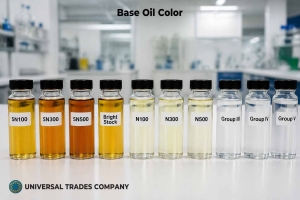
To understand where N600 fits, it is helpful to look at the typical viscosity ladder of neutral mineral stocks. Refinery distillation towers separate lubricant fractions into distinct cuts, each serving a specific formulating purpose:
- sn70 base oil / N70: Very light neutral. Used for low-temperature applications, shock absorber fluids, and diluents.
- N100 Base Oil: Light neutral. Ideal for light hydraulic fluids and spindle oils.
- N150 Base Oil / sn150 base oil: Medium-light neutral. The backbone of passenger car motor oils and standard hydraulic oils.
- Base Oil sn300: Medium neutral. Used in general-purpose industrial oils and engine oil blends.
- N220 Base Oil: Medium-heavy neutral. Used for compressor lubricants and moderate gear oils.
- N500 Base Oil / sn500 Base Oil: Heavy neutral. Standard choice for industrial gear oils, marine engine oils, and greases.
- N600 Base Oil: Very heavy neutral. Provides enhanced film thickness for heavy machinery, open gears, and heavy greases without the extreme flow resistance of bright stock.
- Brightstock base oil: Ultra-heavy residual oil. Used for high-temperature, extremely high-load applications.
2. API Base Oil Categorization and N600
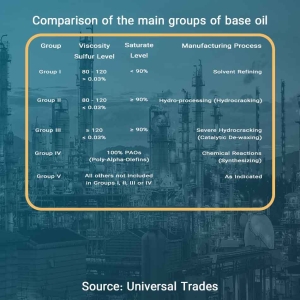
Understanding base oil types requires looking at the American Petroleum Institute (API) grouping system. This classification divides base stocks into five groups based on their chemical composition:
Group 1 N600
Traditionally, N600 has been produced as a group 1 base oil through solvent extraction refining. Because Group I processing retains a higher concentration of aromatic molecules (saturates <90%< 90\% and sulfur >0.03%> 0.03\%), it offers excellent polar additive solvency. This makes Group I N600 highly favored in grease manufacturing and heavy-duty gear formulations where additive solubility is critical.
Group 2 N600
With modern hydrocracking and hydrotreating technologies, refineries now produce group 2 base oil N600. Group II N600 features saturates greater than 90% and sulfur levels below 0.03%. It exhibits superior oxidation stability, lighter color, and lower Noack volatility, making it highly desirable for high-temperature circulating systems and modern marine lubricants.
The Role of Groups III, IV, and V
When formulating premium or extreme-environment lubricants, formulators often look beyond mineral oils. A comparison of mineral and synthetic base oil reveals that while mineral oils like N600 offer cost-effectiveness and excellent natural oiliness, synthetic alternatives offer better performance at thermal extremes:
- group 3 base oil: Highly hydroisomerized mineral oils with a viscosity index above 120, offering semi-synthetic performance.
- group 4 base oil: Polyalphaolefins (PAOs) that provide outstanding low-temperature fluidities and thermal stability.
- group 5 base oil: Esters, polyalkylene glycols (PAGs), and alkylated naphthalenes, often blended with N600 to boost solvency, clean-running performance, and film strength.
3. Technical Characteristics of N600 Base Oil
The physical and chemical properties of N600 define how it behaves under mechanical stress. Below is a detailed analysis of key base oil specifications that engineers and procurement specialists analyze:
- Kinematic Viscosity at 40°C & 100°C: Viscosity is the measure of fluid shear resistance. N600 typically exhibits a kinematic viscosity between 100 to 125 cSt at 40°C and 11.5 to 13.5 cSt at 100°C. This heavy viscosity allows it to withstand extreme mechanical loads and boundary lubrication regimes.
- Viscosity Index (VI): The VI indicates how much viscosity changes with temperature. Typically ranging from 95 to 105 for paraffinic N600, it demonstrates stable performance across moderate temperature fluctuations.
- Flash Point (COC): The flash point measures the lowest temperature at which the oil’s vapors can ignite when exposed to a flame. For N600, a high flash point of 240°C ensures safe operations in high-temperature environments.
- Pour Point: The pour point represents the lowest temperature at which the oil remains fluid. N600 typically has a pour point between and . Waxy paraffins are controlled during refining to ensure low-temperature pumpability.
- Noack Volatility: Due to its heavy molecular structure, N600 has an exceptionally low evaporation rate (Noack volatility), minimizing oil consumption and viscosity increase during service.
4. Production and Refining Processes
Refining raw petroleum into high-purity N600 Base Oil like other petroleum products requires several advanced refinery operations:
Crude Oil → Atmospheric Distillation → Vacuum Distillation → Solvent Extraction/Deasphalting → Hydrocracking → Hydroisomerization → Severe Hydrotreating → Group II Base Oil
Vacuum Distillation
Atmospheric distillation first removes light fractions like gasoline, diesel, and kerosene. The remaining heavy atmospheric residue is transferred to a vacuum distillation column. Operating under reduced pressure lowers the boiling points of heavy molecules, preventing thermal cracking while separating heavy neutral distillates, including the N600 cut.
Solvent Extraction or Hydrocracking
- For Group I N600: The vacuum distillate undergoes solvent extraction using polar solvents (like furfural or NMP) to extract aromatic hydrocarbons, which naturally degrade viscosity index and oxidation resistance.
- For Group II N600: The distillate undergoes hydrocracking at high pressures and temperatures in the presence of hydrogen. This process breaks up impurities, converts aromatics to saturated naphthenes and paraffins, and eliminates sulfur and nitrogen compounds.
Dewaxing
To prevent the crystallization of paraffin waxes at low temperatures, the oil is dewaxed. This is achieved either through solvent dewaxing (using methyl ethyl ketone/toluene solvents) or catalytic dewaxing (hydroisomerization), which reshapes waxy n-paraffins into branched iso-paraffins.
Hydrofinishing
The final processing step is hydrofinishing, a mild catalytic hydrotreating process that removes trace color bodies, improves thermal color stability, and neutralizes remaining reactive molecules.

5. Industrial Applications and Uses of N600 Base Oil
Thanks to its robust film strength and reliable thermal limits, N600 is widely utilized across several key industrial sectors:
Heavy-Duty Industrial Gear Oils
Industrial gear systems in cement factories, steel mills, and paper plants operate under severe shock-loading conditions. N600 provides the base viscosity required to formulate ISO VG 150, 220, and 320 gear lubricants. When paired with sulfur-phosphorus EP additives, it prevents metal-to-metal contact, scuffing, and micro-pitting on gear teeth.
Marine Lubricants
Slow-speed and medium-speed marine diesel engines burn heavy residual fuels, producing highly acidic combustion byproducts. N600 is blended into marine cylinder lubricants (MCL) and system oils. Its heavy viscosity seals the piston rings, protects cylinder liners from abrasive wear, and handles high additive loads.
Industrial Greases
Grease thickeners (like lithium, calcium, or aluminum complex soaps) act like sponges holding lubricating oil. N600 is highly valued in grease manufacturing because its high viscosity provides strong load support, while its Group I solvency characteristics allow the soap structure to disperse evenly during processing.
Metalworking and Drawing Fluids
In metal forming, stamping, and wire-drawing operations, extreme boundary friction occurs. N600 acts as a carrier oil that maintains boundary film protection on tools and dies under high pressures.
6. Technical Specification Sheet (COA)
The table below outlines the standard specifications for a typical N600 Base Oil (paraffinic, Group I and Group II variants):
| Property | Typical Value (Group I) | Typical Value (Group II) | ASTM Test Method |
|---|---|---|---|
| Appearance | Clear & Bright | Clear & Bright | Visual |
| Color | Max L3.0 | Max L1.5 | ASTM D1500 |
| Density @ 15°C (g/cm³) | 0.885 – 0.898 | 0.875 – 0.888 | ASTM D4052 |
| Kinematic Viscosity @ 40°C (cSt) | 105 – 118 | 110 – 122 | ASTM D445 |
| Kinematic Viscosity @ 100°C (cSt) | 11.2 – 12.5 | 11.8 – 13.2 | ASTM D445 |
| Viscosity Index (VI) | Min 95 | Min 100 | ASTM D2270 |
| Flash Point, COC (°C) | Min 245 | Min 255 | ASTM D92 |
| Pour Point (°C) | Max -9 | Max -12 | ASTM D97 |
| Sulfur Content (wt%) | > 0.1 | < 0.03 | ASTM D2622 |
| Saturates (wt%) | < 85 | > 95 | ASTM D2007 |
| Acid Number (mg KOH/g) | Max 0.05 | Max 0.01 | ASTM D664 |
Note: Actual values may fluctuate slightly depending on the origin of the crude oil and the refinery’s operational settings.
7. Formulation Synergy and Blending
Lubricant formulators rarely use N600 in isolation. Instead, they blend it with lighter or heavier base stocks to achieve precise ISO viscosity targets and maximize cost efficiency.
- Blending N600 with N150 Base Oil or sn150 base oil: This combination yields intermediate viscosities suitable for ISO VG 46 and 68 hydraulic systems operating under high temperatures.
- Blending N600 with N220 Base Oil or Base Oil sn300: Often used in industrial circulating systems, turbine oils, and moderate-duty gearboxes to balance high-temperature load resistance with low-temperature pumpability.
- Blending N600 with brightstock base oil: Extremely high-viscosity applications (ISO VG 460 and 680 gear oils) require blending N600 with bright stock to ensure the fluid maintains proper shear stability under boundary conditions.
8. Global Market and Procurement
The trade dynamics of N600 are deeply tied to industrial growth, marine shipping traffic, and global refining infrastructure.
Supply and Demand
The top 10 base oil producing countries and the top 10 base oil exporting countries (such as the United States, South Korea, Singapore, and Saudi Arabia) have modernized their refineries. While Group I plants have faced closures in some parts of the world, demand for heavy neutrals like N600 remains strong in developing regions. In these areas, infrastructure, construction, and mining activities drive the consumption of heavy industrial oils and greases.
Logistics and Packaging
N600 is shipped worldwide using various packaging methods depending on order volumes:
- Bulk Vessels: Used for large international shipments to blending plants.
- Flexitanks & ISO Tanks: Standard for mid-sized industrial shipments, offering excellent contamination control.
- IBC Totes (1000L) & Steel Drums (200L): Preferred by local distributors and smaller lubricant manufacturers.
9. Storage, Handling, and Safety Recommendations
To preserve the quality of N600 Base Oil and prevent degradation:
- Temperature Control: Store N600 in dedicated carbon steel or stainless steel tanks at stable ambient temperatures. In cold climates, mild tank heating may be necessary to lower viscosity and facilitate pumping.
- Contamination Prevention: Keep storage containers tightly sealed. Water contamination can cause additive hydrolysis and haze, while dust particles degrade the oil’s lubricating film strength.
- Shelf Life: Under sealed, dry conditions, N600 has an outstanding shelf life of up to five years without significant loss of chemical stability.
- Safety: Like most mineral hydrocarbons, N600 is not classified as a hazardous substance under normal handling conditions. However, personnel should use protective gloves, avoid inhaling oil mists, and prevent spills into local waterways.
Conclusion
N600 Base Oil is a vital component of the heavy industrial lubrication market. Its high viscosity, low volatility, and excellent thermal stability make it a key building block for gear oils, marine lubricants, and industrial greases.
Whether compared to lighter grades like N220 Base Oil and N500 Base Oil or heavy residual oils like bright stock base oil, N600 offers formulators exceptional flexibility. It allows them to achieve precise viscosity targets while keeping production costs manageable.
For procurement managers, chemical traders, and lubricant formulators, selecting high-quality N600—sourced from reputable refining regions—is essential to producing lubricants that keep modern industrial machinery running smoothly and reliably.
Global Petroleum Trade Solutions | Universal Trades
As a reputable international petroleum trading enterprise, Universal Trades specializes in the reliable procurement, export, and supply chain management of high-grade petroleum commodities, refined fuels, and industrial feedstocks designed to meet rigorous global standards.









Leave a Reply
Want to join the discussion?Feel free to contribute!