
Base Oil SN70: Properties, Applications, and Buying Guide

Base Oil SN70 is a light solvent neutral (SN) mineral base oil commonly used in lubricant blending, transformer oils, and process oil formulations. Because of its relatively low viscosity and good solvency characteristics, SN70 plays an important role in formulations where flow properties and blending flexibility are critical.
For lubricant manufacturers, petroleum traders, and procurement specialists, understanding SN70’s technical characteristics, production methods, and typical applications helps ensure the correct base oil grade is selected for each formulation.
SN70 generally belongs to the family of Group I base oils, which remain widely used due to their balanced cost, solvency, and compatibility with additives. If you want a broader overview of base oil categories, see our guide on Types of Base Oil.
What Does “SN” Mean in Base Oil?
The designation “SN” stands for “Solvent Neutral.” This naming convention originated from traditional solvent refining processes used in Group I base oil production.
In solvent refining, undesirable compounds such as aromatics, sulfur, and waxes are partially removed using selective solvents. The resulting base oil is described as neutral because its chemical composition becomes more stable and suitable for lubricant formulation.
SN grades are typically classified according to their viscosity range, which is roughly reflected in the number following the designation. For example:
- SN70 – very light solvent neutral oil
- SN150 – medium viscosity base oil
- SN500 – heavier base oil for industrial lubricants
A detailed explanation of these refining methods can be found in the article on the Base Oil Production Process. While SN grades are most commonly associated with Group I base oils, modern lubricant formulations may also rely on Group 2 Base Oil, Group 3 Base Oil, or even Group 4 Base Oil and Group 5 Base Oil for higher performance requirements.
Typical Technical Properties of SN70
Although specifications vary slightly by refinery, SN70 base oil generally falls within the following property ranges:
Kinematic Viscosity (40 °C)
Typically around 10–15 cSt, making SN70 one of the lightest solvent neutral base oils.
Viscosity Index (VI)
Usually between 90–100, providing moderate viscosity stability across temperature ranges.
Flash Point
Often above 190 °C, indicating acceptable safety during storage and blending operations.
Pour Point
Usually around ‑6 °C to ‑12 °C, depending on wax content and refining quality.
Color
Typically light yellow to pale, though color alone does not determine quality. The significance of this parameter is discussed in more detail in Base Oil Color.
Sulfur and Saturates
As a Group I base oil, SN70 may contain slightly higher sulfur and aromatic content compared with more refined oils such as Group II or Group III.
These properties provide good solvency, which helps dissolve additive packages effectively—an advantage that is sometimes reduced in highly refined base oils.
Main Applications of SN70 Base Oil
Because of its light viscosity and solvency, SN70 base oil is widely used in several industrial formulations.
1. Light Lubricant Formulations
SN70 can serve as a base stock in low‑viscosity lubricants, especially where high solvency is beneficial for additive compatibility.
2. Transformer Oils
Some transformer oil formulations use light base oils similar to SN70 due to their excellent flow characteristics and electrical insulating properties after proper treatment.
3. Metalworking Fluids
In metalworking operations, SN70 may be used in cutting oils and metal forming fluids, where lubrication and cooling properties are required.
4. Process Oils
Many industrial sectors—including rubber and chemical manufacturing—use light base oils like SN70 as process oils in production processes.
5. Blending with Heavier Base Oils
Lubricant manufacturers frequently blend SN70 with heavier grades such as SN150 Base Oil or even Bright Stock Base Oil to fine‑tune viscosity levels in final lubricant formulations.
The selection of a specific base oil type often depends on whether the final product requires mineral or synthetic base oils, which is explained further in the Mineral vs Synthetic Base Oil Comparison.
SN70 vs Other Base Oil Grades
Compared with heavier solvent neutral oils, SN70 has significantly lower viscosity, which makes it suitable for lighter lubricant applications.
SN70 vs SN150
SN150 has higher viscosity and is more commonly used in engine oils and industrial lubricants. SN70 is often used as a blending component to adjust viscosity.
SN70 vs Heavier SN Grades
Grades such as SN500 provide stronger film strength and are better suited for gear oils and heavy‑duty lubricants.
In modern lubricant manufacturing, some applications may substitute SN grades with Group II or Group III base oils when higher oxidation stability or lower sulfur content is required.
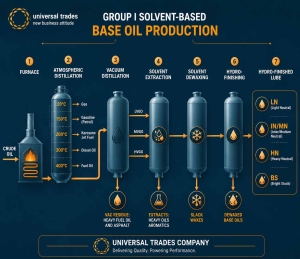
How SN70 Base Oil Is Produced
SN70 is generally produced through the refining of crude oil into lubricating fractions. The process typically includes:
- Atmospheric and vacuum distillation
- Solvent extraction to remove aromatics
- Dewaxing to improve low‑temperature flow
- Hydrotreating to enhance stability and color
The feedstock used in these processes often originates from lube cut streams, which are intermediate fractions produced during crude distillation. The difference between these intermediates and finished base oils is explained in Lube Cut vs Base Oil.
Global production of base oils is concentrated in several major refining regions. For an overview of major industry players, see Top 10 Base Oil Producing Countries.
How Buyers Evaluate SN70 Quality
For procurement managers and lubricant manufacturers, purchasing SN70 requires careful evaluation of laboratory test reports and refinery specifications.
Key factors typically reviewed include:
- viscosity consistency
- flash and pour point values
- color stability
- sulfur content
- additive compatibility
Buyers also consider supply reliability and price trends, which are influenced by refinery output and global petroleum markets. Market dynamics are discussed in Base Oil Price Forecast.
Another important factor is whether the base oil is virgin or re‑refined. Some markets increasingly use Recycled Base Oil as a cost‑effective alternative when quality specifications allow.
For a deeper guide on technical inspection and lab analysis, see Base Oil Quality Evaluation.
Final Thoughts
Although often overshadowed by heavier base oil grades, SN70 base oil remains a valuable component in many industrial formulations. Its low viscosity, strong solvency, and blending flexibility make it useful in light lubricants, transformer oils, process oils, and additive‑rich formulations.
As lubricant technologies evolve and newer base oil groups gain popularity, understanding the characteristics and appropriate applications of traditional solvent neutral oils like SN70 helps manufacturers and buyers choose the most cost‑effective and technically suitable base stock.
For further technical resources and market insights, explore More Articles About Base Oil on our website.
Global Petroleum Trade Solutions | Universal Trades
As a reputable international petroleum trading enterprise, Universal Trades specializes in the reliable procurement, export, and supply chain management of high-grade petroleum commodities, refined fuels, and industrial feedstocks designed to meet rigorous global standards.










Leave a Reply
Want to join the discussion?Feel free to contribute!