
Group 3 Base Oils: properties, Grades, and Applications

Base oil forms the backbone of any lubricant, typically making up 60% to 90% of the final product. Its quality directly influences crucial lubricant properties such as viscosity, oxidation stability, solubility, and volatility. The American Petroleum Institute (API) categorizes base oils into five groups (I to V) based on their saturated hydrocarbon content, sulfur levels, and Viscosity Index (VI). Generally, higher saturates, lower sulfur, and a higher VI indicate superior base oil quality.
Group 3 base oils stand out for their exceptional purity and performance compared to Group I and II oils, placing them in the high-quality category. These oils are produced through advanced processes like severe hydrocracking of crude oil or innovative synthetic methods such as Gas-to-Liquid (GTL) technology. Hydrocracking involves breaking down larger hydrocarbon molecules in the presence of hydrogen and a catalyst, which effectively removes impurities, reduces aromatic compounds, and increases the saturation level. The result is a base oil with significantly enhanced properties, making it ideal for high-performance applications.
Definition and Characteristics of Group 3 Base Oils
Group III base oils are defined by the following key specifications:
- Saturated Hydrocarbon Content: Greater than 90%
- Sulfur Content: Less than 0.03%
- Viscosity Index (VI): Greater than 120
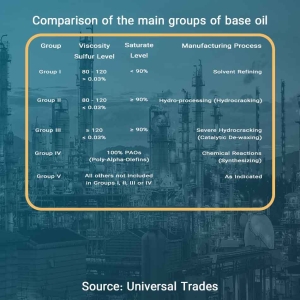
These specifications firmly establish Group 3 base oils as very high-quality base stocks, often referred to as “synthetic base oils” or “Very High Viscosity Index (VHVI) Base Oils” due to their superior performance characteristics.
Key Properties:
- Excellent Oxidation Stability: Their high purity and the absence of undesirable compounds give them exceptional resistance to oxidation, significantly extending the lubricant’s service life.
- Low Volatility: Possessing very low volatility, these oils minimize evaporation at high temperatures, leading to reduced oil consumption.
- Superior Low-Temperature Properties: They exhibit outstanding performance in cold conditions, maintaining fluidity due to a low pour point. This is critical for lubricants used in cold climates or low-temperature applications.
- High Viscosity Index: With a VI above 120, their viscosity changes minimally with temperature fluctuations, ensuring stable lubricant performance across a wider range of operating temperatures.
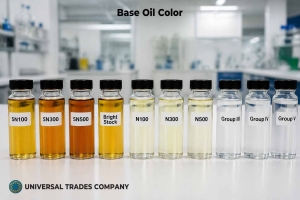
- Clarity and Light Color: Their high purity typically results in a clear, colorless appearance.
- Additive Responsiveness: Although their inherent solvency might be lower than Group 1 oils, they interact effectively with appropriate additives, allowing for the formulation of exceptional high-performance lubricants.
- High Thermal Stability: They demonstrate strong resistance to thermal degradation, a crucial attribute for modern engines operating at elevated temperatures.
Advantages and Limitations
Advantages:
- Superior Performance: They are ideal for demanding applications and harsh operating conditions, including modern automotive engines and advanced industrial lubricants.
- Extended Lubricant Life: Their excellent oxidation and thermal stability significantly prolong the service life of the lubricant.
- Reduced Oil Consumption: Low volatility leads to less evaporation and, consequently, lower oil consumption.
- Improved Fuel Economy: Their optimal viscosity and flow characteristics can contribute to better fuel efficiency.
- Environmental Friendliness: Their high purity and reduced emissions make them a more environmentally conscious choice.
Limitations:
- Higher Cost: The complex and advanced production processes result in a higher price point compared to Group I and II base oils.
- Lower Solvency: Their inherent solvency for additives is generally lower than Group I oils, which may necessitate the use of specific additives or more precise formulations in the final lubricant.
Group III Base Oil Grades
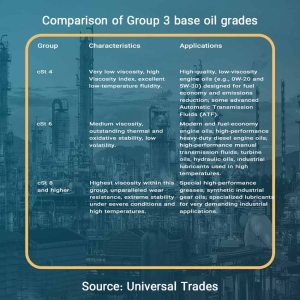
Group III base oils are categorized based on their kinematic viscosity at 100°C. This viscosity determines the lubricant’s ability to form an adequate oil film and withstand loads under operational temperatures. Common Group III base oil grades include 2 cSt, 4 cSt, 6 cSt, and 8 cSt (kinematic viscosity at 100°C) and above. A higher cSt value indicates higher oil viscosity.
2 cSt
This is the lightest Group III base oil grade. Its low viscosity makes it suitable for formulating low-viscosity engine oils and light industrial fluids.
- Applications: Low-viscosity engine oils (e.g., 0W-20, 5W-20), light hydraulic fluids, transformer oils, metalworking fluids.
4 cSt
The 4 cSt grade is one of the most common Group III base oils, offering a good balance between viscosity and performance. It’s widely used in the production of various lubricants.
- Applications: Automotive engine oils (e.g., 5W-30, 10W-30), industrial gear oils, transmission fluids, hydraulic fluids, turbine oils.
6 cSt
Group III base oil with a 6 cSt viscosity is suitable for applications requiring greater oil film stability and higher load-carrying capacity.
- Applications: Heavy-duty engine oils (e.g., 10W-40, 15W-40), high-performance industrial gear oils, compressor oils, greases.
8 cSt and Above
These and higher viscosity grades are designed for extremely heavy-duty applications and severe operating conditions that demand a robust oil film and exceptional thermal stability.
- Applications: Heavy-duty diesel engine oils, high-load industrial lubricants, heavy industrial gear oils, hydraulic fluids for high-pressure applications.
Applications of Group III Base Oils
Due to their superior properties, Group III base oils are utilized across a wide range of advanced industries and applications.
- Automotive Engine Oils: These oils are a core component in the formulation of modern, high-performance engine oils, including fully synthetic and semi-synthetic variants. They help maintain engine cleanliness, reduce wear, and extend engine life in newer gasoline and diesel vehicles. They play a vital role, especially in low-viscosity oils like 0W-20 and 5W-30, which contribute to improved fuel economy.
- Industrial Gear Oils: In gearboxes and power transmission systems that require resistance to heavy loads and high thermal stability, Group III base oils offer excellent performance.
- Hydraulic Fluids: Their oxidation stability and anti-wear properties make them suitable for high-pressure and high-temperature hydraulic systems.
- Compressor Oils: Their low volatility and thermal stability make these oils ideal for air and gas compressors, where minimizing evaporation and deposit formation is crucial.
- Greases: They are used in the formulation of high-performance greases, particularly those designed for high or low-temperature applications.
- Turbine Oils: For gas and steam turbines that demand exceptional thermal and oxidation stability, Group III base oils provide optimal performance.
- Transformer Oils: Good dielectric properties and oxidation stability make them suitable for use in electrical transformers.
- Metalworking Fluids: In some advanced cutting and cooling fluids, they are employed due to their stability and performance at high temperatures.
Selected Technical Specifications for Group III Base Oil Grades
For further reading on base oil laboratory analysis, please refer to the article “Technical Specifications of Base Oil.”
Future Outlook for Group III Base Oils
The future of Group III base oils is bright and expanding. Given the growing demand for high-performance lubricants and increasingly stringent environmental standards, Group III base oils are set to play a pivotal role in the lubricant industry.
- Growing Demand in the Automotive Industry: With advancements in engine technology and the shift towards lower-viscosity engine oils for improved fuel efficiency, the demand for Group III base oils is steadily rising. Hybrid and electric vehicles also require specific, high-stability lubricants often formulated with Group III oils.
- Increased Use in Industrial Lubricants: Various industries, including manufacturing, energy, and petrochemicals, are seeking lubricants that can perform in tougher operating conditions, offer extended service life, and provide higher efficiency. Group III base oils effectively meet these requirements.
- Technological Advancements: Progress in production processes (such as GTL technologies) and the development of new catalysts will contribute to the production of higher-quality Group III base oils with more competitive production costs.
- Sustainability and Environment: Due to their high purity and reduced emissions compared to traditional base oils, Group III oils align with global sustainability trends and efforts to minimize environmental impact.
For more information about the various types of petroleum products, please refer to the article “Introduction to the Types of Petroleum Products and Their Applications.”
Frequently Asked Questions (FAQ)
In this section, we address some common questions about base oils, particularly Group III base oils.
What are Group III Base Oils? Group III Base Oils are a category of very high-quality, highly refined mineral base oils produced through severe hydrocracking of crude oil or advanced synthetic processes like GTL. Their key API specifications include: over 90% saturated compounds, less than 0.03% sulfur, and a Viscosity Index (VI) greater than 120. These oils are ideal for high-performance lubricants and demanding applications due to their high purity, excellent oxidation stability, low volatility, and good low-temperature performance.
What’s the main difference between Group III, Group I, and Group II base oils? The primary difference lies in their production process and, consequently, their final properties.
- Group I: Produced by solvent refining, with less than 90% saturates, more than 0.03% sulfur, and a VI between 80 and 120. They have lower purity and stability.
- Group II: Produced by hydroprocessing, with over 90% saturates, less than 0.03% sulfur, and a VI between 80 and 120. They offer better purity and stability than Group I.
- Group III: Produced by severe hydrocracking or synthetic processes, with over 90% saturates, less than 0.03% sulfur, and a VI greater than 120. This group offers the highest level of purity, stability, and performance among highly refined mineral base oils.
Are Group III base oils considered synthetic? Technically, Group III base oils are derived from crude oil, so they are not entirely “synthetic” in the sense of being produced from non-petroleum chemicals (like PAOs or esters). However, due to their highly severe refining process and performance properties that closely resemble true synthetic oils (Group IV and V), they are often referred to as “semi-synthetic base oils” or “Hydrocracked Synthetics” and can often substitute for true synthetics in many applications.
Why are Group III base oils more expensive? The higher cost of Group III base oils stems from their complex and advanced production process. Severe hydrocracking requires significant investment in equipment, higher energy consumption, and more sophisticated technologies. These elevated production costs are reflected in the final product price.
Can Group III base oils be blended with other groups? Yes, in many lubricant formulations, Group III base oils are blended with other groups (especially Group II) and various additives to achieve the desired properties for specific applications. This blending helps optimize both performance and cost.
Conclusion
Group III base oils have secured a prominent position in the lubricant industry thanks to their exceptional characteristics, including excellent oxidation stability, low volatility, superior low-temperature properties, and a high viscosity index. Produced through advanced processes like severe hydrocracking or GTL from crude oil, their outstanding purity and performance make them the top choice for formulating modern automotive engine oils, advanced industrial gear oils, high-performance hydraulic fluids, and a wide range of specialized industrial lubricants.
While their higher production cost compared to Group I and II oils is a limitation, their numerous benefits—such as extended lubricant service life, reduced oil consumption, and improved fuel economy—provide significant added value. With the increasing trend towards stricter environmental standards and the growing demand for high-performance lubricants across various industries, the future of Group III base oils looks very promising. Their market share is expected to continue rising as they not only meet current industry needs but also contribute to greater sustainability and efficiency in the future.
Global Petroleum Trade Solutions | Universal Trades
As a reputable international petroleum trading enterprise, Universal Trades specializes in the reliable procurement, export, and supply chain management of high-grade petroleum commodities, refined fuels, and industrial feedstocks designed to meet rigorous global standards.








The article highlights the High Viscosity Index (VI > 120) of Group III. For a mechanic, what does a VI of 130 specifically mean for an engine running in both very cold startup and hot summer operation compared to a Group II oil?
A VI of $130$ means the Group III oil maintains its viscosity far better than a Group II (VI $\sim 100$) oil across the temperature spectrum. Practically, this translates to faster, safer cold starts (less thickening) and better film strength/protection at peak operating temperatures (less thinning) without relying as heavily on VII additives.
Considering the higher price of Group III base oil compared to lower groups, is its use for older industrial machinery economically justified?
Yes, because its high resistance to oxidation extends oil drain intervals. This reduces maintenance costs and offsets the higher initial price in the long run.