
N220 Base Oil: Uses, and Specifications

The lubricant industry has become increasingly technical over the past several decades. Industrial equipment now operates under heavier loads, higher temperatures, longer service intervals, and tighter mechanical tolerances than in the past. Gearboxes in steel mills face continuous shock loading, hydraulic systems operate under elevated pressures, turbines run for long periods with minimal interruption, and compressors must resist oxidation and deposit formation under high thermal stress.
These operating conditions have increased the importance of lubricant quality. Although additives provide essential performance functions such as anti-wear protection, oxidation control, corrosion inhibition, foam resistance, and extreme-pressure performance, the base oil remains the main structural component of most finished lubricants. In many formulations, base oil accounts for 70–95% of the finished lubricant.
For this reason, the selection of a suitable lubricant base stock directly affects:
- viscosity behavior
- oxidation stability
- thermal resistance
- volatility
- film strength
- additive response
- equipment protection
- service life
As explained in Introduction to Petroleum Products, base oils are produced as part of the petroleum refining value chain. Crude oil is separated, upgraded, and treated through refining processes such as atmospheric distillation, vacuum distillation, solvent extraction, hydrocracking, dewaxing, and hydrofinishing. These processes generate fuels, petrochemical feedstocks, and specialized petroleum products such as lubricant base oils.
Within the neutral mineral base oil range, N220 Base Oil is a highly practical and commercially important grade. It is commonly categorized as a heavy neutral base oil or medium-heavy neutral lubricant base stock. Its viscosity is higher than light neutral oils such as N150 and SN150, but lower than heavier grades such as SN500 and N500. This makes N220 especially useful in industrial lubricant formulation where formulators need stronger oil film thickness than lighter grades can provide without moving into very high-viscosity base stocks.
N220 Base Oil is widely used in gear oils, hydraulic oils, turbine oils, compressor oils, marine lubricants, metalworking fluids, circulating oils, and industrial greases. Its balanced viscosity and compatibility with additive systems make it a valuable component for lubricant manufacturers, industrial buyers, and B2B petroleum product importers.
What is N220 Base Oil?
N220 Base Oil is a neutral mineral base oil used as a primary blending component in industrial lubricants. The letter “N” generally refers to neutral base oil, while the number “220” historically relates to viscosity classification conventions used in the base oil market.
In practical terms, N220 is often positioned as a medium-heavy or heavy neutral petroleum base oil. It is thicker than lighter neutral grades such as N100, N150, and SN150, but less viscous than SN500, N500, or bright stock.
Typical N220 Base Oil viscosity ranges are approximately:
| Property | Typical Range |
|---|---|
| Kinematic Viscosity @ 40°C | 40–50 cSt |
| Kinematic Viscosity @ 100°C | 6.5–8.0 cSt |
These values may vary depending on crude source, refinery configuration, processing severity, and whether the product is produced as API Group I or Group II base oil.
N220 as a Heavy Neutral Base Oil
N220 is commonly described as a heavy neutral base oil because it provides higher viscosity and stronger film strength than light neutral oils. This makes it useful in lubricants that must protect moving surfaces under moderate to heavy mechanical loads.
In lubricant formulation, viscosity is one of the most important design parameters. If the base oil viscosity is too low, the lubricant may not maintain an adequate oil film under load. If the viscosity is too high, the lubricant may increase energy consumption, reduce pumpability, and cause poor low-temperature circulation. N220 offers a middle-ground solution for many industrial applications.
Position in the Neutral Base Oil Viscosity Ladder
Neutral base oils are often selected according to viscosity requirements. A simplified viscosity ladder may look like this:
| Base Oil Grade | General Category | Typical Role |
|---|---|---|
| SN70 / N70 | Very light neutral | Low-viscosity blends, process oils |
| N100 | Light neutral | Hydraulic oils, turbine oils |
| SN150 / N150 | Light neutral | Engine oils, hydraulic oils, industrial oils |
| SN300 | Medium neutral | General industrial lubricants |
| N220 | Medium-heavy / heavy neutral | Gear oils, compressor oils, industrial lubricants |
| SN500 / N500 | Heavy neutral | Gear oils, marine oils, heavy-duty lubricants |
| Bright Stock | Very heavy base stock | Marine oils, gear oils, high-viscosity formulations |
This positioning allows N220 to serve as a flexible blending component. It can increase viscosity when blended with lighter grades and improve flow characteristics when blended with heavier grades.
API Base Oil Classification
Base oils are commonly classified under the API base oil grouping system. A detailed overview is provided in Introduction to Base Oil Types. The API classification divides base stocks into five groups based on sulfur content, saturates level, and viscosity index.
Group I Base Oil
Group I Base Oil is produced mainly through solvent refining. It typically contains higher aromatic content and higher sulfur compared with Group II base oils. Group I oils generally have good additive solvency because aromatic molecules help dissolve polar additive components.
Typical Group I characteristics include:
- saturates below 90%
- sulfur above 0.03%
- viscosity index between 80 and 120
- good solvency
- moderate oxidation stability
Group I N220 may be useful in formulations where additive solubility is important, especially in certain industrial oils, metalworking fluids, and applications where cost-performance balance is a key purchasing factor.
Group II Base Oil
Group II Base Oil is produced using hydroprocessing technologies such as hydrotreating, hydrocracking, and hydrofinishing. These processes remove sulfur, nitrogen, and unstable aromatic compounds while increasing the saturates content.
Typical Group II characteristics include:
- saturates above 90%
- sulfur below 0.03%
- viscosity index usually between 80 and 120
- better oxidation stability
- improved color and purity
- lower aromatic content
Group II N220 generally offers improved oxidation stability, lower sulfur, better thermal performance, and longer lubricant service life compared with conventional Group I alternatives.
Group III Base Oil
Group III Base Oil is produced through severe hydrocracking and hydroisomerization. It has a viscosity index above 120 and is often used in high-performance engine oils and premium industrial lubricants. N220 is less commonly discussed as a standard Group III grade because Group III base oils are often marketed under different viscosity cuts and performance categories.
Group IV Base Oil
Group IV consists of polyalphaolefin (PAO) synthetic base stocks. These are synthetic hydrocarbons with excellent low-temperature behavior, oxidation stability, and volatility control.
Group V Base Oil
Group V includes all other base stocks not included in Groups I–IV. Examples include esters, polyalkylene glycols, alkylated naphthalenes, and other specialty fluids.
Group I vs Group II N220 Base Oil
The performance of N220 depends strongly on whether it is Group I or Group II.
| Feature | Group I N220 | Group II N220 |
|---|---|---|
| Refining Method | Solvent refining | Hydroprocessing |
| Aromatic Content | Higher | Lower |
| Sulfur Content | Higher | Lower |
| Oxidation Stability | Moderate | Better |
| Color Stability | Moderate | Better |
| Additive Solvency | Better natural solvency | May require careful additive selection |
| Typical Use | Cost-sensitive industrial oils | Higher-performance industrial lubricants |
For procurement teams, this distinction is important. Two products may both be sold as N220 Base Oil, but their performance can differ significantly depending on API group, refinery technology, and Certificate of Analysis values.
Position of N220 Among Neutral Base Oils
N220 Base Oil is best understood by comparing it with other commonly traded and blended neutral base oils such as SN150 Base Oil, SN300 Base Oil, SN500 Base Oil, N100 Base Oil, N150 Base Oil, and N500 Base Oil.
Comparison of N220 Base Oil with Other Base Oils
| Base Oil Grade | Relative Viscosity | Key Differences Compared to N220 | Typical Applications |
|---|---|---|---|
| SN150 Base Oil | Lighter than N220 | Lower viscosity, thinner lubricating film, better low‑temperature flow | Engine oils, hydraulic fluids, general industrial lubricants |
| SN300 Base Oil | Slightly lighter or similar | Moderate viscosity, thinner oil film in some formulations | Industrial lubricants, compressor oils |
| SN500 Base Oil | Heavier than N220 | Higher viscosity, thicker oil film, stronger load‑carrying capacity | Industrial gear oils, marine lubricants, heavy-duty lubricants |
| N150 Base Oil | Lighter than N220 | Better flow characteristics but lower film strength | Hydraulic oils, turbine oils |
| N500 Base Oil | Much heavier than N220 | Higher viscosity and load support but lower pumpability | High‑viscosity industrial lubricants, heavy gear oils |
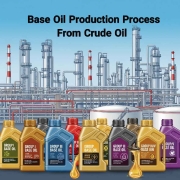
N220 Base Oil Production Process
The quality of N220 Base Oil depends on the refining process used to produce it. Base oil production is more complex than simple crude oil distillation. It requires separation, purification, molecular upgrading, and finishing steps to create a stable lubricant base stock.

Atmospheric Distillation
Crude oil first enters an atmospheric distillation unit, where it is separated into fractions according to boiling range. Lighter products such as LPG, naphtha, kerosene, and diesel are separated from heavier fractions.
The heavier atmospheric residue becomes feedstock for further processing.
Vacuum Distillation
The atmospheric residue is then processed in a vacuum distillation unit. Because lubricating oil molecules have high boiling points, vacuum conditions are used to reduce thermal cracking and separate lubricant-range distillates more efficiently.
Vacuum distillation produces fractions that may be further refined into light, medium, and heavy neutral base oils, including N220.
Solvent Extraction
For Group I base oil production, solvent extraction removes undesirable aromatic compounds that reduce oxidation stability and viscosity index. Common extraction solvents include furfural, phenol, and N-methyl-2-pyrrolidone.
Solvent extraction improves:
- viscosity index
- oxidation resistance
- color stability
- thermal behavior
However, Group I products still retain more aromatics than hydroprocessed Group II base oils.
Hydrocracking and Hydrotreating
For Group II production, lubricant feedstocks undergo hydroprocessing under hydrogen pressure. This removes sulfur, nitrogen, oxygen compounds, and unstable aromatics.
Hydroprocessing improves:
- sulfur reduction
- saturates content
- oxidation stability
- thermal resistance
- color and purity
This is why modern Group II N220 Base Oil is often preferred for higher-performance industrial lubricant formulation.
Dewaxing
Wax molecules can cause poor low-temperature behavior. Dewaxing removes or converts waxy components to improve pour point and cold-flow properties.
Dewaxing may be performed through:
- solvent dewaxing
- catalytic dewaxing
- hydroisomerization, depending on refinery configuration
Hydrofinishing
Hydrofinishing is a final polishing step. It improves the base oil’s color, stability, odor, and resistance to oxidation. For buyers, hydrofinished base oils usually show better appearance and more consistent quality.
Molecular Structure and Performance Characteristics
The performance of N220 Base Oil is directly linked to its molecular composition. Lubricant base oils contain different hydrocarbon families, including paraffins, naphthenes, and aromatics.
Paraffinic vs Naphthenic Base Oil
As explained in Paraffinic vs. Naphthenic Base Oil, paraffinic oils contain more straight-chain and branched saturated hydrocarbons, while naphthenic oils contain more cyclic saturated structures.
Paraffinic base oils generally provide:
- higher viscosity index
- better oxidation stability
- lower volatility
- better high-temperature performance
Naphthenic oils generally provide:
- stronger solvency
- better low-temperature fluidity in some cases
- different additive compatibility behavior
N220 is typically a paraffinic neutral base oil, especially when produced from paraffinic crude streams and refined through modern processing methods.
Oxidation Resistance
Oxidation occurs when base oil molecules react with oxygen at elevated temperatures. This can produce acids, sludge, varnish, and deposits. Hydroprocessed N220 contains fewer unstable aromatics and sulfur compounds, which improves oxidation resistance.
Viscosity Behavior
The viscosity of N220 makes it suitable for applications where oil film strength is required but extremely heavy viscosity is not desirable. Its viscosity-temperature behavior is measured by the viscosity index. A higher viscosity index means the oil changes less with temperature, improving performance across operating conditions.
Volatility
Volatility affects evaporation loss. Lower volatility reduces oil consumption and helps maintain viscosity during high-temperature operation. N220 generally has lower volatility than lighter base oils such as N100 or SN150.
Additive Compatibility
Base oil composition influences how additives dissolve and perform. Group I N220 may offer better natural solvency due to higher aromatic content, while Group II N220 offers better oxidation stability but may require careful additive formulation to ensure full additive compatibility.
Technical Specifications of N220 Base Oil
Typical N220 Base Oil specifications vary by refinery, crude source, and processing route. Buyers should always verify values using a recent Certificate of Analysis (COA).
| Property | Typical Value | ASTM Test Method |
|---|---|---|
| Appearance / Color | Clear & Bright / ≤ L1.5 | ASTM D1500 |
| Density @ 15°C | 0.870–0.890 g/cm³ | ASTM D4052 |
| Kinematic Viscosity @ 40°C | 40–50 cSt | ASTM D445 |
| Kinematic Viscosity @ 100°C | 6.5–8.0 cSt | ASTM D445 |
| Viscosity Index | 95–110 | ASTM D2270 |
| Flash Point, COC | ≥ 220°C | ASTM D92 |
| Pour Point | ≤ −9°C to −15°C | ASTM D97 |
| Sulfur Content | <0.03 wt% for Group II | ASTM D2622 |
| Saturates | >90% for Group II | ASTM D2007 |
| Noack Volatility | 6–12 wt% | ASTM D5800 |
| Acid Number | Typically low | ASTM D664 |
| Water Content | Trace / controlled | ASTM D6304 |
Why These Properties Matter
Kinematic viscosity determines the oil’s resistance to flow and its ability to form a lubricating film. For N220, the viscosity range makes it useful in gear oils, compressor oils, and heavy industrial lubricants.
Viscosity index shows how stable the oil viscosity remains as temperature changes. A higher VI improves lubricant reliability in variable operating conditions.
Flash point indicates the temperature at which vapors may ignite. A higher flash point is important for safety and high-temperature applications.
Pour point measures low-temperature flow behavior. Lower pour points improve pumpability in colder operating environments.
Sulfur content affects oxidation behavior, emissions considerations, and compatibility with modern lubricant requirements.
Saturates content is a key indicator of chemical stability. Higher saturates typically mean better oxidation stability.
Noack volatility measures evaporation loss under high-temperature conditions. Lower volatility helps reduce oil consumption and viscosity change.
Industrial Applications of N220 Base Oil
N220 Base Oil is used across multiple industrial sectors because it offers a practical balance of viscosity, film strength, and formulation flexibility.
Gear Oils
Industrial gear systems require lubricants that can maintain strong films between meshing gear teeth. N220 provides the base viscosity needed for many moderate to heavy gear oil formulations. When combined with extreme-pressure additives, antioxidants, and anti-foam agents, it can help protect gearboxes against wear, pitting, and scuffing.
Hydraulic Oils
Although many hydraulic oils use lighter base stocks, N220 can be used in heavier hydraulic oil formulations or blended with lighter oils to reach specific ISO viscosity grades. It is useful where hydraulic systems operate under high pressure and require stronger film support.
Turbine Oils
Turbine lubricants require oxidation stability, water separation, rust protection, and foam control. Group II N220 can contribute to stable turbine oil formulations, particularly where higher viscosity turbine lubricants are required.
Compressor Lubricants
Compressors operate at elevated temperatures and are vulnerable to varnish and carbon deposit formation. N220 can be used in compressor oils where moderate-heavy viscosity and oxidation resistance are required.
Marine Lubricants
Marine equipment often requires durable lubricants capable of operating under heavy loads and harsh conditions. N220 can be blended into marine lubricants, auxiliary engine oils, and onboard machinery lubricants.
Heavy Industrial Lubricants
Steel plants, cement plants, mining operations, and manufacturing facilities use lubricants that must resist heat, pressure, contamination, and continuous operation. N220 provides a useful base stock for heavy-duty circulating oils and machinery lubricants.
Metalworking Oils
Certain cutting oils, forming oils, and machining lubricants use N220 where higher oil film strength and lubrication are needed. Group I N220 may be valued in some metalworking formulations because of its solvency characteristics.
Grease Production
N220 is commonly used as a base oil component in grease manufacturing. In lithium, calcium, and complex greases, the base oil viscosity influences pumpability, load protection, and lubrication film strength.
N220 in Lubricant Formulation and Blending
Lubricant formulators rarely use one base oil in isolation. Instead, they blend multiple base oils to reach target viscosity, performance, and cost requirements.
N220 may be blended with:
- SN150 Base Oil
- SN300 Base Oil
- SN500 Base Oil
- N150 Base Oil
- N500 Base Oil
Blending with SN150 or N150
Blending N220 with SN150 or N150 lowers the overall viscosity and improves flow characteristics. This approach is useful when producing medium-viscosity industrial oils.
Blending with SN300
SN300 and N220 can be combined to fine-tune viscosity while maintaining balanced performance. This blend may be used in general industrial lubricants and circulating oils.
Blending with SN500 or N500
Blending N220 with heavier grades such as SN500 or N500 increases film strength and load-carrying capability. This is common in gear oil and marine lubricant formulations.
Formulation Impact
Changing the ratio of N220 affects:
- final ISO viscosity grade
- film thickness
- pumpability
- oxidation stability
- additive response
- energy efficiency
- high-temperature protection
For lubricant formulators, N220 is valuable because it provides flexibility between lighter and heavier neutral grades.
Comparison With Other Base Oils
N220 vs N150 Base Oil
| Feature | N220 Base Oil | N150 Base Oil |
|---|---|---|
| Viscosity | Higher | Lower |
| Film Strength | Stronger | Moderate |
| Flow Behavior | Less fluid | Better flow |
| Typical Uses | Gear oils, compressor oils, heavy industrial oils | Hydraulic oils, turbine oils, general lubricants |
| Formulation Role | Raises viscosity | Reduces viscosity |
N220 is better suited for heavier-duty applications, while N150 is preferred for lighter lubricants requiring easier circulation.
N220 vs SN500 Base Oil
| Feature | N220 Base Oil | SN500 Base Oil |
|---|---|---|
| Viscosity @40°C | 40–50 cSt | Often 90–110 cSt |
| Film Strength | Moderate-high | High |
| Pumpability | Better | Lower |
| Typical Uses | Medium-heavy industrial oils | Heavy gear oils, marine oils |
| Blending Role | Balanced viscosity component | Heavy viscosity builder |
SN500 is more suitable for very high-viscosity lubricants, while N220 offers better flow and formulation flexibility.
N220 vs SN300 Base Oil
| Feature | N220 Base Oil | SN300 Base Oil |
|---|---|---|
| Viscosity | Slightly higher in many markets | Medium |
| Load Support | Better | Moderate |
| Low-Temperature Flow | Moderate | Better |
| Applications | Gear, compressor, industrial oils | General industrial oils, engine oil blends |
N220 is preferred when greater film thickness is needed.
N220 vs N500 Base Oil
| Feature | N220 Base Oil | N500 Base Oil |
|---|---|---|
| Viscosity | Medium-heavy | Heavy |
| Circulation Efficiency | Better | Lower |
| Load Capacity | Moderate-high | High |
| Typical Use | Balanced industrial formulations | Heavy-duty and high-viscosity lubricants |
N500 provides higher viscosity, but N220 offers better balance between protection and fluid movement.
Advantages of N220 Base Oil
N220 Base Oil offers several practical advantages for lubricant manufacturers and industrial users.
Strong Film Strength
Its viscosity enables better separation of moving surfaces compared with lighter grades, reducing wear under load.
Stable Viscosity Behavior
With an appropriate viscosity index, N220 maintains reliable performance across a range of operating temperatures.
Good Oxidation Resistance
Especially in Group II form, N220 resists oxidation and helps extend lubricant service life.
Additive Compatibility
N220 can be formulated with anti-wear agents, antioxidants, corrosion inhibitors, viscosity modifiers, and extreme-pressure additives.
Cost-Performance Balance
Compared with synthetic base stocks, N220 provides a practical balance between performance and cost for many industrial lubricants.
Broad Industrial Use
Its viscosity profile makes it suitable for gear oils, compressor oils, hydraulic fluids, marine lubricants, and greases.
Global Market and Trade of N220 Base Oil
N220 Base Oil is traded globally as part of the broader petroleum base oil market. Demand is linked to industrial activity, manufacturing growth, marine transportation, construction, mining, and lubricant blending capacity.
Major Producing Regions
Key producing and exporting regions include:
- Middle East
- South Korea
- Singapore
- China
- Europe
- United States
- India
- Southeast Asia
Refineries with advanced hydroprocessing capacity can produce high-quality Group II N220 with low sulfur and strong oxidation stability.
Global Demand Drivers
Demand for N220 is supported by:
- industrial gear oil production
- hydraulic fluid manufacturing
- compressor oil demand
- grease production
- marine lubricant blending
- heavy machinery maintenance
Emerging markets with expanding manufacturing and infrastructure sectors often show strong demand for industrial lubricant base oils.
Packaging Options
N220 Base Oil is commonly supplied in:
- bulk vessel shipments
- road tankers
- ISO tanks
- flexitanks
- IBC totes
- 200-liter steel drums
Bulk and flexitank shipments are common for importers and lubricant blenders, while drums and IBCs are used for smaller-volume buyers.
Logistics Considerations
Buyers should consider:
- product origin
- COA consistency
- contamination control
- tank cleanliness
- lead time
- port handling conditions
- heating requirements in colder climates
Although N220 is not usually difficult to pump, viscosity increases at lower temperatures, so logistics planning may be required in cold regions.
HS Code for N220 Base Oil
N220 Base Oil is commonly classified under:
HS Code 2710.19 — Petroleum oils and oils obtained from bituminous minerals, other than crude.
Exact customs classification may vary depending on country, product composition, and local customs interpretation.
Typical Export Markets
Common import and distribution markets include:
- South Asia
- Africa
- Middle East
- Latin America
- Southeast Asia
- Eastern Europe
In these markets, N220 is often purchased by lubricant blenders, industrial distributors, and chemical traders.
Storage and Handling Recommendations
Proper storage and handling help preserve N220 Base Oil quality and prevent contamination.
Storage Temperature
N220 should be stored in clean tanks or sealed containers at moderate temperatures. Typical storage temperatures are ambient to mildly heated conditions, depending on climate and handling requirements.
Contamination Prevention
Base oil should be protected from:
- water
- dust
- rust particles
- incompatible chemicals
- other lubricant grades
- process oil contamination
Even small amounts of contamination can affect finished lubricant quality.
Tank and Drum Handling
Storage tanks should be clean, dry, and dedicated where possible. Drums should be stored under cover, preferably horizontally or with bungs protected from water accumulation.
Shelf Life
Under proper storage conditions, mineral base oils such as N220 can remain stable for several years. However, buyers should still check appearance, water content, and COA data before use in critical formulations.
Safety Considerations
N220 Base Oil is generally stable under normal handling conditions, but standard petroleum product precautions should be followed:
- avoid prolonged skin contact
- use proper ventilation
- prevent spills
- keep away from ignition sources
- follow Safety Data Sheet instructions
Frequently Asked Questions About N220 Base Oil
What is N220 Base Oil used for?
N220 Base Oil is used in gear oils, compressor oils, hydraulic fluids, turbine oils, marine lubricants, metalworking fluids, circulating oils, and industrial greases.
What is the viscosity of N220 Base Oil?
Typical N220 Base Oil viscosity is approximately 40–50 cSt at 40°C and 6.5–8.0 cSt at 100°C, although exact values vary by supplier and refinery.
Is N220 Base Oil Group I or Group II?
N220 can be produced as either Group I Base Oil through solvent refining or Group II Base Oil through hydroprocessing. Group II N220 generally has lower sulfur and better oxidation stability.
What is the difference between N220 and N150 Base Oil?
N220 is heavier than N150 and provides stronger oil film thickness. N150 is better suited for lighter hydraulic and turbine oils, while N220 is more suitable for gear oils, compressor oils, and heavier industrial lubricants.
What is the difference between N220 and SN500?
SN500 is significantly heavier than N220. N220 offers better flow and pumpability, while SN500 provides higher viscosity and greater film thickness for heavy-duty lubricant formulations.
Can N220 Base Oil be used in gear oils?
Yes. N220 is commonly used in industrial gear oil formulations because its viscosity supports film strength and load protection.
Can N220 be used in hydraulic oil formulation?
Yes, but usually in heavier hydraulic grades or as part of a blend. Lighter hydraulic oils may use N100, N150, or SN150 as primary base stocks.
What industries use N220 Base Oil?
Industries using N220 include manufacturing, mining, marine transportation, power generation, steel production, construction, cement production, and lubricant blending.
What is the HS Code for N220 Base Oil?
N220 Base Oil is commonly classified under HS Code 2710.19, though exact classification should be confirmed according to local customs regulations.
Is N220 Base Oil suitable for grease production?
Yes. N220 can be used as the base oil component in lithium, calcium, and complex greases where moderate-heavy viscosity and film strength are required.
How should buyers evaluate N220 Base Oil quality?
Buyers should review the COA for viscosity, viscosity index, flash point, pour point, sulfur content, saturates, color, density, water content, and oxidation-related indicators.
Is N220 Base Oil better than SN300?
Not always. N220 is better when higher viscosity and stronger film strength are required. SN300 may be better when moderate viscosity and easier flow are needed.
Conclusion
N220 Base Oil is an important heavy neutral base oil in modern industrial lubricant formulation. Its viscosity range gives it a practical balance between film strength, flow behavior, oxidation resistance, and blending flexibility. This makes it valuable for gear oils, compressor lubricants, hydraulic fluids, turbine oils, marine oils, metalworking fluids, and grease manufacturing.
Compared with lighter grades such as N150, SN150, and N100, N220 provides stronger lubricating films and better load support. Compared with heavier grades such as SN500 and N500, it offers improved pumpability and better flexibility for medium-heavy lubricant formulations.
For lubricant buyers, procurement teams, chemical traders, and industrial engineers, understanding the technical specifications of N220 Base Oil is essential. API group, refining method, viscosity, sulfur content, saturates, flash point, pour point, and oxidation stability all influence the final performance of the lubricant.
As industrial machinery continues to demand longer service intervals, better energy efficiency, and improved equipment reliability, the role of high-quality base oils will remain central. Within this context, N220 Base Oil continues to serve as a reliable and versatile lubricant base stock, offering a strong balance of performance, availability, and economic value for industrial lubrication systems.
Global Petroleum Trade Solutions | Universal Trades
As a reputable international petroleum trading enterprise, Universal Trades specializes in the reliable procurement, export, and supply chain management of high-grade petroleum commodities, refined fuels, and industrial feedstocks designed to meet rigorous global standards.









Leave a Reply
Want to join the discussion?Feel free to contribute!