
Base Oil Specifications Explained: How to Read VI, Pour Point, and Flash Point
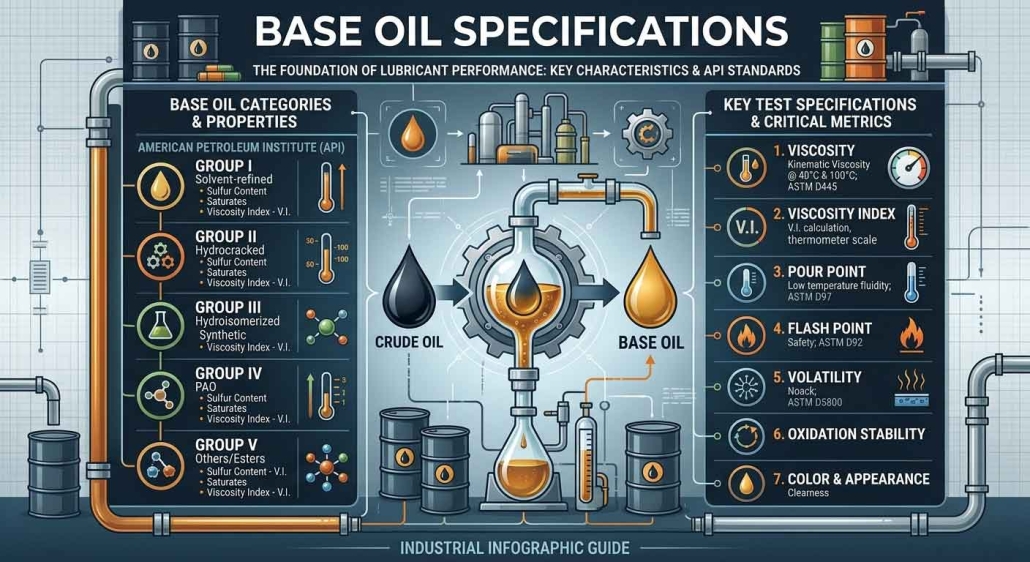
Base oil specifications are more than lab numbers—they directly affect lubricant performance, storage behavior, blending stability, and procurement risk. For lubricant manufacturers, traders, and industrial buyers, understanding a base oil’s test values helps prevent off‑spec purchases, blending failures, and unexpected field performance issues. Whether you source Group 1, 2, 3, 4 or 5 Base Oil, , reading a technical data sheet correctly is essential. This guide explains the most important laboratory parameters and shows how to use them in real buying decisions more effectively than a simple PDF specification sheet.
What the Main Base Oil Specifications Mean
Viscosity Index (VI)
VI shows how much an oil’s viscosity changes with temperature. A higher VI means better viscosity stability across hot and cold operating conditions. Low VI can lead to thin oil at high temperature and poor protection under load. High VI is especially important in modern automotive and industrial lubricants, and it is one reason buyers compare mineral vs synthetic base oil before formulation.
Pour Point
Pour point is the lowest temperature at which the oil still flows. If the pour point is too high, the lubricant may perform poorly in cold climates, cause startup issues, or reduce pumpability. This property matters especially for hydraulic fluids, engine oils, and gear oils used in low‑temperature conditions.
Flash Point
Flash point indicates the temperature at which vapors can ignite. A lower-than-expected flash point may suggest contamination with lighter fractions, poor refining, or safety concerns in storage and handling. It is also relevant when comparing standard grades with Bright Stock Base Oil or heavier neutrals.
Noack Volatility
Noack measures how much oil evaporates at high temperature. Lower Noack volatility generally means lower oil consumption, better thermal stability, and less deposit formation. It is more relevant for high-performance formulations, especially Group III, Group IV, and some Group V base stocks.
CCS (Cold Cranking Simulator)
CCS evaluates low-temperature apparent viscosity under simulated engine cranking conditions. While CCS is primarily associated with finished engine oils, it can be useful when assessing the cold behavior contribution of certain base stocks in formulations. If CCS-related low-temperature behavior is poor, startup lubrication may be compromised.
Base Oil Technical Specification Tables by API Group
Group I Base Oil
| Typical Grades | KV @ 40°C (cSt) | KV @ 100°C (cSt) | VI | Pour Point (°C) | Flash Point (°C) | Noack | CCS | Sulfur wt% | Satu-rates % | ASTM Color |
|---|---|---|---|---|---|---|---|---|---|---|
| SN70 / SN100 | 28–35 | 5.0–5.8 | 90–100 | -6 to -12 | 200–220 | Limited relevance | Limited relevance | >0.03 | <90 | 1.5–3.0 |
| SN150 | 30–35 | 5.5–6.5 | 90–100 | -6 to -9 | 210–225 | Limited relevance | Limited relevance | >0.03 | <90 | 1.5–3.0 |
| SN500 | 90–110 | 10–12 | 90–98 | -6 to -9 | 240–260 | Moderate | Limited relevance | >0.03 | <90 | 2.0–4.0 |
| Bright Stock | 400–500+ | 28–35 | 90–95 | 0 to +15 | 280–320 | Low relevance | Not typical | >0.03 | <90 | 4.0–8.0 |
If values fall outside range: low flash point may indicate contamination; poor VI may reduce thermal stability; abnormal color may suggest refining inconsistency or oxidation. For deeper background, see Base Oil Color, Lube Cut vs Base Oil, and Base Oil Production Process.
Group II Base Oil
| Typical Grades | KV @ 40°C (cSt) | KV @ 100°C (cSt) | VI | Pour Point (°C) | Flash Point (°C) | Noack | CCS | Sulfur wt% | Satu-rates % | ASTM Color |
|---|---|---|---|---|---|---|---|---|---|---|
| N60 / N70 | 10–15 | 2.5–3.2 | 95–110 | -9 to -18 | 180–210 | Moderate | Limited relevance | ≤0.03 | >90 | <1.0 |
| N100 / N150 | 20–35 | 4.0–6.0 | 100–115 | -9 to -15 | 200–230 | Moderate | Limited relevance | ≤0.03 | >90 | <1.0 |
| N220 | 40–50 | 6.0–8.0 | 100–115 | -9 to -15 | 220–240 | Moderate | Limited relevance | ≤0.03 | >90 | <1.0 |
| N500 / N600 | 90–120 | 10–14 | 95–110 | -6 to -12 | 240–260 | Moderate | Limited relevance | ≤0.03 | >90 | <1.5 |
If values fall outside range: low saturates or high sulfur may indicate the product is not truly Group II; poor pour point can affect cold flow; high volatility may reduce finished lubricant performance. Related reading: Types of Base Oil.
Group III Base Oil
| Typical Grades | KV @ 40°C (cSt) | KV @ 100°C (cSt) | VI | Pour Point (°C) | Flash Point (°C) | Noack % | CCS | Sulfur wt% | Satu-rates % | ASTM Color |
|---|---|---|---|---|---|---|---|---|---|---|
| 2 cSt | 7–9 | 2.0–2.5 | 115–135 | -30 to -45 | 160–190 | 12–18 | Relevant in blends | ≤0.03 | >90 | Water white |
| 4 cSt | 18–22 | 3.5–4.3 | 120–140 | -18 to -30 | 200–230 | 8–14 | Relevant in blends | ≤0.03 | >90 | Water white |
| 6 cSt | 30–36 | 5.5–6.3 | 120–140 | -15 to -24 | 220–240 | 5–10 | Relevant in blends | ≤0.03 | >90 | Water white |
| 8 cSt | 45–55 | 7.5–8.5 | 125–145 | -12 to -21 | 230–250 | 4–8 | Relevant in blends | ≤0.03 | >90 | Water white |
If values fall outside range: low VI weakens premium lubricant positioning; high Noack can increase oil consumption and deposits; poor low-temperature behavior hurts cold-start performance.
Group IV Base Oil (PAO)
| Typical Grades | KV @ 40°C (cSt) | KV @ 100°C (cSt) | VI | Pour Point (°C) | Flash Point (°C) | Noack % | CCS | Sulfur wt% | Satu-rates % | Color |
|---|---|---|---|---|---|---|---|---|---|---|
| PAO 2 | 8–10 | 2.0–2.3 | 125–145 | -60 to -75 | 160–190 | 14–20 | Excellent | Nil | ~100 | Water white |
| PAO 4 | 16–20 | 3.8–4.3 | 125–145 | -60 to -75 | 200–230 | 8–12 | Excellent | Nil | ~100 | Water white |
| PAO 6 | 28–34 | 5.8–6.3 | 130–150 | -54 to -72 | 220–250 | 5–8 | Excellent | Nil | ~100 | Water white |
| PAO 8 / 10 | 45–65 | 8–10 | 135–155 | -48 to -66 | 230–260 | 3–6 | Excellent | Nil | ~100 | Water white |
If values fall outside range: lower purity or abnormal volatility may indicate blending, contamination, or non-PAO substitution.
Group V Base Oil
| Typical Grades | KV @ 40°C (cSt) | KV @ 100°C (cSt) | VI | Pour Point (°C) | Flash Point (°C) | Noack | CCS | Sulfur | Satu-rates | Color |
|---|---|---|---|---|---|---|---|---|---|---|
| Ester 46 | 40–50 | 8–10 | 130–160 | -40 to -60 | 240–270 | Low–Moderate | Very good | Nil | N/A | Clear |
| Ester 68 | 60–75 | 10–14 | 130–170 | -36 to -54 | 250–280 | Low–Moderate | Very good | Nil | N/A | Clear |
| PAG grades | Varies widely | Varies | 160+ possible | Very low | High | Low | Excellent | Nil | N/A | Clear |
| Alkylated Naphthalene | Varies | Varies | 110–140 | -30 to -50 | 230–260 | Low | Good | Nil | N/A | Clear |
If values fall outside range: hydrolytic instability, seal compatibility issues, or formulation imbalance may occur depending on chemistry. Group V products vary widely, so review chemistry-specific data carefully.
How to Quickly Identify Off-Spec Base Oil from a Lab Report
Use this buyer checklist before approving a COA:
- Confirm the product matches the claimed API group by saturates, sulfur, and VI
- Check whether kinematic viscosity fits the advertised grade
- Review pour point for the intended climate or application
- Compare flash point against normal grade values to detect contamination
- Use Noack to assess evaporation risk in high-temperature formulations
- Review color and appearance for refining consistency
- Ask whether the material is virgin, re-refined, or blended if data looks inconsistent
For sourcing decisions, it also helps to monitor Top 10 Base Oil Producing Countries and current Base Oil Price Forecast trends.
FAQ
What is the most important specification in base oil?
There is no single most important value. VI, viscosity, pour point, and flash point must all match the intended application.
Can Group II and Group III oils have similar viscosity grades?
Yes, but Group III usually offers higher VI and lower volatility.
Is Noack relevant for all base oils?
It is most useful for high-performance and automotive-related formulations, especially Group III, IV, and V.
Does dark color always mean poor-quality base oil?
No. Some Group I and heavy grades naturally have darker color.
Where can I learn more about base oil categories?
See Types of Base Oil and browse More Articles on Base Oil.
Global Petroleum Trade Solutions | Universal Trades
As a reputable international petroleum trading enterprise, Universal Trades specializes in the reliable procurement, export, and supply chain management of high-grade petroleum commodities, refined fuels, and industrial feedstocks designed to meet rigorous global standards.








Leave a Reply
Want to join the discussion?Feel free to contribute!