
Top 10 Largest Base Oil Exporting Countries 2026 (Global Trade Analysis)
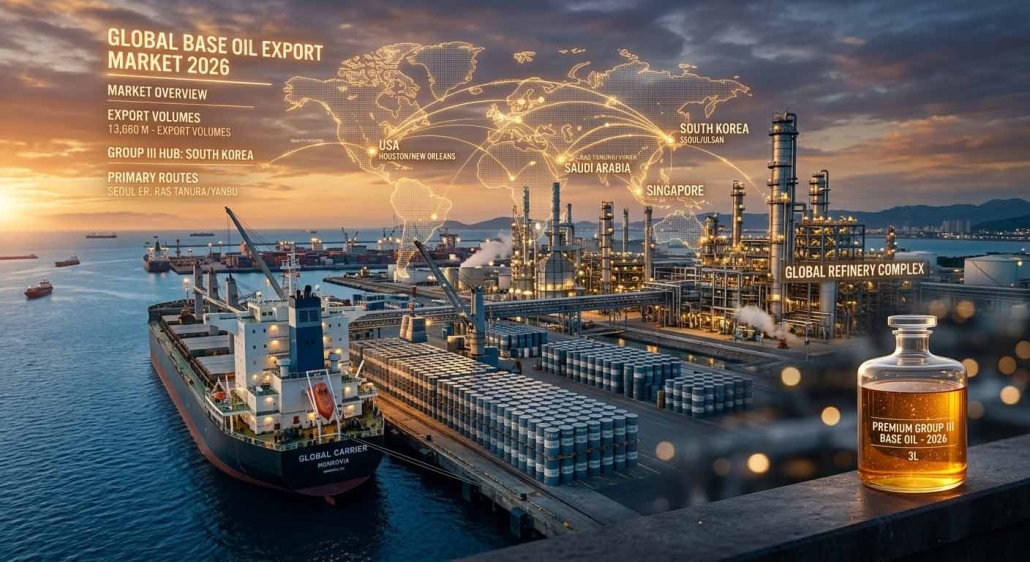
Base oil is the primary raw material used in the production of lubricants, greases, and various industrial oils. It forms the foundation of finished lubricants used in automotive engines, heavy machinery, marine applications, and industrial equipment. Understanding the structure of the global base oil market is therefore essential for lubricant buyers, traders, and energy analysts.
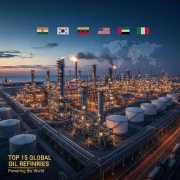
Global base oil exports are heavily influenced by refining capacity, crude oil availability, and advanced processing technologies. Countries with modern refineries and strong petrochemical infrastructure dominate base oil trade, supplying Group I, Group II, and increasingly Group III base oils to international markets. Many of these export hubs are closely linked to regions with large crude supplies and refining clusters discussed in analyses of the Largest Oil Producing Countries in the World and the Largest Oil Refineries in the World. As lubricant demand continues to grow across Asia, Africa, and emerging markets, global base oil trade remains a key segment of the petroleum products supply chain.
Top 10 Largest Base Oil Exporting Countries
The following table provides an estimated overview of the leading base oil exporting countries based on refinery capacity, export flows, and industry reports.
| Rank | Country | Estimated Export Volume (Million Tons/Year) | Share of Global Exports | Main Base Oil Groups Exported |
|---|---|---|---|---|
| 1 | South Korea | 8.5 | 18% | Group II, Group III |
| 2 | United States | 7.2 | 15% | Group II, Group III |
| 3 | Singapore | 5.0 | 10% | Group II, Group III |
| 4 | Saudi Arabia | 4.8 | 10% | Group II, Group III |
| 5 | China | 3.8 | 8% | Group I, Group II |
| 6 | India | 3.2 | 7% | Group I, Group II |
| 7 | Netherlands | 2.6 | 5% | Group I, Group II |
| 8 | UAE | 2.4 | 5% | Group II, Group III |
| 9 | Qatar | 2.1 | 4% | Group III |
| 10 | Germany | 1.8 | 4% | Group I, Group II |
| — | Other Countries | 6.6 | 14% | Various |
| — | Total Global Exports | ~48 | 100% | All Groups |
Many of these exporters operate sophisticated refining and petrochemical complexes developed by some of the Top Oil and Gas Companies and located in major refining hubs connected to global maritime trade routes.
Why These Countries Dominate Base Oil Exports
Advanced Refinery Technology
Countries such as South Korea, the United States, and Saudi Arabia have invested heavily in hydrocracking and hydro‑isomerization technologies. These processes enable the production of high‑quality Group II and Group III base oils, which are increasingly demanded by modern automotive lubricants.
Integrated Petrochemical Complexes
Many of the leading exporters operate integrated refining and petrochemical facilities. These complexes allow refiners to optimize crude processing and produce a wide range of petroleum products, including fuels, base oils, and petrochemical feedstocks. This integrated model is common in large energy hubs that also contribute significantly to Top Countries in Petroleum Product Production.
Strategic Export Locations
Geography plays an important role in base oil trade. Singapore, South Korea, and the UAE are strategically located along major shipping routes serving Asia, the Middle East, and Africa. These locations make them ideal distribution centers for lubricant base oil suppliers.
In particular, Asian refining hubs also supply feedstocks for fuels discussed in articles about Top Countries in Gasoline Production and Top Diesel Producing Countries.
Access to Crude Oil and Feedstocks
Access to abundant crude oil reserves significantly improves refining economics. Major exporters such as Saudi Arabia, the UAE, and Qatar benefit from proximity to some of the world’s largest hydrocarbon resources, which are discussed in global assessments of the Top Countries by Oil Reserves.
Base Oil Production by Region
Global base oil production is concentrated in a few major refining regions with strong petroleum infrastructure.
| Region / Continent | Estimated Production (Million Tons/Year) | Share of Global Production |
|---|---|---|
| Asia-Pacific | 38 | 44% |
| North America | 20 | 23% |
| Europe | 14 | 16% |
| Middle East | 10 | 12% |
| Latin America | 3 | 3% |
| Africa | 2 | 2% |
| Total | ~87 | 100% |
Asia-Pacific leads global production due to massive refining capacity in China, South Korea, Singapore, and India. These countries not only supply domestic lubricant markets but also export large volumes to Africa and Southeast Asia.
Industry Context: Global Base Oil Market Trends
Rising Global Lubricant Demand
Global lubricant demand continues to grow alongside industrialization, vehicle ownership, and infrastructure development. Expanding automotive markets—particularly in Asia and Africa—drive demand for high‑quality engine oils, which depend on advanced base oils.
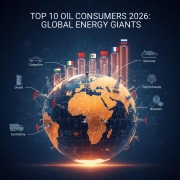
These trends are closely tied to broader petroleum consumption patterns discussed in research on the Largest Oil Consuming Countries in the World.
Shift from Group I to Group II and Group III
The global base oil industry is undergoing a structural transition. Older Group I plants are gradually being replaced by modern facilities producing Group II and Group III base oils, which offer better oxidation stability, lower sulfur content, and improved viscosity performance.
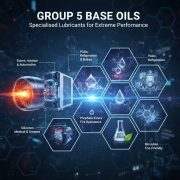
For a deeper technical explanation, readers often explore resources such as Introduction to Types of Base Oil and Introduction to Types of Petroleum Products.
Influence of Crude Oil Prices
Crude oil price fluctuations significantly affect refining margins and base oil production economics. When crude prices rise, refiners must carefully balance fuel production and specialty products such as base oils.
Market participants frequently monitor long‑term outlooks such as the Crude Oil Price Forecast to anticipate changes in refining profitability.
Relationship with Other Refined Products
Base oil production is closely linked to the broader refining output of fuels and distillates. Refineries producing base oils also generate products such as diesel, gasoline, kerosene, and heavy materials used in Bitumen Articles.
Understanding related products like Kerosene, Introduction to Types of Diesel, and More Articles About Gasoline helps explain how refiners optimize their production slates across different markets.
Conclusion
The global base oil export landscape is dominated by technologically advanced refining hubs in Asia, North America, and the Middle East. Countries such as South Korea, the United States, Singapore, and Saudi Arabia lead international trade thanks to modern refining technologies, integrated petrochemical complexes, and strategic export infrastructure.
As the lubricant industry evolves, demand for higher‑quality Group II and Group III base oils is expected to grow. This shift will likely strengthen the position of regions with advanced hydroprocessing capabilities, particularly Asia-Pacific and the Middle East. For buyers and traders monitoring global lubricant supply chains, understanding the structure of base oil exporting countries and global refining capacity remains essential for navigating the future of the global base oil market.
Global Petroleum Trade Solutions | Universal Trades
As a reputable international petroleum trading enterprise, Universal Trades specializes in the reliable procurement, export, and supply chain management of high-grade petroleum commodities, refined fuels, and industrial feedstocks designed to meet rigorous global standards.

Global Petroleum Trade Solutions | Universal Trades
As a reputable international petroleum trading enterprise, Universal Trades specializes in the reliable procurement, export, and supply chain management of high-grade petroleum commodities, refined fuels, and industrial feedstocks designed to meet rigorous global standards.





Leave a Reply
Want to join the discussion?Feel free to contribute!