
Lube Cut vs. Base Oil: Key Differences and Applications
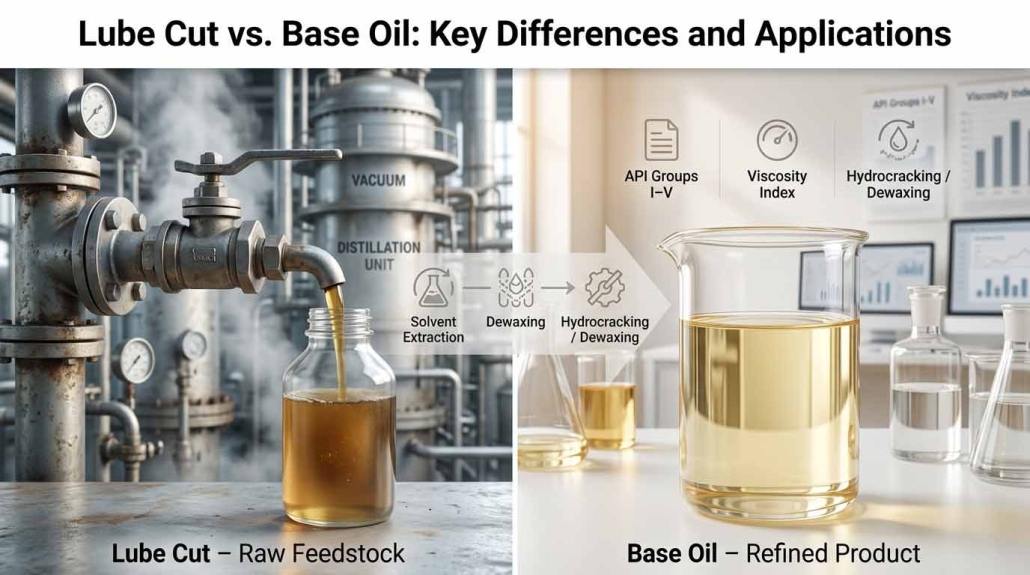
In the petrochemical and lubricant manufacturing industries, the terms “lube cut” and “base oil” are frequently discussed. While they are intrinsically linked in the production lifecycle, they are entirely different products with distinct physical properties and stages of refinement.
Understanding the relationship between the two is crucial for B2B buyers, lubrication engineers, and automotive professionals. Simply put, lube cut is the raw feedstock, and base oil is the highly refined finished product.
In this article, we will explore the exact definitions, refining processes, and applications of both, helping you make informed sourcing decisions. For more in-depth industry insights, you can always explore our dedicated lube cut articles.
What is a Lube Cut?
A lube cut (short for lubricating oil cut) is a specific hydrocarbon fraction obtained during the vacuum distillation of crude oil. After the lighter products like gasoline and diesel are extracted at atmospheric pressure, the heavier residue is distilled in a vacuum to prevent thermal cracking. The resulting distillate is the lube cut.
At this stage, the lube cut is raw, unrefined, and contains numerous impurities. These impurities include aromatics, sulfur, nitrogen, and wax, which make it unsuitable for direct use as a high-performance lubricant. Depending on the specific crude oil source and distillation parameters, refineries produce various types of lube cuts, each destined for different refining pathways.
Because of its unrefined nature, lube cut serves almost exclusively as a manufacturing feedstock. It is the vital starting material from which functional, market-ready lubricants are eventually derived.
What is Base Oil?
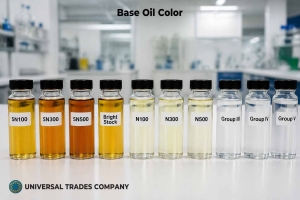
Base oil is the refined product created by processing the raw lube cut. It makes up the vast majority (typically 70% to 90%) of any finished lubricating oil, with chemical additives making up the remainder. Through extensive chemical and physical processing, the impurities found in the lube cut are removed or altered.
The refinement process significantly improves
the fluid’s physical properties. Essential parameters such as the Viscosity Index (VI), pour point, and oxidation stability are optimized. By the end of the refining process, you have a stable, high-quality base oil ready to be blended into motor oils, hydraulic fluids, and industrial greases.
If you are looking to dive deeper into the chemistry and market trends of these refined fluids, we recommend browsing our comprehensive base oil articles.
The Refining Process: From Lube Cut to Base Oil
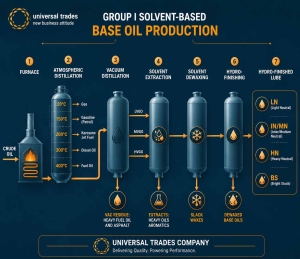
Transforming lube cut into a premium base oil requires a multi-step refining process. Each step is designed to target and eliminate specific unwanted compounds:
- Solvent Extraction: This process removes heavy aromatic compounds, which have poor oxidation stability and low viscosity indices.
- Solvent Dewaxing: Wax molecules crystallize at low temperatures, which is disastrous for lubricants. Dewaxing removes these waxes to lower the oil’s pour point.
- Hydrofinishing/Hydrocracking: This involves reacting the oil with hydrogen gas under high pressure. It removes sulfur and nitrogen while converting unsaturated hydrocarbons into highly stable saturated molecules.
API Classifications and Base Oil Varieties
The American Petroleum Institute (API) categorizes base oils into five distinct groups based on their sulfur content, saturates, and Viscosity Index (VI). Understanding the different types of base oil is essential for formulating specific lubricants.
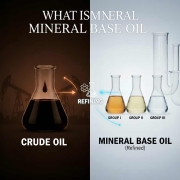
Broadly speaking, these are divided into mineral base oil (Groups I, II, and III) and synthetic base oil (Groups IV and V).
Mineral Base Oils (Groups I – III)
- Group I: Extracted using older solvent refining processes, group 1 base oil is the least refined. It contains less than 90% saturates, more than 0.03% sulfur, and has a viscosity index range of 80 < VI < 120.
- Group II: Produced using hydrocracking, group 2 base oil is purer. It features greater than or equal to 90% saturates, less than or equal to 0.03% sulfur, and a VI of 80 < VI < 120$. It offers better antioxidant properties.
- Group III: Subjected to severe hydrocracking, group 3 base oil achieves greater than 90% saturates and less than 0.03% sulfur, but boasts a higher viscosity index (VI > 120). It performs similarly to synthetics.
Synthetic Base Oils (Groups IV – V)
- Group IV: This category is reserved entirely for Polyalphaolefins (PAOs). A group 4 base oil is fully synthetic, offering exceptional performance in extreme temperatures and possessing a very high viscosity index.
- Group V: This is the catch-all category for all other base oils not included in the first four groups. A group 5 base oil includes esters, silicones, and naphthenic oils, typically used as specialized additives or in highly specific industrial applications.
Key Industrial Applications
Because lube cut is unfinished, its sole application is acting as the primary feedstock for petroleum refineries. It is traded in bulk among petrochemical companies equipped to refine it.
Base oils, however, have endless applications. They are the foundation of passenger car motor oils (PCMO), heavy-duty diesel oils, transmission fluids, and gear oils. In the industrial sector, they are formulated into turbine oils, compressor oils, metalworking fluids, and hydraulic fluids.
Conclusion
In summary, while “lube cut” and “base oil” belong to the same petrochemical family tree, they represent completely different stages of production. Lube cut is the raw, unrefined fraction pulled straight from the vacuum distillation tower. Base oil is the highly refined, stable, and categorized fluid ready for commercial blending. Knowing the difference is the first step in mastering lubricant procurement and engineering.
Frequently Asked Questions (FAQs)
1. Is lube cut the same as base oil?
No. Lube cut is the unrefined raw material extracted from crude oil during vacuum distillation. Base oil is the finished, refined product created by processing that lube cut to remove impurities.
2. Can you use lube cut directly as a lubricant?
No, lube cut cannot be used directly as a lubricant. It contains high levels of waxes, sulfur, and aromatics that cause poor performance, rapid oxidation, and engine sludge. It must be refined first.
3. What is the role of lube cut in petrochemical manufacturing?
Lube cut serves specifically as the primary feedstock for base oil refineries. Its main industrial purpose is to be subjected to solvent extraction, dewaxing, and hydrocracking.
4. How is base oil categorized?
The American Petroleum Institute (API) categorizes base oils into five groups (Groups I through V) based on their percentage of saturates, sulfur content, and Viscosity Index(VI).
5. What is the difference between mineral and synthetic base oils?
Mineral base oils (Groups I, II, and III) are refined directly from crude oil (lube cuts). Synthetic base oils (Groups IV and V) are chemically engineered from smaller molecules to create pure, highly consistent lubricants for extreme conditions.
Global Petroleum Trade Solutions | Universal Trades
As a reputable international petroleum trading enterprise, Universal Trades specializes in the reliable procurement, export, and supply chain management of high-grade petroleum commodities, refined fuels, and industrial feedstocks designed to meet rigorous global standards.








Leave a Reply
Want to join the discussion?Feel free to contribute!