
Bitumen COA Sample + Typical Technical Properties (60/70, 80/100, 40/50)
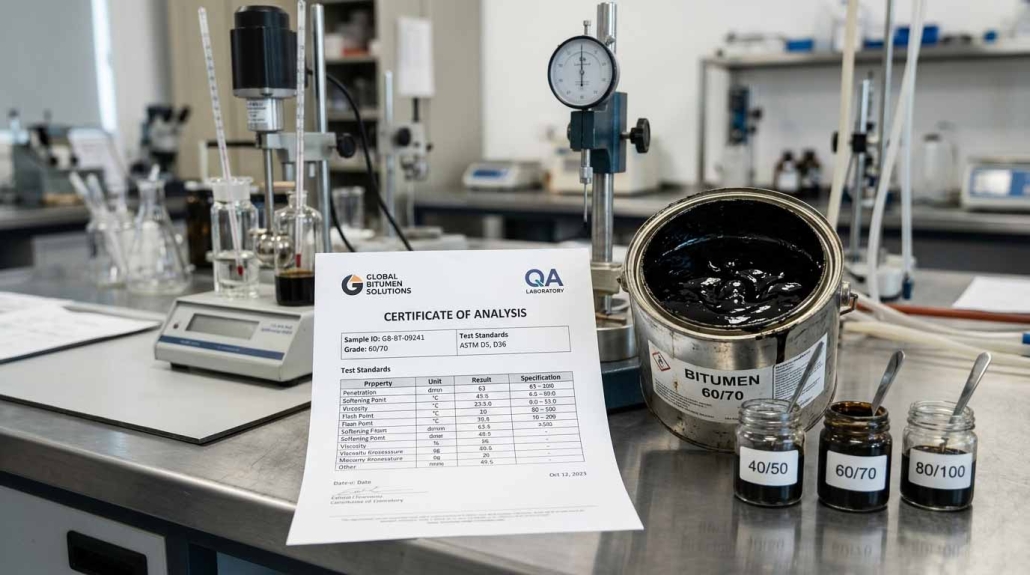
Buying penetration grade bitumen like other petroleum products often comes down to one question: “Can you share the COA?” This guide gives you (1) a clear COA sample format, (2) typical property ranges for 60/70, 80/100, and 40/50, and (3) a practical framework to choose the right grade and avoid costly quality surprises.
You’ll also see what should match across export paperwork and how to spot red flags—before you commit to a shipment.
COA vs. TDS vs. Specification (What’s the difference?)
Many buyers use these terms interchangeably, but they serve different purposes.
| Document | What it is | What it’s used for | Key limitation |
|---|---|---|---|
| Specification | A set of acceptance limits (requirements) for a grade | Contracting, compliance, pass/fail acceptance | Doesn’t show the actual batch results |
| TDS (Technical Data Sheet) | Product info + typical properties and usage guidance | Pre-qualification, product understanding | “Typical” values are not batch-specific |
| COA (Certificate of Analysis) | Actual test results for a specific batch/lot | Shipment acceptance, QC verification | Only represents that batch; results may vary |
If you’re still deciding what type of binder you need (for example Types of Bitumen beyond penetration grades), a TDS-style overview can help. If you’re finalizing a purchase, a COA is the document that should reflect the exact material shipped.
What a real COA typically includes (and why it matters)
A practical COA for penetration grade bitumen commonly includes these items (test methods vary by lab and standard):
- Penetration @ 25°C (0.1 mm): Primary grade identifier for pen-grade bitumen. Lower penetration usually means harder binder.
- Softening Point (Ring & Ball): Indicates resistance to softening at higher temperatures. Often, harder grades show higher softening points.
- Ductility @ 25°C: A proxy for stretch/adhesion behavior; useful for detecting overly brittle material.
- Flash Point (COC): Safety-related; supports handling and heating practices (relevant when comparing Hot Bitumen vs. Cold Bitumen).
- Solubility: Screens for excessive insoluble matter/contamination.
- Specific Gravity (Density): Helpful for mass/volume conversions and consistency checks.
- Loss on Heating / RTFOT (if provided): Indicates volatility/short-term aging tendency.
Depending on the contract and destination, you may also see viscosity-related results or additional aging/chemical indicators—especially when the project calls for modified binders like Polymer Modified Bitumen, or when the supply chain includes products such as Cutback Bitumen or Emulsion Bitumen (which have different test profiles and use cases).
For context on where these properties come from upstream, it helps to understand the Bitumen Production Process and how feedstock and process controls at a Bitumen Refinery influence batch consistency.
COA sample (SAMPLE / EXAMPLE ONLY)
Below is a simplified example layout. Values are SAMPLE/EXAMPLE ONLY and must not be treated as guaranteed specs. Real results vary by refinery, crude source, and batch.
Product: Penetration Grade Bitumen 60/70
Batch/Lot: 24-067B (Example)
Date: 2026-05-01 (Example)
Test Lab: Internal QC / Third-party (Example)
| Property | Unit | Test (typical) | Result (Example Only) |
|---|---|---|---|
| Penetration @ 25°C | 0.1 mm | ASTM D5 (commonly) | 66 |
| Softening Point (R&B) | °C | ASTM D36 (commonly) | 50.0 |
| Ductility @ 25°C | cm | Common method | 110 |
| Flash Point (COC) | °C | Common method | 255 |
| Solubility | % | Common method | 99.2 |
| Specific Gravity @ 25°C | — | Common method | 1.03 |
| Loss on Heating (mass change) | % | Common method | 0.20 |
How to use this sample:
- The format is what matters: clear batch ID, dates, units, methods, and results.
- A credible COA should look consistent with the grade and should match shipment identifiers in export documents (details below).
If your procurement is for specialized binders (e.g., Oxidized Bitumen for industrial applications or Natural Bitumen blends), request a COA format aligned with that product type.
Typical technical properties by grade (60/70, 80/100, 40/50)
The table below shows typical ranges you may see in the market for penetration grades. These are not contractual limits unless you set them in your specification.
| Property (typical) | 40/50 (harder) | 60/70 (mid) | 80/100 (softer) | How to interpret |
|---|---|---|---|---|
| Penetration @ 25°C (0.1 mm) | 40–50 | 60–70 | 80–100 | Lower = harder binder (often better rut resistance in heat) |
| Softening Point (°C) | 52–58 | 48–54 | 42–48 | Higher = more heat resistance (generally) |
| Ductility @ 25°C (cm) | 80–120 | 100–150 | 100–200 | Very low ductility can signal brittleness/aging |
| Flash Point (°C) | 230–300 | 230–300 | 230–300 | Safety indicator; confirm your heating SOPs |
| Solubility (%) | 99.0–99.7 | 99.0–99.7 | 99.0–99.7 | Lower solubility may indicate impurities/contamination |
| Specific Gravity @ 25°C | 1.01–1.06 | 1.01–1.06 | 1.01–1.06 | Mostly a consistency check, not a grade selector |
Important: Harder grades (like 40/50) typically show lower penetration and higher softening point than softer grades (like 80/100). If a COA claims the opposite without explanation, treat it as a verification trigger.
For deeper grade comparisons, see Bitumen 60/70 vs. 80/100 and Bitumen 40/50 vs. 60/70. If you’re mapping binder choice to end-use, start with Bitumen Uses and Applications and a Project-Based Bitumen Selection Guide.
How to choose between 60/70, 80/100, 40/50
Use this decision framework (typical guidance—final choice should match your project spec, climate, and mix design):
1) Climate (temperature profile)
- Hotter climates / higher pavement temperatures: tend to favor harder grades (often 40/50 or 60/70) for rutting resistance.
- Cooler climates / lower pavement temperatures: may favor softer grades (often 80/100) to reduce cracking risk.
Cracking risk is multifactorial (mix design, base condition, compaction, aging). If cracking is your main issue, review Causes of Asphalt Cracking alongside binder selection.
2) Traffic load and rutting sensitivity
- Heavier traffic / higher axle loads: typically pushes you toward 40/50 or 60/70.
- Lower traffic roads: 60/70 or 80/100 is often considered depending on climate and workability needs.
3) Mixing temperature & workability
- Softer grades can be easier to work with at lower temps; harder grades may require stricter temperature control. For non-traditional handling/placement, note the differences in Hot Bitumen vs. Cold Bitumen.
3 quick scenarios (typical)
- Coastal hot region + heavy trucks: often 40/50 (or a performance/modified solution if specified).
- Moderate climate + general road works: commonly 60/70.
- Cooler region + cracking concerns: often 80/100 (subject to design and spec).
If you need a faster shortcut, use the Simple Guide to Choosing Bitumen Based on Project Needs and cross-check with Most Commonly Used Bitumen Grades.
Quality & fraud prevention (practical buyer checks)
If you buy on COA alone, you’re vulnerable to both inconsistency and document risk. Use these checks:
- Batch consistency over time
Ask for COAs from the last 3–5 lots. Large swings in penetration/softening point may indicate unstable processing or blending. Understanding the supplier’s Bitumen Production Process helps you ask the right questions.
- Lab credibility and traceability
Prefer COAs that show lab identity, test date, and clear sample/batch IDs. If a third-party lab is used, check accreditation status (without assuming it guarantees quality).
- Cross-check penetration vs. softening point
You’re not calculating a formula here—just sanity-checking. A “60/70” COA with penetration near 90 and softening point near 58 deserves scrutiny.
- Watch for suspiciously wide tolerances or vague language
COAs should report results, not only broad ranges. Overly generic COAs can be recycled documents.
- Document mismatch red flags
If the COA’s batch number, production date, packaging type, or net weight doesn’t align with shipping docs, pause and verify. This is a common pain point when trading internationally—especially across multiple Bitumen Exporting Countries.
For a broader checklist, link your QC requirements to a page like Difference Between High-Quality and Low-Quality Bitumen.
Export practicality: what buyers request with the COA (and what must match)
In real export transactions, buyers commonly request COA together with:
- SDS/MSDS (safety data)
- Packing List (net/gross, package count)
- Bill of Lading (consignment details)
- Certificate of Origin (where applicable)
What should match across documents (high-impact fields):
- Product name/grade (e.g., 60/70)
- Packaging type and count (drums, jumbo bags, bulk)
- Batch/lot numbers (when used)
- Production date or loading date (where stated)
- Consignee/shipper details and destination
Export planning also ties into availability and market timing; pages like Bitumen Price Forecast, Top Bitumen Producing Countries, and Bitumen Exporting Countries can support procurement decisions and expectation-setting.
FAQ
1) What is a bitumen COA?
A COA (Certificate of Analysis) reports actual lab test results for a specific batch/lot of bitumen shipped (or prepared for shipment).
2) Is a COA the same as a specification?
No. A specification states requirements/limits. A COA shows measured results for a batch. Use both.
3) Do COA values change from batch to batch?
Yes—within a controlled range for reputable production. Crude source, process conditions, and storage can shift results slightly.
4) Which COA tests matter most for penetration grades?
Commonly: penetration @25°C, softening point, ductility, flash point, and solubility—plus aging indicators if required by your spec.
5) Can a COA be verified?
You can request third-party testing, match batch identifiers to shipping docs, and compare results against your agreed spec and historical COAs.
6) Is 40/50 always “better” than 60/70?
Not necessarily. 40/50 is typically harder (often better for heat/rutting), but it may increase cracking risk in colder conditions. Selection should match climate and design.
7) Do emulsions/cutbacks use the same COA format?
Not usually. Emulsion Bitumen and Cutback Bitumen involve different composition and tests, so the COA items differ.
8) What about oxidized or natural bitumen?
Oxidized Bitumen and Natural Bitumen are used for different applications and have different property priorities (e.g., softening point targets can be much higher for oxidized grades).
Global Petroleum Trade Solutions | Universal Trades
As a reputable international petroleum trading enterprise, Universal Trades specializes in the reliable procurement, export, and supply chain management of high-grade petroleum commodities, refined fuels, and industrial feedstocks designed to meet rigorous global standards.









Leave a Reply
Want to join the discussion?Feel free to contribute!