
Oxidized Bitumen 85/25: Specifications, Uses ,and Production
Executive Key Takeaways
- Optimal Viscoelastic Balance: Oxidized Bitumen 85/25 delivers a softening point of 80°C to 90°C and a penetration of 20 to 30 dmm, providing high-temperature flow resistance without low-temperature brittleness.
- Refined Chemical Structure: Air-blowing converts lighter maltenes into structured asphaltenes, yielding a highly stable, UV-resistant colloidal matrix.
- Corrosion & Moisture Barrier: Excellent electrical resistivity and water impermeability make it ideal for pipeline wrapping, undersealing, and roofing.
- Strict Handling Controls: Melting must occur between 160°C and 180°C; overheating past 200°C permanently degrades the physical and chemical properties.
- Logistics Optimization: Drum shipping requires specific steel gauges to avoid leaks during transit, with a maximum payload limit of approximately 20 metric tons per 20ft container.
Introduction: Understanding Oxidized Bitumen 85/25
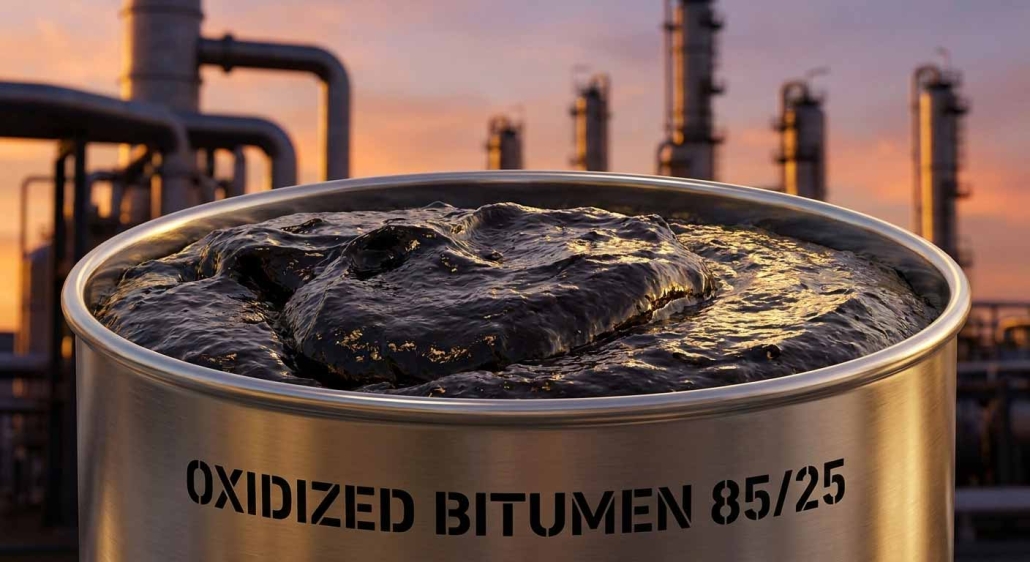
Oxidized Bitumen 85/25 (frequently termed blown bitumen 85/25) is a specialized, semi-solid grade of asphalt. Classified under high-molecular-weight industrial Petroleum Products, this material is produced through the controlled oxidation of vacuum distillation residues.
The designation “85/25” represents two vital physical characteristics:
- 85 (Softening Point): The temperature range in degrees Celsius (80°C to 90°C) at which the material changes from a semi-solid to a liquid state, measured using the Ring and Ball method.
- 25 (Penetration Value): The depth in tenths of a millimeter (20 to 30 dmm) that a standard needle penetrates the material at 25°C under a load of 100 grams for 5 seconds.
This balance between high softening temperature and low penetration gives it rubber-like elasticity and excellent durability. Industrial buyers choosing a binder should consult a Simple Guide to Choosing the Right Bitumen to ensure the specifications match their project’s structural and climate requirements.
Chemical Production & Reactor Mechanics
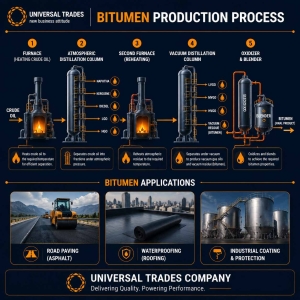
The transformation of refinery residues into Oxidized Bitumen 85/25 occurs inside a vertical blowing reactor. The reaction depends on temperature, air flow rate, and pressure.
Reactor Setup and Flow Dynamics
The process begins with hot vacuum bottoms sourced from the distillation units of a Bitumen Refinery. The feedstock is preheated to 190°C–210°C and pumped into the bottom of the oxidation column. Compressed air is introduced through a sparger at the base of the reactor, dispersing fine bubbles upward through the liquid.
Chemical Kinetics and Reaction Mechanics
As air rises through the hot liquid, oxygen molecules react with the hydrocarbon chains. The reaction follows three main steps:
- Dehydrogenation: Oxygen combines with hydrogen atoms in the bitumen, forming water vapor which is vented off.
- Polymerization: Hydrocarbon radicals join together to form larger, more complex molecular chains.
- Asphaltene Synthesis: Lighter maltenes (resins and oils) convert into heavier, structured asphaltene molecules. This process shifts the colloidal balance from a sol-type to a gel-type structure.
The reaction is exothermic. Cool oil or water jacket systems keep temperatures between 220°C and 250°C to prevent thermal cracking. The process is stopped when target softening and penetration values are reached. For details on how this differs from standard distillation, read about the Bitumen Production Process.
Physical & Chemical Properties: Technical Data Sheet
To verify that each batch meets industrial standards, Oxidized Bitumen 85/25 must undergo laboratory testing before shipment.
Specifications of Oxidized Bitumen 85/25
| Physical Property | Typical Value | Unit | Test Method |
|---|---|---|---|
| Softening Point | 80 – 90 | °C | ASTM D36 / EN 1427 |
| Penetration @ 25°C (100g, 5s) | 20 – 30 | 0.1 mm | ASTM D5 / EN 1426 |
| Ductility @ 25°C | Min 1.5 | cm | ASTM D113 / EN 12591 |
| Loss on Heating (5h @ 163°C) | Max 0.2 | wt % | ASTM D6 / EN 12607-1 |
| Flash Point (Cleveland Open Cup) | Min 260 | °C | ASTM D92 / EN ISO 2592 |
| Specific Gravity @ 25°C | 1.00 – 1.05 | g/cm³ | ASTM D70 / EN ISO 3838 |
| Solubility in Trichloroethylene | Min 99.0 | % | ASTM D2042 / EN 12592 |
| Softening Point Gain (Post-Heating) | Max 4.0 | °C | ASTM D6 / ASTM D36 |
Bitumen Grade Comparison Matrix
Different industrial applications require specific physical properties. Standard paving binders like Bitumen 60/70, Bitumen 80/100, and Bitumen 40/50 are designed for roads and flow easily under high temperatures, making them unsuitable for vertical waterproofing coatings.
The table below compares Oxidized Bitumen 85/25 with these standard paving grades and other industrial grades.
Technical Performance Comparison
| Property | Test Standard | Oxidized 85/25 | Paving 60/70 | Paving 80/100 | Paving 40/50 | Oxidized 90/15 |
|---|---|---|---|---|---|---|
| Primary Process | N/A | Air-Blowing | Vacuum Dist. | Vacuum Dist. | Vacuum Dist. | Air-Blowing |
| Penetration (dmm) | ASTM D5 | 20 – 30 | 60 – 70 | 80 – 100 | 40 – 50 | 10 – 20 |
| Softening Point (°C) | ASTM D36 | 80 – 90 | 46 – 54 | 43 – 51 | 50 – 58 | 85 – 95 |
| Ductility (cm) | ASTM D113 | Min 1.5 | Min 100 | Min 100 | Min 100 | Min 1.5 |
| Flash Point (°C) | ASTM D92 | Min 260 | Min 250 | Min 250 | Min 250 | Min 260 |
| Solubility (%) | ASTM D2042 | Min 99.0 | Min 99.0 | Min 99.0 | Min 99.0 | Min 99.0 |
| Thermal Elasticity | Viscosity | Excellent | Poor | Very Poor | Poor | High |
| Resistance to Sagging | Visual | Excellent | Poor | Very Poor | Poor | Exceptional |
Critical Technical Comparisons:
- Vs. Paving Grades: A Comparison of Bitumen 40/50 and 60/70 shows that paving grades are designed for flexibility under traffic loads. When comparing Comparison of Bitumen 60/70 and 80/100, these materials flow under direct summer heat, whereas Oxidized 85/25 stays stable on sloped surfaces up to 85°C.
- Vs. Oxidized Bitumen 90/15: Grade 90/15 is harder and has a higher softening point, but it becomes brittle in colder climates. Oxidized 85/25 remains flexible at lower temperatures while resisting heat.
Core Industrial Applications
The high adhesive strength, waterproofing, and durability of Oxidized Bitumen/Blown Bitumen make it highly versatile across several key industries.
Waterproofing and Roofing Systems
This grade is widely used in manufacturing roofing felts, shingles, and damp-proof membranes. Its high softening point prevents the coating from sliding or dripping on pitched roofs exposed to hot weather, making it one of the top choices when selecting the Best Bitumen for Roof Insulation.
Corrosion Protection for Industrial Pipelines
Buried and underwater steel pipes require heavy-duty corrosion protection. Hot-applied Oxidized Bitumen 85/25 forms a thick, electrically resistant barrier that blocks water, oxygen, and soil acids, protecting the steel from rust.
Expansion Joint Fillers & Sealing Compounds
Concrete slabs on runways, bridges, and highways need flexible joints to handle thermal expansion and contraction. Blown asphalt is combined with mineral fillers to create hot-pour joint sealants. These sealants prevent water from seeping into the subbase, which is one of the main Causes of Asphalt Cracking.
Sound Dampening and Vibration Insulation
Its viscoelastic properties make it effective for soundproofing. It is used in automotive underseal coatings and floor laminates to absorb vibrations and reduce noise.
To learn more about how this material fits into other applications, read our Introduction to Types of Bitumen and Their Applications or read about general Applications of Bitumen.

Procurement & Verification: Quality Testing Standards
For procurement managers, using untested or low-quality bitumen can lead to coating failures, poor adhesion, and cracking.
Before confirming any shipment, buyers should request a laboratory test report from an independent body like SGS or Bureau Veritas. Reviewing a Sample Bitumen Certificate of Analysis helps verify parameters such as flash point, solubility, and penetration.
Verification Guidelines:
- Penetration Test (ASTM D5): Measures binder hardness to ensure the product is not too soft.
- Softening Point (ASTM D36): Confirms thermal resistance.
- Loss on Heating (ASTM D6): Measures volatile mass loss to ensure long-term stability.
Understanding these parameters helps buyers identify the Differences Between High-Quality and Low-Quality Bitumen and avoid substandard mixtures. For more details on testing procedures, refer to our guide on Bitumen Quality Testing.
Step-by-Step Application & Operational Safety
Unlike cold-applied Emulsified Bitumen or solvent-diluted Cutback Bitumen (which are detailed in our comparison of Cold and Hot Bitumen), Oxidized Bitumen 85/25 is solid at room temperature and must be melted before use.
Step-by-Step Site Application Guide
Step 1: Surface Preparation
The substrate must be completely dry and free of dust, loose concrete, rust, or grease. Wet surfaces will cause steam bubbles, leading to adhesion failure and peeling.
Step 2: Melter Setup
Use a double-jacketed boiler heated by thermal oil. Avoid direct heating, as hot spots will burn the bitumen.
Step 3: Controlled Heating
Heat the material slowly to between 160°C and 180°C. Keep the agitator running to distribute heat evenly.
Step 4: Application
Apply the molten bitumen using squeegees, industrial mops, or hot-spray gear. Keep the area well-ventilated.
Pro-Tip: Avoid Thermal Degradation
CRITICAL OPERATIONAL WARNING: Never heat Oxidized Bitumen 85/25 above 200°C or expose it to direct flames. Overheating breaks down the asphaltene structures, lowering the softening point, increasing brittleness, and shortening the Service Life of Bitumen.
Safety teams must ensure all operators wear heat-resistant suits, heavy-duty gloves, and face shields to prevent thermal burns.

Packaging, Logistics, and Cargo Safety
Industrial packaging must protect the bitumen during transit, especially when crossing hot tropical shipping routes.
Packaging Options
Exporters provide several standard Types of Bitumen Packaging:
- New Steel Drums: 150kg, 180kg, or 200kg capacities. These offer excellent protection against moisture and physical damage.
- Jumbo Bags: 1-ton flexible bags with internal melting liners, ideal for high-volume users.
- Polyethylene Bags / Cartons: 25kg blocks wrapped in meltable film or packed in corrugated boxes, convenient for small-scale applications.
Procurement Risk Warning: Substandard drum thickness combined with thermal expansion during shipping is one of the main Causes of Leakage in Export Bitumen Drums. Always specify the required steel gauge in your purchase contract to avoid cargo damage and cleanup costs.
Container Loadability Guidelines
To maximize transport efficiency, review these standard load limits for 20-foot shipping containers:
- 150kg Steel Drums: ~110 drums per 20ft container (approx 16.5 metric tons payload).
- 200kg Steel Drums: ~80 drums per 20ft container (approx 16.0 metric tons payload).
- Meltable Polybags (25kg in Cartons): ~800 boxes stacked on pallets per 20ft container (approx 20.0 metric tons payload).
- Jumbo Bags (1000kg): ~20 bags per 20ft container (approx 20.0 metric tons payload).
Market Sourcing & Price Fluctuations
Because asphalt prices track global crude oil indexes, monitoring the Global Bitumen Price Forecast helps procurement managers time their purchases effectively.
Additionally, analyzing the Top Bitumen Exporting Countries can help you optimize shipping costs and navigate customs regulations.
To find the best fit for your project, consult our Simple Guide to Choosing the Right Bitumen. For further reading, check our technical Bitumen Articles.
Frequently Asked Questions (FAQ)
What is 85 25 grade bitumen?
It is an oxidized (blown) bitumen grade with a softening point of 85°C (ASTM D36) and a penetration value of 25 dmm (ASTM D5). It is engineered for industrial waterproofing and anti-corrosion coatings.
Can Oxidized Bitumen 85/25 be used for road paving?
No. Its high hardness and low ductility make it unsuitable for road surfaces, where traffic loads would cause premature cracking. For roads, paving grades like Bitumen 85/100 or elastomeric options like Polymer Modified Bitumen (PMB) are used instead.
What is the shelf life of Oxidized Bitumen 85/25?
When stored in solid form under cover, protected from direct sunlight and water, it has an almost indefinite shelf life (up to 5 years without significant property loss).
How is Oxidized Bitumen 85/25 heated safely?
It should be heated indirectly in a double-jacketed oil boiler to between 160°C and 180°C. Direct heating or heating above 200°C degrades the polymer chains and ruins the material.
What are the main causes of leakage in export bitumen drums?
Leakage is typically caused by using thin-gauge steel drums that fail under the pressure of thermal expansion in hot climates during transit. Selecting the correct drum specifications helps prevent this issue.
Which bitumen grades are most popular for industrial insulation?
Oxidized grades such as 85/25, 90/15, and 115/15 are the most Popular Bitumen Grades for industrial insulation due to their high softening points and structural stability.
Global Petroleum Trade Solutions | Universal Trades
As a reputable international petroleum trading enterprise, Universal Trades specializes in the reliable procurement, export, and supply chain management of high-grade petroleum commodities, refined fuels, and industrial feedstocks designed to meet rigorous global standards.










Leave a Reply
Want to join the discussion?Feel free to contribute!