
Diesel No.1 (D1): Properties, and Uses
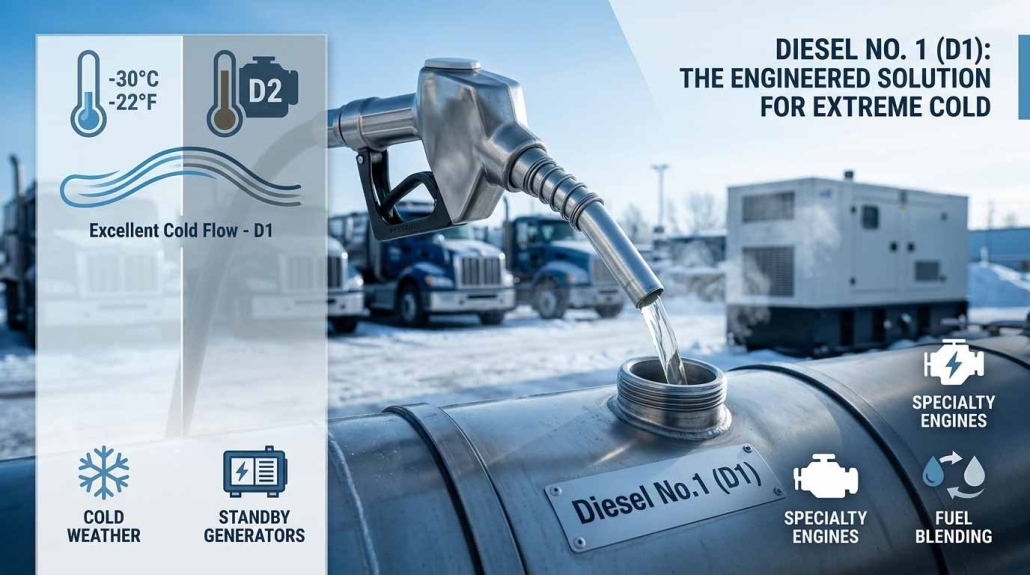
Diesel No.1 (D1)—sometimes also referred to as No.1-D fuel—is a lighter, cleaner‑burning, and cold‑resistant diesel grade widely used in regions with severe weather and in engines requiring fast, reliable ignition. As one of the essential Petroleum Products, D1 offers unique advantages that make it valuable across transportation, industrial, and commercial sectors. This article provides a clear, expert‑level explanation of how D1 works, how it differs from D2, and how buyers can evaluate its suitability for their needs.
What Is Diesel No.1 (D1)?
Diesel No.1 is defined under the ASTM D975 standard. It is distilled from lighter cuts during the Diesel Production Process, resulting in:
• Lower viscosity
• Lower density
• Higher volatility
• Faster ignition
• Strong low‑temperature performance
Its composition is closer to kerosene than standard diesel, which is why its Diesel Color often appears lighter. Modern D1 is commonly produced as ULSD Diesel, containing ultra‑low sulfur levels to meet environmental regulations.
For deeper background on similar products, you can explore related Diesel Articles or comparisons in “Types of Diesel Fuel Grades and Their Applications.”
Key Characteristics of Diesel No.1 (D1)
1. Excellent Cold Weather Performance
Among all diesel grades, D1 stands out for its resistance to waxing and gelling. Its naturally low Cold Filter Plugging Point makes it ideal for regions that rely on Winter Fuel blends. This is a major reason why some of the Top 10 Diesel Producing Countries refine and distribute D1 extensively in colder months.
2. Higher Volatility
Because it vaporizes more easily, D1 ignites faster—especially in cold starts. Engines in high altitudes, portable generators, or emergency backup systems benefit from this stable ignition quality.
3. Higher Cetane Quality
D1 typically has a higher Cetane Number, which improves engine responsiveness, combustion efficiency, and overall smoothness.
4. Lower Energy Content
Compared to D2, D1 contains fewer heavy hydrocarbons. This means slightly lower fuel economy, which users should consider when comparing it with other Petroleum Products.
5. Cleaner Combustion
Because D1 burns with fewer residues, engines experience fewer signs of contamination—helpful when monitoring for issues found in Signs of Low‑Quality Diesel.
Main Applications of Diesel No.1 (D1)
Cold Climate Operations
D1 is the preferred fuel in extremely cold regions where standard diesel would gel. Its natural flow characteristics outperform many additive‑enhanced blends such as EN590 Diesel winter grades.
Industrial Generators & Backup Power
Fast ignition and stable combustion make D1 a top choice for remote operations, hospitals, telecom towers, and factories where reliability is critical.
Aviation Ground Equipment & High‑Altitude Machinery
In high-altitude environments, low volatility fuels struggle to ignite. D1 solves this problem with its cleaner burn and easy ignition.
Blending with D2
Refineries and distributors often mix D1 with D2 to create balanced winter blends, improving the cold resistance of D2 without compromising performance.
Specialty Engines
Certain engines requiring cleaner combustion or more stable cold starts—such as off‑road machinery, emergency vehicles, and older diesel engines—perform well with D1. In some cases, D1 may also be used with renewable additives like Biodiesel.
Diesel No.1 (D1) vs Diesel No.2 (D2)
Composition
• D1: lighter, narrower distillation range
• D2: heavier, more energy-dense
Cold Weather Behavior
• D1: exceptional low-temperature flow
• D2: needs additives or blending to prevent wax formation
Energy Content
• D1: lower heating value → slightly reduced mileage
• D2: higher BTU → more efficient for long-haul transport
Applications
• D1: cold regions, generators, specialty engines
• D2: trucking, shipping, industrial fleets
Lubricity & Engine Protection
D2 naturally provides better lubricity. D1 requires additive enhancement, especially under ULSD Diesel specifications.
Environmental Impact
Both fuels can meet strict sulfur limits, but D1 tends to burn cleaner.
For broader context on combustion differences, users can also see Differences Between Gasoline and Diesel.
Additional Helpful Sections
Advantages of Diesel No.1 (D1)
• Superior cold performance
• Cleaner burning
• Fast, reliable ignition
• Ideal for sensitive or emergency equipment
• Widely used in winterizing blends
Disadvantages of Diesel No.1 (D1)
• Lower energy content
• Lower lubricity compared to D2
• Higher cost and limited availability in warm regions
Storage & Handling Guidelines
D1’s higher volatility means it should be stored in sealed tanks to avoid evaporation losses. Regular inspections help prevent contamination or discoloration.

Engine Compatibility
Modern diesel engines generally run well on D1, especially for cold starts. However, long-distance fleet operators often prefer D2 for better fuel economy.
Frequently Asked Questions (FAQ)
Is D1 similar to kerosene?
They share similar distillation ranges, but D1 is engineered for diesel engines, while kerosene is not.
Can D1 replace D2 completely?
Yes, but fuel economy may decrease due to lower energy content.
Is D1 included in EN590 specifications?
Not directly. EN590 Diesel is a standardized automotive fuel, while D1 is an ASTM grade. EN590 may use D1‑like components in winter formulations.
Conclusion
Diesel No.1 (D1) is a specialized, high‑performance fuel designed for cold weather, critical equipment, and applications requiring clean and reliable ignition.
By considering characteristics, applications, environmental factors, and performance differences, users can confidently evaluate whether D1 is the ideal option for their engines, climate, and operational demands.
Global Petroleum Trade Solutions | Universal Trades
As a reputable international petroleum trading enterprise, Universal Trades specializes in the reliable procurement, export, and supply chain management of high-grade petroleum commodities, refined fuels, and industrial feedstocks designed to meet rigorous global standards.










Leave a Reply
Want to join the discussion?Feel free to contribute!