
Bitumen 40/50: Ideal for High-Load and High-Temperature Pavements

The Problem: Why Standard Roads Fail Under Heat and Pressure
In regions with soaring ambient temperatures, asphalt is under constant siege. When a standard binder is used on high-traffic corridors, the sun’s energy softens the pavement. This loss of stiffness leads to permanent deformation, or “rutting”—those dangerous grooves formed by heavy truck tires.
The Agitation: The Cost of the “Wrong” Grade
For a road contractor or procurement manager, choosing a softer grade to save on upfront costs is a high-risk gamble. Premature pavement failure leads to:
- Increased frequency of Causes of Asphalt Cracking.
- Budget-draining emergency repairs.
- Safety hazards for motorists.
If the binder doesn’t have the right thermoplastic stability, the road effectively “melts” under the pressure of heavy axle loads.
The Solution: Bitumen 40/50
Bitumen 40/50 is the strategic solution for heavy-duty infrastructure. As a semi-hard penetration grade, it offers the structural “backbone” required to withstand both high temperatures and static loads. By selecting this grade from a reputable Bitumen Refinery, engineers ensure the asphalt remains resilient where others fail.
Technical Specifications: Data-Backed Performance
Bitumen 40/50 is refined through controlled vacuum distillation to achieve precise consistency. Unlike softer options, its lower penetration value means it maintains higher viscosity at operating temperatures.
Comparative Grade Analysis: 40/50 vs. 60/70 vs. 80/100
When evaluating the Most Common Bitumen Grades, understanding the trade-off between hardness and flexibility is key.
| Feature | Bitumen 40/50 | Bitumen 60/70 | Bitumen 80/100 |
|---|---|---|---|
| General Application | Heavy-duty / Tropical / Airports | Standard Highways / Temperate | Cold Climates / Rural Roads |
| Penetration @ 25°C (dmm) | 40 – 50 | 60 – 70 | 80 – 100 |
| Softening Point (°C) | 52 – 60 | 49 – 56 | 42 – 48 |
| Ductility @ 25°C (cm) | 100 Min | 100 Min | 100 Min |
| Flash Point (°C) | 230 Min | 232 Min | 232 Min |
| Specific Gravity (g/cm³) | 1.01 – 1.06 | 1.01 – 1.06 | 1.00 – 1.05 |
| Solubility in Trichloroethylene | 99% Min | 99% Min | 99% Min |
Note: For projects requiring extreme elasticity beyond standard grades, engineers often transition to Polymer Modified Bitumen.
Why Bitumen 40/50? The Technical Nuance
The secret to the performance of 40/50 lies in its thermoplastic properties. Bitumen is a visco-elastic material; at high temperatures, it behaves like a liquid, and at low temperatures, like an elastic solid.
Bitumen 40/50 has a higher “Softening Point” (up to 60°C). This means it stays in its “elastic” phase longer than softer grades. In high-traffic zones, this stiffness prevents the aggregate from shifting, which is the primary defense against surface deformation. It is an essential component in the broader category of Petroleum Products used for national infrastructure.
Procurement and Logistics Strategy
Buying Bitumen 40/50 requires more than just looking at a price sheet. You must consider the entire supply chain to ensure quality and cost-efficiency.
Quality Assurance
Always demand a Sample Bitumen Certificate of Analysis before a shipment leaves the port. A standard Bitumen Quality Test should confirm the “Spot Test” is negative, ensuring the material hasn’t been “cracked” or overheated during the Bitumen Production Process. Understanding the Differences Between High-Quality and Low-Quality Bitumen is what separates a 20-year road from a 5-year failure.
Packaging and Export
Depending on the destination—especially in Top Bitumen Exporting Countries—the choice of Types of Bitumen Packaging is critical.
- New Steel Drums: Ideal for preventing the Causes of Leakage in Export Bitumen Drums.
- Jumbo Bags / Bitubags: Cost-effective for large land-based projects.
- Bulk: Recommended for refineries and large-scale Bitumen Applications.
Global Markets
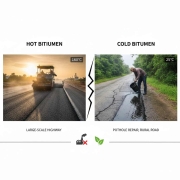
Strategic buyers monitor the Bitumen Global Price Forecast to lock in rates. Whether you are dealing with Hot and Cold Bitumen or specialized variants like Oxidized Bitumen, Bitumen Emulsion, or Cutback Bitumen, timing the market is as important as the technical spec.
Final Recommendation: Choosing the Right Grade
If your project is located in a desert climate or handles heavy industrial traffic, Bitumen 40/50 is the superior ROI choice.
- For a deeper dive into the “hard vs. soft” debate, read our Bitumen 40/50 vs 60/70 Comparison.
- If you are working in moderate climates, you may find Bitumen 60/70 more appropriate.
- For cold-weather regions, refer to our guide on Bitumen 80/100 or the Bitumen 60/70 vs 80/100 Comparison.
Unsure which path to take? Use our Simple Guide to Choosing the Right Bitumen or explore our Introduction to Types of Bitumen and Their Applications. For specialized residential needs, we also offer insights on the Best Bitumen for Roof Waterproofing.
Conclusion
Bitumen 40/50 is a high-performance paving grade for projects that require strong heat resistance, high load-bearing capacity, and long-term pavement stability. In hot climates and heavy-traffic areas, softer grades may lose stiffness quickly, causing rutting, deformation, and higher maintenance costs. With its harder penetration grade and higher softening point, Bitumen 40/50 helps asphalt maintain its structural integrity under demanding conditions.
For highways, airports, industrial roads, and other heavy-duty applications, it offers a dependable balance of performance and lifecycle value. When a project faces extreme heat and repeated heavy loads, Bitumen 40/50 is often the smarter long-term choice.
Related Articles & Bitumen Expert Guide
Bitumen Shelf Life: How production quality and storage conditions affect product durability and final performance.
Bitumen Refinery: An introduction to production unit structures and standards governing bitumen refining.
Top Bitumen Exporting Countries: A look at the global market and major players in meeting international bitumen demand.
High-Quality vs. Low-Quality Bitumen: How to avoid purchasing impure and counterfeit products through visual and technical inspections.
Best Bitumen for Roof Insulation: Selecting the right grade and type of bitumen for durable and long-lasting waterproofing.
Frequently Asked Questions
What is Bitumen 40/50 used for?
Bitumen 40/50 is commonly used for heavy-duty pavements, including highways, airport runways, port roads, industrial zones, and roads in tropical or desert climates. It is preferred where high temperatures and heavy traffic require greater pavement stiffness.
Why is Bitumen 40/50 better for hot climates?
Bitumen 40/50 has a lower penetration value and a higher softening point than softer grades. This allows it to remain more stable at elevated temperatures and reduces the risk of rutting and surface deformation.
What is the difference between Bitumen 40/50 and Bitumen 60/70?
The main difference is hardness. Bitumen 40/50 is harder and more resistant to deformation, making it better for high-load and high-heat applications. Bitumen 60/70 is slightly softer and is generally more suitable for moderate climates and standard highway conditions.
Is Bitumen 40/50 suitable for all road projects?
No. Although Bitumen 40/50 performs well in hot and heavy-traffic conditions, it may not be the best choice for colder regions where greater flexibility is needed. In such cases, softer grades like Bitumen 60/70 or Bitumen 80/100 may be more appropriate.
What makes Bitumen 40/50 resistant to rutting?
Its semi-hard penetration grade and higher softening point help the binder retain stiffness at higher service temperatures. This limits aggregate movement and improves resistance to permanent deformation under repeated traffic loads.
What quality documents should buyers request before purchasing Bitumen 40/50?
Buyers should request a Certificate of Analysis (COA), product technical data sheet (TDS), and recent quality test results, including penetration, softening point, flash point, ductility, and spot test results. These documents help verify that the material meets the required specification.
What are the common packaging options for Bitumen 40/50?
Bitumen 40/50 is usually supplied in:
- New steel drums
- Jumbo bags / bitubags
- Bulk shipments
The best option depends on shipment volume, destination, unloading facilities, and project logistics.
Can Bitumen 40/50 reduce maintenance costs?
Yes. When selected for the right climate and traffic conditions, Bitumen 40/50 can help reduce premature pavement failure, lower repair frequency, and improve the overall service life of the road. This often results in better long-term cost efficiency.
Is Bitumen 40/50 the same as Polymer Modified Bitumen?
No. Bitumen 40/50 is a standard penetration-grade bitumen, while Polymer Modified Bitumen (PMB) is enhanced with polymers to improve elasticity, fatigue resistance, and performance under more extreme conditions. PMB may be preferred for highly specialized projects.
How do I know if Bitumen 40/50 is the right grade for my project?
The right choice depends on several factors:
- Climate
- Traffic intensity
- Axle load
- Pavement structure
- Project budget
- Maintenance expectations
Global Petroleum Trade Solutions | Universal Trades
As a reputable international petroleum trading enterprise, Universal Trades specializes in the reliable procurement, export, and supply chain management of high-grade petroleum commodities, refined fuels, and industrial feedstocks designed to meet rigorous global standards.






Leave a Reply
Want to join the discussion?Feel free to contribute!