
Penetration Grade Bitumen (30/40–100/120): Technical Specifications, Refinery CoA & Export Guide
Penetration-graded asphalt cements remain the bedrock of international heavy-transport infrastructure. Designated by standard needle penetration under precise loading, thermal, and temporal parameters, these viscoelastic binders supply the structural elasticity, tensile modulus, and cohesive strength demanded by civil engineering designs.
Engineering asphalt concrete mixtures requires a strategic compromise between high-temperature shear resistance (mitigating permanent deformation and rutting under heavy axle traffic) and low-temperature thermal fatigue elasticity (preventing micro-fissuring and macro-cracking). The selection spectrum governs pavement lifecycle costs across diverse climatic zones:
Climatic & Structural Allocation Matrix:
• Hard Paving Grades (30/40 & 40/50): High-shear freight corridors, container terminals, airport aprons, and desert/arid environments with sustained ambient temperatures exceeding 40°C.
• Standard Industrial Grade (60/70): The global reference grade for national highway trunk networks, arterial expressways, and moderate-to-warm climatic regimes.
• Flexible/Low-Modulus Grades (80/100 & 100/120): Formulated for cold winter climates, high-altitude roadways, and sub-base applications where diurnal thermal swings cause severe contraction stresses.
2. Master Technical Specifications & ASTM / EN Compliance
The comparative matrix below details the standardized engineering thresholds for export-grade Middle East penetration bitumen against unified ASTM D946, ASTM D5, ASTM D36, and European EN 12591 procedures.
| Property Description | Standard Method | Bitumen 30/40 | Bitumen 40/50 | Bitumen 60/70 | Bitumen 80/100 | Bitumen 100/120 |
|---|---|---|---|---|---|---|
| Penetration @ 25°C (100g, 5s) | ASTM D5 / EN 1426 | 30 – 40 dmm | 40 – 50 dmm | 60 – 70 dmm | 80 – 100 dmm | 100 – 120 dmm |
| Softening Point (Ring & Ball) | ASTM D36 / EN 1427 | 52 – 60 °C | 50 – 58 °C | 49 – 56 °C | 45 – 52 °C | 42 – 50 °C |
| Ductility @ 25°C (5 cm/min) | ASTM D113 / EN 13589 | Min. 100 cm | Min. 100 cm | Min. 100 cm | Min. 100 cm | Min. 100 cm |
| Flash Point (Cleveland Open Cup) | ASTM D92 / EN ISO 2592 | Min. 250 °C | Min. 250 °C | Min. 232 °C | Min. 225 °C | Min. 220 °C |
| Specific Gravity @ 25°C | ASTM D70 / EN 15326 | 1.01 – 1.06 | 1.01 – 1.06 | 1.01 – 1.06 | 1.00 – 1.05 | 1.00 – 1.05 |
| Solubility in Trichloroethylene | ASTM D2042 / EN 12592 | Min. 99.0 wt% | Min. 99.0 wt% | Min. 99.0 wt% | Min. 99.0 wt% | Min. 99.0 wt% |
| Loss on Heating (163°C, 5h) | ASTM D6 / EN 12607-2 | Max. 0.2 wt% | Max. 0.2 wt% | Max. 0.2 wt% | Max. 0.5 wt% | Max. 0.5 wt% |
| Retained Penetration After TFOT | ASTM D1754 / D5 | Min. 55% | Min. 55% | Min. 52% | Min. 47% | Min. 42% |
To evaluate how structural differences and shear moduli influence project designs, review our technical breakdown on Bitumen 40/50 vs 60/70: Differences and Uses and our commercial overview of Bitumen 60/70 paving applications. For testing procedures, refer to Common Bitumen Quality Tests Every Buyer Should Know.
3. Decoding Refinery Certificates of Analysis (CoA) & Tolerances
In Middle East petroleum refining complexes, crude assay blending and vacuum distillation cuts naturally yield batch-to-batch operational variances. A Certificate of Analysis (CoA) reports the actual empirical value of a manufactured lot, whereas the contractual Technical Data Sheet (TDS) provides the allowable envelope.
For instance, an ASTM D946 compliant batch of Bitumen 60/70 may yield a penetration value of 62 dmm in Batch A and 68 dmm in Batch B. Both fall squarely within the contracted tolerance window. To examine actual refinery batch sheets, review our benchmark on Bitumen COA Sample + Typical Technical Properties (60/70, 80/100, 40/50).
Critical Quality Verification Points:
- Solubility in TCE (Min. 99.0%): Verifies absence of ash, carbonaceous coke fines, or inert mineral fillers.
- Flash Point Safety Margin: Middle East vacuum residue regularly exceeds 260°C–290°C, providing critical safety margins during hot-mix asphalt (HMA) heating at 160°C.
- Third-Party Port Inspection (SGS / Geo-Chem / Intertek): Independent survey teams perform composite sampling (ASTM D140) from shore storage tanks prior to loading, verifying mass, volume, and specifications for irrevocable LC drawdown.
4. Packaging, Logistics & Export Infrastructure in the Middle East
Export economics depend heavily on payload efficiencies and handling capabilities at the destination terminal. Detailed operational calculations can be explored in our Bitumen Packaging Guide: New Steel Drums, Jumbo Bags, or Bulk?.
Key Packaging Formats:
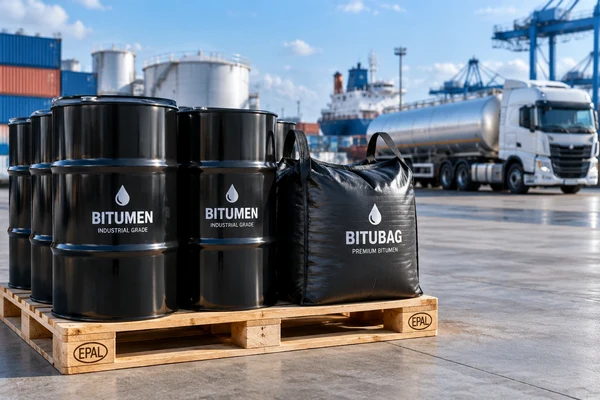
- New Cold-Rolled Steel Drums (150 kg, 180 kg, 240 kg): The standard for global transshipment. Standard 20ft dry containers accommodate 80 to 110 drums (~15 to 19.8 MT net), depending on shipping line gross mass limits and port axle-weight regulations.
- Poly Jumbo Bags / Bitubags (300 kg & 1,000 kg): Multi-layer woven polypropylene bags engineered with a meltable inner liner. These reduce tare mass and optimize freight to roughly 20–22 MT net per 20ft container.
- Bulk Bitumen Vessels & ISO Tank Containers: Equipped with internal thermal oil or direct flame heating coils for direct discharge into shore terminal tanks.
Preventing Drum Leakage in Tropical Marine Transit:
Solar radiation in Persian Gulf and Red Sea shipping routes can elevate container interior temperatures above 60°C, causing hydraulic expansion of the bitumen. Universal Trades enforces an engineered 2–3% ullage (headspace), uses cold-rolled steel drums with tight seams, and applies heat-resistant bung gaskets. Learn more in our troubleshooting guide on Why Bitumen Drums Leak During Export (Causes and Prevention Methods).
5. Commercial Terms & Procurement Playbook (Universal Trades Standards)
Universal Trades executes bulk and containerized petroleum cargo operations under established international trading conventions:
- Minimum Order Quantity (MOQ): 100 Metric Tons (MT) (~5 × 20ft FCLs).
- Incoterms: FOB Persian Gulf (Bandar Abbas, Jebel Ali, Hamriyah), CFR/CIF major global container terminals, or CPT overland border hubs.
- Shipping Documentation: Full clean on-board Ocean Bill of Lading (3/3), Commercial Invoice, Detailed Packing List, Certificate of Origin (COO), and Independent SGS/Geo-Chem Inspection Certificate.
6. Frequently Asked Questions (FAQ)
What is the acceptable tolerance for penetration variation on a refinery CoA?
A delivered lot complies with contractual terms as long as the independent surveyor’s results fall within the specified ASTM/EN range (e.g., 60–70 dmm for 60/70). Small variances of 1–2 dmm between laboratories represent normal ASTM D5 repeatability margins rather than material non-compliance.
What is the standard production and loading lead time for a 100 MT order?
Standard 100 MT orders packed in new steel drums require approximately 7 to 14 business days from financial instrument confirmation to container gate-in at the terminal. Specialized packaging or bulk vessels require 14 to 21 business days.
How do ocean freight economics compare between Steel Drums and Jumbo Bags?
Jumbo Bags reduce tare weight, allowing up to 20–22 MT of net cargo per 20ft container compared to 16–19.8 MT for drummed cargo. This lowers per-ton ocean freight costs, provided the discharge destination operates adequate decanting/melting equipment.
Can Penetration Bitumen 60/70 directly substitute 80/100 in ongoing road works?
Substitution requires consultant approval and mix redesign. Bitumen 60/70 provides higher load stability and rutting resistance in warm climates, but offers less flexibility in cold conditions, which may increase cracking risk if the aggregate gradation is not adjusted.
Procure Middle East Export-Grade Bitumen (MOQ: 100 MT)
Universal Trades supplies civil engineering contractors, government authorities, and trading partners worldwide with certified Penetration Grade Bitumen (30/40, 40/50, 60/70, 80/100, 100/120).
- Flexible Packaging: New Steel Drums (150/180/240 kg), Jumbo Bags (300/1000 kg), or Bulk
- Verified Quality: 100% third-party batch inspection (SGS / Geo-Chem)
- Global Delivery: FOB Persian Gulf | CIF Worldwide Ports
Global Petroleum Trade Solutions | Universal Trades
As a reputable international petroleum trading enterprise, Universal Trades specializes in the reliable procurement, export, and supply chain management of high-grade petroleum commodities, refined fuels, and industrial feedstocks designed to meet rigorous global standards.











Leave a Reply
Want to join the discussion?Feel free to contribute!