
Bitumen 60/70 vs. 80/100: The Ultimate Comparison for Paving
In the world of road construction and infrastructure, choosing the right binder is the difference between a highway that lasts decades and one that crumbles in seasons. Among the various grades available, Bitumen 60/70 and Bitumen 80/100 are the global industry standards.
Understanding the Introduction to types of bitumen and their uses is the first step for any contractor or importer. These numbers aren’t just arbitrary; they represent the “penetration grade,” a measure of the bitumen’s hardness and consistency.
The Science of Penetration: What the Numbers Mean
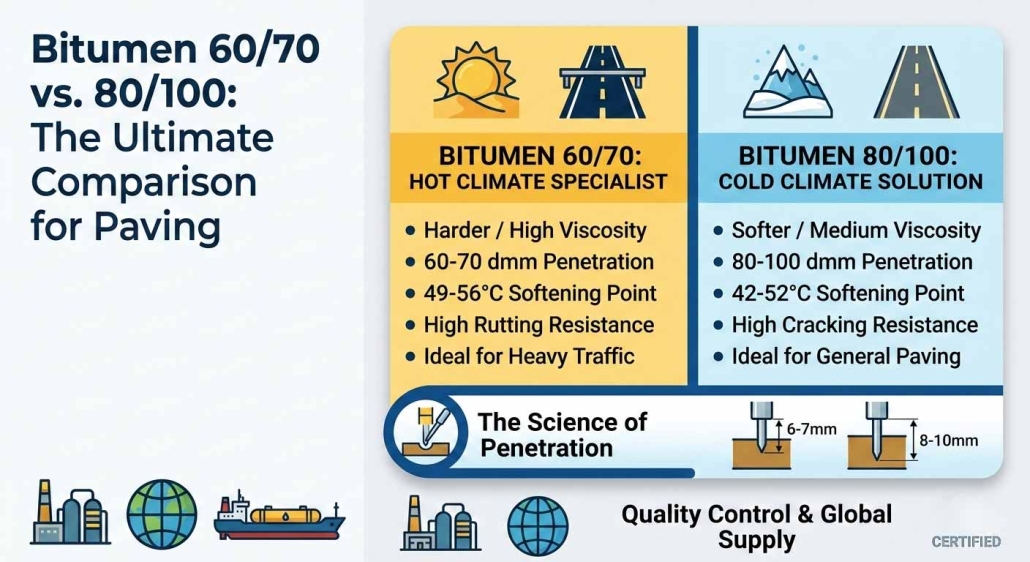
Before diving into the comparison, we must understand the penetration test. A standard needle is allowed to penetrate a bitumen sample for 5 seconds at 25°C.
-
Bitumen 60/70: The needle penetrates between 6 and 7 millimeters (60-70 decimillimeters).
-
Bitumen 80/100: The needle penetrates between 8 and 10 millimeters (80-100 decimillimeters).
The logic is simple: The lower the number, the harder the bitumen. The higher the number, the softer and more flexible the material.
Bitumen 60/70 vs. 80/100: Quick Comparison Table
| Feature | Bitumen 60/70 | Bitumen 80/100 |
| Consistency | Harder / High Viscosity | Softer / Medium Viscosity |
| Penetration Value | 60 – 70 dmm | 80 – 100 dmm |
| Softening Point | 49 – 56 °C | 42 – 52 °C |
| Ideal Climate | Hot / Tropical | Cold / Temperate |
| Traffic Load | Heavy / High Volume | General / Moderate |
| Resistance | High Rutting Resistance | High Cracking Resistance |
Deep Dive: Bitumen 60/70 (The “Hot Climate” Specialist)
Bitumen 60/70 is a semi-hard penetration grade bitumen used as a paving grade binder. It is primarily produced during the bitumen production process at a bitumen refinery by the air-blowing of vacuum bitumen.
Where is Bitumen 60/70 used?
-
High-Traffic Highways: Because of its hardness, it provides superior stability under heavy axle loads.
-
Tropical Regions: In areas with high ambient temperatures, 60/70 maintains its stiffness and prevents “bleeding” or softening of the asphalt.
-
Rutting Prevention: It is the go-to choice to prevent permanent deformation in pavement surfaces subjected to intense heat and weight.
Deep Dive: Bitumen 80/100 (The “Cold Climate” Solution)
Bitumen 80/100 is a softer grade. While it shares a similar origin in the refinery alongside other petroleum products like gasoline, diesel, kerosene, and base oil, its physical properties serve a different niche.
What is Bitumen 80/100 used for?
-
Cold & Temperate Regions: Its softer nature allows the road surface to expand and contract without breaking.
-
Crack Prevention: In freezing temperatures, harder bitumen becomes brittle and snaps. 80/100 remains flexible, absorbing the thermal stress.
-
General Paving: It is widely used for local roads, airfields, and residential streets where traffic loads are moderate.
Note: Some regions also utilize natural bitumen to enhance the properties of these refinery grades, depending on the specific project requirements.
The Verdict: Which Type of Bitumen is Better?
There is no “better” grade; there is only the “right” grade for your environment.
-
Choose 60/70 if: You are building a highway in a desert or tropical region (e.g., Middle East, Africa) where summer temperatures exceed 40°C.
-
Choose 80/100 if: You are paving in a region with harsh winters or significant temperature fluctuations (e.g., Central Asia, parts of Europe) to avoid thermal cracking.
Quality Control and Global Supply
When sourcing materials from the Burner of bitumen producing countries, quality is paramount. A comparison of quality and poor quality bitumen shows that impurities like sulfur levels or improper vacuum distillation can lead to premature road failure. Always ensure your supplier provides a valid analysis report (COA) confirming the penetration and softening points.
Frequently Asked Questions (FAQ)
1. Can I use Bitumen 80/100 in a hot desert climate?
It is not recommended. In high heat, 80/100 becomes too soft, leading to severe rutting and “bleeding,” where the bitumen rises to the surface, making the road slippery and unstable.
2. What are the main types of bitumen?
The primary categories include Penetration Grade (like 60/70), Viscosity Grade (VG-30, VG-40), Cutback Bitumen, Emulsions, and Oxidized Bitumen.
3. Is there a price difference between 60/70 and 80/100?
Generally, the price difference is minimal as they come from the same distillation process. However, local demand and availability in specific refining hubs may cause slight fluctuations.
4. How does the production of bitumen affect other fuel outputs?
Bitumen is the “bottom of the barrel.” Efficiently producing high-quality bitumen requires a balance in the refinery output of lighter ends like gasoline and diesel.
Global Petroleum Trade Solutions | Universal Trades
As a reputable international petroleum trading enterprise, Universal Trades specializes in the reliable procurement, export, and supply chain management of high-grade petroleum commodities, refined fuels, and industrial feedstocks designed to meet rigorous global standards.




Leave a Reply
Want to join the discussion?Feel free to contribute!