
Simple Guide to Choosing the Right Bitumen + Comparison Table
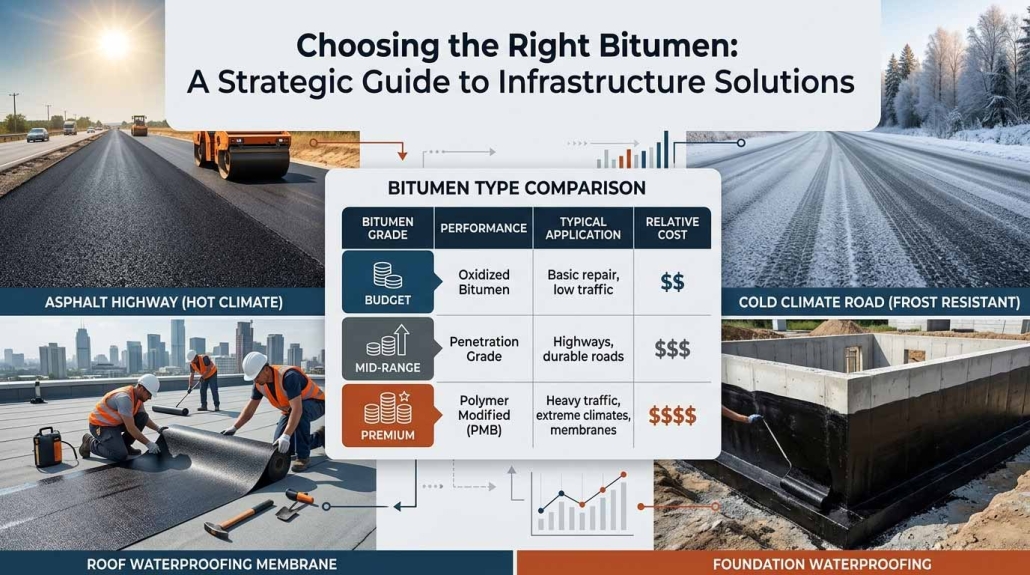
Choosing the right type of bitumen is one of the most important decisions in construction, road engineering, and waterproofing projects. Different environmental conditions, traffic loads, and application methods require specific bitumen grades to ensure durability, performance, and cost efficiency. Selecting the wrong type can lead to premature pavement failure, poor waterproofing performance, and higher maintenance costs.
In this guide, we explain how to choose the appropriate bitumen for different applications in simple terms. You will also find a practical comparison table and clear recommendations for budget, mid‑range, and premium bitumen options depending on project requirements.
Bitumen Selection Guide (Comparison Table)
| Application / Project Need | Budget-Friendly Option | Mid-Range Option | Premium / Long-Life Option |
| Asphalt for hot, high-traffic regions | Bitumen 60/70 | Polymer Modified Bitumen (PMB) | High-performance PMB |
| Asphalt for cold or low-traffic regions | Bitumen 80/100 | Bitumen 70/100 | Polymer Modified Bitumen |
| Roof waterproofing in moderate climates | Oxidized Bitumen 85/25 | Oxidized Bitumen 90/15 | Polymer Modified Waterproofing Bitumen |
| Roof waterproofing in hot climates with high UV exposure | Oxidized Bitumen | Polymer Modified Bitumen | APP/SBS Modified Bitumen |
| Waterproofing indoor pools or shaded environments | Cutback Bitumen | Emulsified Bitumen | Polymer Modified Waterproofing Bitumen |
| Industrial waterproofing and foundations | Oxidized Bitumen | Emulsified Bitumen | Polymer Modified Bitumen
|
| Road maintenance and surface treatment | Cutback Bitumen | Emulsified Bitumen | Polymer Modified Emulsion |
Asphalt Production for Hot and High‑Traffic Regions
In hot climates with heavy traffic loads, the asphalt binder must resist deformation and rutting. A cost‑effective choice is bitumen grade 60/70, which provides reasonable performance for many road construction projects.
A mid‑range option is polymer modified bitumen (PMB), which improves elasticity and resistance to high temperatures. This option is commonly used in highways and urban roads where traffic density is high. For projects requiring maximum durability and long service life, high‑performance PMB is the best solution. The polymer modification enhances flexibility, resistance to cracking, and overall pavement lifespan.
Asphalt for Cold or Low‑Traffic Areas
Cold regions require bitumen that maintains flexibility at low temperatures. Bitumen 80/100 is often the most economical solution for roads with limited traffic. A balanced option is bitumen 70/100, which provides improved resistance to temperature changes and moderate traffic loads. For demanding climates or roads that experience freeze‑thaw cycles, polymer modified bitumen offers the best durability and crack resistance.
Roof Waterproofing Under Different Climate Conditions
For roof insulation projects, oxidized bitumen (such as 85/25) is usually the most affordable option and works well in moderate climates. A mid‑range solution is oxidized bitumen 90/15, which offers better durability and improved resistance to heat and environmental exposure.
For long‑term waterproofing and extreme climates, **polymer modified bitumen membranes** provide superior flexibility, UV resistance, and longer service life.
Waterproofing Indoor Pools and Shaded Environments
Indoor pools, basements, and shaded areas typically experience minimal UV exposure but high humidity. Cutback bitumen is often the most cost‑effective waterproofing solution for these environments.
A mid‑range option is emulsified bitumen, which is easier to apply and safer due to its water‑based composition.
For maximum performance and durability, **polymer modified waterproofing bitumen** provides excellent adhesion and long‑lasting moisture protection.
Industrial Waterproofing and Foundation Protection
Foundations, tunnels, and underground structures require strong moisture resistance. Oxidized bitumen offers a cost‑effective basic solution.
A mid‑range alternative is bitumen emulsions, which provide easier application and good adhesion to concrete surfaces.
For critical infrastructure projects, polymer modified bitumen systems offer the highest durability and resistance to environmental stress.
Practical Tips for Choosing Bitumen
When selecting bitumen for any project, consider the following factors:
- Climate conditions: Temperature extremes can significantly affect bitumen performance.
- Traffic load:Roads with heavy traffic require stronger and more elastic binders.
- Application method: Some bitumen types are easier and safer to apply.
- Project lifespan: Premium bitumen may cost more initially but reduce long‑term maintenance costs.
Understanding the types of bitumen and their properties helps engineers and contractors choose the best option for their projects.
Related Topics for Further Reading
To gain a deeper understanding of the bitumen industry, you may also explore:
- Bitumen uses
- Bitumen price forecast
- Bitumen packaging
- Top bitumen producing countries
- Hot bitumen vs cold bitumen
- Bitumen refineries
- Natural bitumen
- Bitumen production
- Emulsified bitumen
- Types of bitumen
Conclusion
Selecting the right bitumen depends on several factors including climate, traffic load, and application type. While standard penetration grade bitumen may be suitable for many projects, polymer modified bitumen and specialized products offer better durability and performance in demanding environments. By carefully evaluating project requirements and balancing cost with long‑term performance, engineers and contractors can significantly improve the lifespan and reliability of roads, roofs, and waterproofing systems.
Frequently Asked Questions (FAQ)
What is the most commonly used bitumen grade?
Penetration grade bitumen such as 60/70 and 80/100 are among the most widely used grades for road construction worldwide.
Which bitumen is best for waterproofing?
Oxidized bitumen is commonly used for waterproofing, whilen polymer modified bitumen provides the highest durability and flexibility.
What is the difference between hot bitumen and cold bitumen?
Hot bitumen requires heating before application, while cold bitumen products such as emulsions and cutbacks can be applied at lower temperatures.
Is polymer modified bitumen worth the higher cost?
Yes. Although it is more expensive initially, it often provides longer service life, better resistance to temperature changes, and reduced maintenance costs.
How does climate affect bitumen selection?
Temperature extremes can cause bitumen to soften or crack. Choosing the correct grade ensures proper performance in both hot and cold climates.
Global Petroleum Trade Solutions | Universal Trades
As a reputable international petroleum trading enterprise, Universal Trades specializes in the reliable procurement, export, and supply chain management of high-grade petroleum commodities, refined fuels, and industrial feedstocks designed to meet rigorous global standards.







Leave a Reply
Want to join the discussion?Feel free to contribute!