
Bitumen 80/100: Specification and Uses

What Is Bitumen 80/100?
Bitumen 80/100 is a standard penetration grade bitumen widely used in asphalt production, road construction, pavement layers, and selected waterproofing and industrial applications. The grade number 80/100 refers to its penetration value at 25°C, which means the material is softer than grades such as 60/70 and 40/50.
In practical terms, this softer consistency makes Bitumen 80/100 a suitable choice for moderate to relatively cold climates, where pavement flexibility is important and the binder must better tolerate temperature-related movement without becoming too brittle.
For buyers, contractors, and asphalt engineers, Bitumen 80/100 is often considered a balanced paving binder when the project needs workable viscosity, good ductility, and reliable performance in less extreme heat conditions. It is also a useful reference point when comparing other most widely used bitumen grades or reviewing a broader introduction to types of bitumen and their applications.
Bitumen 80/100 Meaning: What Does the Grade Number Show?
The term Bitumen 80/100 comes from the penetration grading system. In this system, a standard needle is allowed to penetrate the bitumen sample under controlled test conditions. If the penetration falls between 80 and 100 dmm at 25°C, the binder is classified as Bitumen 80/100.
This number matters because it helps explain the relative hardness of the material:
- Higher penetration value = softer bitumen
- Lower penetration value = harder bitumen
That is why Bitumen 80/100 is softer than Bitumen 60/70 and significantly softer than Bitumen 40/50.
This grading approach remains highly relevant for buyers comparing paving binders, reviewing a simple guide to choosing the right bitumen, or evaluating the best grade for local climate and traffic conditions.
Why Bitumen 80/100 Is Softer Than 60/70
The main difference between Bitumen 80/100 and Bitumen 60/70 is hardness. Bitumen 80/100 allows deeper needle penetration during the standard test, which indicates a softer and more flexible binder.
This matters in field performance:
- Bitumen 80/100 offers greater flexibility and better tolerance to thermal movement.
- Bitumen 60/70 is stiffer and generally performs better in hotter climates and under heavier traffic loads.
- Bitumen 40/50 is harder still, making it more resistant to deformation but less flexible in colder conditions.
If your project involves climate-sensitive paving decisions, this distinction is essential. It is also useful to review a dedicated comparison of bitumen 60/70 and 80/100 or a separate comparison of bitumen 40/50 and 60/70 to understand the full grading range.
Bitumen 80/100 Technical Specifications Table
| Property | Test Method | Typical Specification |
|---|---|---|
| Density at 25°C | ASTM D70 / D3289 | 1000–1050 kg/m³ |
| Penetration at 25°C | ASTM D5 | 80–100 dmm |
| Softening Point | ASTM D36 | 45–52°C |
| Ductility at 25°C | ASTM D113 | 100 cm minimum |
| Loss on Heating | ASTM D6 | 0.5% maximum |
| Drop in Penetration after Heating | ASTM D5 | 20% maximum |
| Flash Point | ASTM D92 | 232°C minimum |
| Solubility in Trichloroethylene | ASTM D2042 | 99.0% minimum |
| Spot Test | A.A.S.H.O. T102 | Negative |
| Viscosity at 60°C | ASTM D2171 | 1000 ± 200 P |
| Viscosity at 135°C | ASTM D2170 | 250 cSt minimum |
What These Properties Mean in Real Performance
A technical table is useful, but engineers and buyers also need to know what the values mean in real-world applications.
Penetration: 80–100
This confirms the binder is relatively soft. It can provide better flexibility than harder grades, which is often beneficial in cooler climates and pavement layers exposed to thermal contraction.
Softening Point: 45–52°C
This range shows the temperature at which bitumen begins to soften significantly. Since this value is moderate, Bitumen 80/100 is not usually the first choice for extremely hot environments with severe loading.
Ductility: 100 cm minimum
High ductility means the binder can stretch without breaking easily. This helps the material tolerate movement and minor stress, which is important in reducing crack-related problems. It also connects well with broader discussions on the causes of asphalt cracking.
Density: 1000–1050 kg/m³
Density is useful for handling, volume calculations, storage planning, and mix design estimations. It can also affect logistics and export planning.
Viscosity at 60°C and 135°C
Viscosity influences pumping, mixing, coating behavior, and application temperature control. For producers of bitumen emulsion, cutback bitumen, or polymer modified bitumen, viscosity-related behavior is particularly important.
Flash Point: 232°C minimum
A higher flash point supports safer heating and handling practices. hazard concerns are more related to temperature, fumes, and handling conditions than to classification as a dangerous product.
Solubility: 99.0% minimum
This is a purity indicator. High solubility generally suggests the binder is relatively free of unwanted mineral impurities and consistent in composition.
Loss on Heating and Retained Penetration
These values help assess how the bitumen behaves after heating. They matter because overheating or poor process control can change binder performance and reduce quality.
Bitumen 80/100 vs 60/70 vs 40/50
Choosing the right bitumen grade is not only about specifications. It is about matching the grade to climate, pavement design, traffic, and performance expectations.
Comparison Table: Bitumen 80/100, 60/70, and 40/50
| Factor | Bitumen 80/100 | Bitumen 60/70 | Bitumen 40/50 |
|---|---|---|---|
| Penetration Range | 80–100 | 60–70 | 40–50 |
| Relative Hardness | Soft | Medium | Hard |
| Flexibility | High | Moderate | Lower |
| Stiffness | Lower | Moderate | High |
| Softening Point | Lower to moderate | Moderate | Higher |
| Viscosity | Lower than 60/70 and 40/50 | Moderate | Higher |
| Climate Suitability | Moderate to cold climates | Warm to moderate climates | Hot climates |
| Traffic Suitability | Light to moderate traffic | Moderate to heavy traffic | Heavy traffic / high stress |
| Cracking Resistance | Better flexibility in colder conditions | Balanced | Lower flexibility in cold conditions |
| Rutting Resistance | Lower than harder grades | Better than 80/100 | Best among the three |
| Common Use Cases | Flexible paving, base and wearing courses in cooler areas | General road construction | Roads with high temperature and deformation risk |
Practical Interpretation
- Choose Bitumen 80/100 when flexibility is a priority and the climate is not extremely hot.
- Choose Bitumen 60/70 when you need a more balanced binder for mainstream road construction.
- Choose Bitumen 40/50 when higher stiffness and deformation resistance are more important than flexibility.
For a deeper grade-selection process, users may also benefit from reading simple guide to choosing the right bitumen and most widely used bitumen grades.

Applications of Bitumen 80/100
Bitumen 80/100 is mainly used for:
- road construction projects in cold regions,
- asphalt mixes,
- base and wearing courses,
- bitumen emulsion production,
- cutback bitumen production,
- modified bitumen applications.
Common Practical Uses
1. Road Construction
This is the primary application. Bitumen 80/100 is widely used in paving projects where a softer binder is needed for flexibility and workable asphalt production.
2. Asphalt Mix Manufacturing
It is suitable for hot mix asphalt in conditions where excessive stiffness may increase cracking risk.
3. Surface and Wearing Courses
In properly designed pavement systems, this grade can be used for upper layers where flexibility and adhesion are needed.
4. Waterproofing and Industrial Uses
Although primarily a paving grade, Bitumen 80/100 may also be referenced in broader construction and petroleum discussions alongside oxidized bitumen, bitumen emulsion, cutback bitumen, and best bitumen for roof waterproofing.
5. Feedstock for Other Bituminous Products
This grade may be used in the manufacture of other products depending on process design, specification targets, and local standards.
If your website has a broader educational section, it is also wise to connect this article to a more general bitumen applications page and a guide to petroleum products.
Bitumen 80/100 by Climate and Project Type
The climate-performance relationship is one of the most important reasons users search for this grade.
| Project Condition | Suitability of Bitumen 80/100 |
|---|---|
| Cold climate paving | High suitability |
| Moderate climate road construction | Good suitability |
| Extremely hot climate pavement | Less ideal than harder grades |
| Heavy traffic highways in hot zones | Usually better to consider 60/70 or 40/50 |
| Base and wearing course asphalt | Commonly suitable, depending on design |
| General-purpose asphalt in flexible systems | Suitable |
This is also where internal educational support helps. For example, users comparing thermal performance may also need articles on hot and cold bitumen and causes of asphalt cracking.
Packaging, Storage, and Supply Options
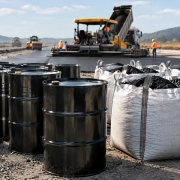
- Bulk
- New steel drums: 150 kg
- New steel drums: 185 kg
- Polybag
Choosing the Right Packaging
The packaging method depends on:
- order volume,
- destination,
- discharge facilities,
- storage capability,
- shipping cost,
- handling preferences.
Bulk is often more economical for large-volume industrial users, while drum packing is widely used in export trade. Polybag solutions may be preferred in some logistics scenarios.
This section is a natural place to link to types of bitumen packaging and also to discuss operational issues such as causes of leakage in export bitumen drums.
Storage Considerations
Good storage practice includes:
- avoiding overheating,
- preventing contamination,
- using clean tanks or containers,
- maintaining safe heating procedures,
- protecting packaged material from damage during loading and unloading.
Buyers concerned about storage duration may also want to review bitumen shelf life.

Quality Factors and Bitumen 80/100 Testing
Not all Bitumen 80/100 available in the market performs equally well. Buyers should pay attention to both specification compliance and consistency from batch to batch.
Key Quality Indicators
When evaluating supply, check:
- penetration range,
- softening point,
- ductility,
- viscosity,
- flash point,
- solubility,
- heating stability,
- batch consistency,
- packaging integrity.
Why Testing Matters
Poor-quality bitumen can lead to:
- premature rutting,
- poor aggregate coating,
- lower durability,
- storage problems,
- application difficulties,
- increased cracking risk.
That is why professional buyers usually request:
- a technical data sheet,
- a certificate of analysis,
- QC documentation,
- pre-shipment inspection if necessary.
This is the best place to connect to bitumen quality test, bitumen certificate of analysis sample, and differences between high-quality and low-quality bitumen.
Safety and Handling Notes
the product is not classified as dangerous under the referenced regulatory frameworks, but handling risks still exist, especially at elevated temperatures.
It also mentions that hazards can be associated with:
- hot material,
- fumes,
- dust generated from cutting or drilling hardened asphalt,
- possible respirable crystalline silica exposure depending on aggregate type.
This information is especially useful for contractors, HSE personnel, and industrial buyers who need more than a basic supplier page.
How to Choose the Right Bitumen Grade
If you are deciding whether Bitumen 80/100 is the correct grade, ask the following:
1. What is the climate?
For colder or moderate climates, Bitumen 80/100 may be a better option than harder grades.
2. How heavy is the traffic?
For heavy traffic and hot zones, 60/70 or 40/50 may offer better rutting resistance.
3. What is the application?
Road paving, asphalt production, industrial use, or conversion into other bituminous products may each require different performance priorities.
4. What standards must be met?
Always align the grade with project specifications, local regulations, and client requirements.
5. What is the supply format?
Choose between bulk, drums, or polybag based on logistics and unloading capability.
A helpful internal reference here would be simple guide to choosing the right bitumen and bitumen production process for users who want to understand how refinery and process factors affect the final grade. You can also support buyer education with pages on bitumen refinery and top bitumen exporting countries.
Bitumen 80/100 Price: What Actually Affects It?
Users often search for Bitumen 80/100 price, but the answer depends on several commercial factors:
- crude oil and feedstock trends,
- refinery supply,
- packing type,
- order volume,
- destination port,
- freight cost,
- inspection requirements,
- payment terms,
- seasonal demand.
Rather than showing a fixed price in evergreen content, it is usually better to explain the pricing logic and direct users to your latest quotation or market page. This section can naturally link to global bitumen price forecast.
Frequently Asked Questions
What is Bitumen 80/100 used for?
Bitumen 80/100 is mainly used in road construction, asphalt mixes, paving works, base and wearing courses, and in some cases as feedstock for products such as bitumen emulsion, cutback bitumen, and modified bitumen.
What does Bitumen 80/100 mean?
It refers to the penetration grade of the bitumen. The number indicates that the penetration value at 25°C falls between 80 and 100 dmm, which means the bitumen is softer than 60/70 and 40/50.
Is Bitumen 80/100 suitable for cold climates?
Yes. Because it is softer and more flexible than harder penetration grades, it is generally more suitable for moderate to cold climate conditions.
What is the softening point of Bitumen 80/100?
the softening point is 45–52°C.
What is the density of Bitumen 80/100?
The density is 1000–1050 kg/m³ at 25°C What is the viscosity of Bitumen 80/100?
- Viscosity at 60°C: 1000 ± 200 P
- Viscosity at 135°C: 250 cSt minimum
What packaging is available for Bitumen 80/100?
- bulk,
- new steel drums of 150 kg,
- new steel drums of 185 kg,
- polybag.
Which is better: Bitumen 80/100 or 60/70?
Neither is universally better. Bitumen 80/100 is better where more flexibility is needed, especially in cooler climates. Bitumen 60/70 is generally better for warmer climates and heavier traffic conditions.
Is Bitumen 80/100 good for waterproofing?
It can be referenced in certain waterproofing-related contexts, but the best product depends on the application. For specialized waterproofing, users should also review best bitumen for roof waterproofing and related product types such as oxidized bitumen.
How can buyers check Bitumen 80/100 quality?
Buyers should review the technical data sheet, certificate of analysis, lab test results, batch consistency, and packaging condition before shipment.
Global Petroleum Trade Solutions | Universal Trades
As a reputable international petroleum trading enterprise, Universal Trades specializes in the reliable procurement, export, and supply chain management of high-grade petroleum commodities, refined fuels, and industrial feedstocks designed to meet rigorous global standards.









Leave a Reply
Want to join the discussion?Feel free to contribute!