
What are the types of bitumen and their uses?

Bitumen, also known as asphalt binder, is a dark, sticky, highly viscous, and semi-solid form of petroleum products. It’s primarily used in road construction, roofing, and sealing applications. This essential material is obtained as a residue during the fractional distillation of crude oil, typically after the extraction of lighter fractions like gasoline, kerosene, and diesel and base oil. Understanding the different bitumen types and their specific properties is crucial for selecting the best type of bitumen for any construction project.
Bitumen Types and Grades
Bitumen is categorized based on its method of production, physical properties, and intended application. The main types include:
-
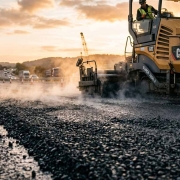
Paving Grade Bitumen (Bitumen Cement): This is the most common type, defined by its physical properties like penetration or viscosity. It’s the primary binder used in flexible road asphalt layers. Bitumen is used for mixing with aggregates to produce hot mix asphalt (HMA).
-
Oxidized Bitumen (Blown Bitumen): Also known as industrial bitumen.
-
Emulsion Bitumen: A mixture of fine bitumen droplets dispersed in water.
-
Cutback Bitumen: Bitumen dissolved in a solvent to reduce its viscosity.
-
Natural Bitumen: Found in natural deposits.

Oxidized Bitumen (Blown Bitumen) and Grading Systems
Oxidized bitumen (blown bitumen) is produced by blowing air through the hot petroleum products residue, altering its chemical structure. This process increases the softening point and reduces the penetration value, making it harder and less susceptible to temperature changes. Bitumen is used for industrial applications where a higher softening point is required.
Viscosity Grading (VG) Bitumens
Viscosity grading classifies bitumen based on its absolute viscosity at 60 degrees Celsius. This system is commonly used for paving bituminous concrete. Bitumen is used for road construction, with specific grades chosen based on climate and traffic:
| Grade | Viscosity at 60∘C (Poise) | Typical Application |
| VG 10 | 800 to 1200 | Light traffic/cold climates. |
| VG 20 | 1600 to 2400 | Medium traffic/moderate climates. |
| VG 30 | 2400 to 3600 | Heavy traffic/hot climates. Bitumen is used for high-stress pavements. |
| VG 40 | 3200 to 4800 | Very heavy traffic/extremely hot climates. |
Performance Grading (PG) Bitumens
Performance Grade (PG) bitumen is classified based on the temperature range over which it performs effectively, minimizing distress like rutting and thermal cracking.
-
PG 46-28: This grade can withstand a high pavement temperature of 46 ∘C and a low pavement temperature of -28∘C. It is suitable for moderate-to-cold climates with less extreme high temperatures.
-
PG 46-22: This grade is suitable for moderate climates where the lowest temperature does not drop below –22∘C.
C-Group (Penetration) Bitumen
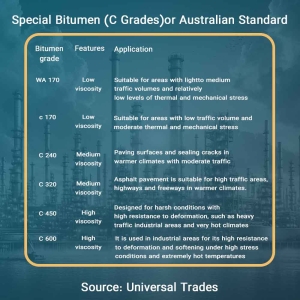
Penetration grade bitumens (C-Group) are classified based on their penetration value (hardness) measured at 25 degrees Celsius : C170, C240, C320, C450, and C600. The higher the numerical grade, the softer the bitumen.
These grades are used for asphalt preparation in various temperature zones; generally, the softer grades are more suitable for paving projects in colder climates.
Emulsion and Cutback Bitumens
Emulsion Bitumen
Emulsion bitumen is an environmentally friendly alternative produced by dispersing bitumen in water with an emulsifying agent. It allows application at lower temperatures.
-
Cationic Emulsion Bitumens (QS, MS, SS): These have positively charged droplets and are the most common type. Bitumen is used for tack coats (SS-1, SS-1h) and chip sealing (MS, QS).
-
Anionic Emulsion Bitumens (QS, MS, SS): These have negatively charged droplets.
Cutback Bitumen
Cutback bitumen is created by blending bitumen with a volatile solvent derived from petroleum products like naphtha or kerosene. Bitumen is used for prime coats and patch sealing in remote areas.
-
Rapid Curing (RC): Uses gasoline or naphtha (highly volatile). Bitumen is used for surface treatment where quick setting is needed.
-
Medium Curing (MC): Uses kerosene (moderate volatility). Bitumen is used for mixing with aggregates in maintenance work.
-
Slow Curing (SC): Uses diesel base oil or lubricating oil (low volatility). this type of Bitumen is used for dust palliatives and stockpile mixes.
Natural Bitumen vs. Petroleum Bitumen
| Comparison | Natural Bitumen | Petroleum Bitumen |
| Source | Found in natural deposits (e.g., lakes, rock). | Residue from crude oil distillation (bitumen production process). |
| Composition | Contains mineral matter, sulfur, and metals. | Primarily hydrocarbons, very low mineral content. |
| Difference | Generally harder, more brittle, and has a lower purity. | Purer, more consistent quality, and controlled properties. |
Bitumen is used for historical paving and specialized applications when natural bitumen is sourced.
Uses of Bitumen and Most Common Types
The versatility of bitumen makes it indispensable in construction. this type of Bitumen is used for a wide range of applications:
-
Road Construction and Paving (Asphalt): The vast majority of paving grade bitumen cement is consumed here. VG 30 and VG 40 are the most commonly used in hot mix asphalt for heavy-duty roads in hot climates.
-
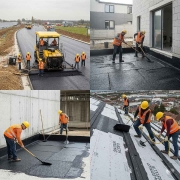
Roofing: Oxidized bitumen is used for waterproofing membranes and roofing felt.
-
Sealing and Waterproofing: Emulsion bitumen and cutbacks are used for protective coatings, pipe coating, and moisture barriers.
-
Insulation: Bitumen is used for soundproofing and electrical insulation compounds.
Problems with Poor Quality Bitumen
Using poor quality bitumen can lead to significant infrastructure failures, including:
-
Premature Rutting: Permanent deformation under traffic loads due to low high-temperature performance (e.g., not meeting the required PG or VG standard).
-
Cracking: Thermal or fatigue cracking due to low low-temperature performance or brittleness.
-
Stripping: Loss of adhesion between the bitumen and aggregates due to moisture sensitivity.
Suitable Alternatives to Bitumen
While bitumen is dominant, several alternatives exist, often addressing environmental concerns or specialized performance needs.
| Alternative | Advantages | Disadvantages |
| Polymer Modified Bitumen (PMB) | Increased elasticity, reduced rutting, better temperature tolerance. | Higher cost, complex bitumen production process. |
| Bio-Binders (from Lignin, Vegetable Oils) | Renewable, lower carbon footprint. | Variable properties, limited long-term performance data, potential odor. |
| Concrete Pavement | Very long service life, high load-bearing capacity. | Higher initial cost, rigid, difficult repair, not flexible for settling ground. |
Bitumen, Asphalt, and Tar: What’s the Difference?
-
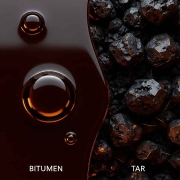
Bitumen: The black, sticky hydrocarbon binder derived from petroleum. It’s the ingredient.
-
Asphalt: In the U.S., “asphalt” is often used interchangeably with “bitumen cement.” Globally, asphalt (or asphalt concrete) is the final road-paving material—a mixture of bitumen binder and mineral aggregate.
-
Tar: A thick, dark liquid produced by the destructive distillation of organic matter (like coal or wood), not petroleum. Tar has different chemical properties and is rarely used in modern road construction due to health concerns and inferior performance compared to bitumen.
Conclusion
Specialized Articles About Bitumen:
Laboratory Properties of Bitumen | Introduction to the Laboratory and Technical Parameters of Bitumen and Their Applications
Why Do Export Bitumen Drums Leak? | Causes of bitumen drum leakage and methods to prevent leakage during export and import.
Causes of Asphalt Cracking | Main reasons for asphalt cracking and effective methods for prevention and repair.
Bitumen 40/50 vs 60/70 Comparison | Comparison of applications, characteristics, advantages, and disadvantages of 40/50 and 60/70 bitumen grades.
Bitumen 60/70 vs 80/100 Comparison | Comparison of applications, properties, advantages, and disadvantages of 60/70 and 80/100 bitumen grades.
CRS-2 Emulsified Bitumen | Introduction to CRS-2 bitumen, its features, and applications
PG 64-22 Bitumen | Introduction to PG 64-22 bitumen, its features, applications, and advantages
VG 40 Bitumen | Introduction to VG 40 bitumen, its features, applications, and key strengths
VG 30 Bitumen | Introduction to VG 30 bitumen, its features, and applications
Oxidized Bitumen 90/15 | Introduction to 90/15 bitumen, its features, and applications
Oxidized Bitumen 85/25 | Introduction to 85/25 bitumen, its features, and applications
Bitumen 85/100 | Introduction to 85/100 bitumen, its features, and applications
Bitumen 40/50 | Introduction to 40/50 bitumen, its features, and applications
Bitumen 80/100 | Introduction to 80/100 bitumen, its features, and applications
Bitumen 60/70 | Introduction to 60/70 bitumen, its features, and applications
Most Commonly Used Bitumen Grades | Introduction and comparison of the most widely used bitumen grades, their advantages and disadvantages, and their share in the bitumen market.
Bitumen Shelf Life | Overview of the shelf life of different types of bitumen and factors affecting bitumen quality over time.
Important Bitumen Quality Tests | Introduction to the most important parameters that determine bitumen quality and the related laboratory tests.
Vacuum Bottom vs Bitumen | Comparison of the properties of vacuum bottom (bitumen feedstock) and finished bitumen.
Global Bitumen Price Forecast for 2026 | Analysis and forecast of global bitumen prices in international markets.
Top 10 Bitumen Producing Countries | Introduction to leading countries in the production of various types of bitumen.
Cold Mix vs Hot Mix Bitumen | Introduction to cold and hot bitumen types and comparison of their advantages and disadvantages.
Bitumen Refineries | Overview of the refining processes through which different types of bitumen are produced in refineries.



Thank you very much for the very useful and comprehensive article you posted on the website. I have a question and would be grateful if you could guide me. What is the difference between bitumen and tar?
Thank you for your message.
Tar and Bitumen
Tar: No longer used in road construction. Currently, roads are mostly constructed using Bitumen.
Reason For Confusion Between Tar and Bitumen: Both are black in color and possess waterproofing and adhesion properties.
Production Method:
Tar → Obtained from the destructive distillation of coal.
Bitumen → Obtained from the refining process of crude oil (fractional distillation).
Additionally:
Tar:
Due to the presence of aromatic compounds, it is often toxic and carcinogenic.
It has less resistance to water and acid compared to bitumen.
Bitumen:
It has good resistance to weathering agents and chemicals.
It is non-toxic or has lower toxicity compared to tar.
After reading about the different types of bitumen in the article, for road construction projects in very hot and high-traffic areas, like major highways with heavy vehicle loads, which type of bitumen should we choose? And why?
For road construction projects in very hot and high-traffic areas, the best choice would be bitumens with higher viscosity and a high softening point. Based on the types mentioned in the article, two excellent options are:
Higher-grade VG (Viscosity Graded) bitumens like VG 30 or VG 40.
Why? VG 30 is excellent for demanding conditions and high traffic, and VG 40, being the highest viscosity grade, offers outstanding resistance to rutting and cracking at high temperatures. It’s ideal for high-stress areas such as intersections or truck parking zones. These grades ensure the asphalt maintains its shape and resists deformation under intense heat and heavy traffic loads.
PG (Performance Graded) bitumens with an appropriate high-temperature rating.
Why? The PG system focuses on bitumen’s performance within the expected temperature range of the pavement’s service life. For very hot regions, you would select a PG grade where the high-temperature number (e.g., PG 76-XX or PG 82-XX, though not specifically listed in the article) exceeds the maximum pavement temperature in that area. These bitumens are specifically engineered to resist rutting and fatigue cracking, which are crucial in hot, high-traffic conditions.
Both of these grading systems help engineers select bitumen that can withstand extreme heat and heavy traffic without permanent deformation.
“This article was incredibly comprehensive and practical! I really enjoyed reading it, especially the section on types of bitumen and the subtle differences between blown, emulsion, and cutback bitumen. I always wondered what the difference was between all those different names and grades, and this article explained it perfectly. The information about the Iranian bitumen market was also very interesting and new to me. Thanks for this high-quality and thorough content.”
I have been exploring for a little bit for any high quality articles or blog posts on this sort of house . Exploring in Yahoo I ultimately stumbled upon this web site. Reading this info So i am happy to express that I’ve an incredibly excellent uncanny feeling I found out just what I needed. I most certainly will make sure to do not fail to remember this site and give it a look regularly.
I really enjoyed this article. This will help me a lot going forward. The research behind this is impressive.
That’s great to hear! I’m so glad the article was helpful and that the research resonated with you. Thanks so much for reading and for the kind words.
Wow that was unusual. I just wrote an very long comment
but after I clicked submit my comment didn’t appear. Grrrr…
well I’m not writing all that over again. Anyway, just wanted to say excellent blog!
We are so sorry to hear that your long comment didn’t go through after you hit submit. 😥 That is incredibly frustrating! It sounds like a temporary connection or server issue might have caused the snag.
We completely understand you not wanting to write it all over again. However, we are truly grateful for you taking the time to come back and leave your kind compliment about the ‘excellent blog!’ That means a lot to us!
We hope to see your full thoughts next time! Thanks for reading and for the feedback!”
The article mentions Cutback Bitumen (RC, MC, SC) causes environmental concerns due to VOC emissions. Given this, why do some remote regions still use it instead of the more environmentally friendly Emulsion Bitumen?
Cutback Bitumen is sometimes preferred in remote regions primarily for its simplicity and fast curing time (especially RC grades). Unlike emulsions, cutbacks are less sensitive to humidity and low temperatures during the curing phase, making them more reliable in unpredictable or challenging weather where heating equipment for hot asphalt is unavailable.
Really well structured.! Your explanation cleared up my confusion.
Thank you! I’m glad to hear that it was helpful and cleared things up for you.
The post is very engaging…. You should write more often….
That’s very kind of you! We are delighted that the post resonated. We will certainly take your suggestion to write more often seriously.
Helpful and concise writing…. This deserves more attention online….
Thank you for the great feedback! We are so glad it resonated with you.
Very informative read. Thanks for sharing your knowledge.
“We are so glad you enjoyed the read! Thank you for the support. We regularly publish similar insights, so we hope you find our future posts just as useful. Feel free to explore our other articles as well!”
Interesting insights shared here. Your explanation cleared up my confusion.
“We are happy to hear this! Thank you for your kind words. Knowing that we’ve provided clarity for our readers is the best feedback we can get. We appreciate you taking the time to let us know!”
Helpful and concise writing…. Your explanation cleared up my confusion….
We are so glad we could help! Thank you for the kind words. Providing helpful and concise content is our top priority, and we’re happy to know our work made a difference for you.
Amazing write-up! Could use a bit more detail, but overall solid.
“Thanks for the feedback! I’m glad you enjoyed the post. I hear you on the details, and I’ll try to dive deeper in my next articles. Stay tuned for more!”
Why is the use of emulsion bitumen recommended over cutback bitumen in new road construction projects?
Emulsion bitumen uses water instead of petroleum solvents (like gasoline or kerosene). This not only eliminates the risk of fire during application but also prevents the evaporation of toxic substances into the air, making it much safer for workers’ health and the environment.
Thoroughly enjoyed this read. Maybe add some visuals next time. 馃檪
Learned something new today! Clear and concise guidance.!
Thank you for reading! I’m so glad to hear that the guide was clear and that you walked away with some new insights. Happy learning!
Pretty solid content here. Loved the way you summarized key points.!