
Euro 3 Diesel Explained: Sulfur Content, and Specifications
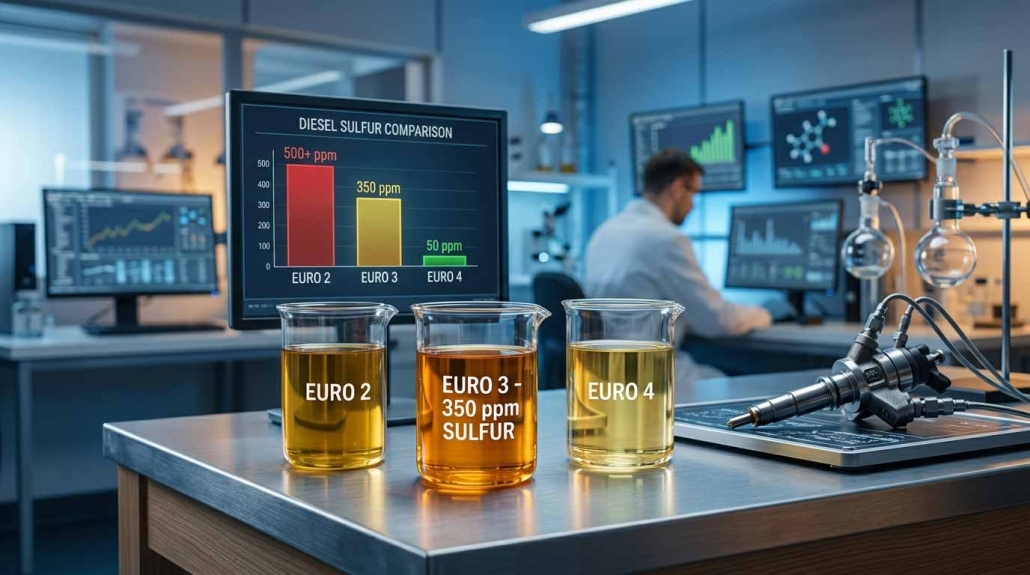
Euro 3 diesel sits in an important middle stage in the evolution of cleaner diesel fuel. It matters because many buyers, traders, and end users are not only asking what Euro 3 diesel is, but also what its sulfur content, emissions implications, and real-world differences are compared with Euro 2 diesel and Euro 4 diesel.
The confusion starts with terminology. In some contexts, “Euro 3” refers to a vehicle emissions stage. In other commercial discussions, it is also used as shorthand for a diesel fuel quality level associated with that period. That distinction is critical. A Euro emissions category is not always the same thing as a universal fuel specification.
This article explains Euro 3 diesel clearly, compares it with older and newer grades, and shows why sulfur ppm matters for emissions, engine compatibility, fuel handling, and commercial relevance. If you want broader context first, see our guide to Petroleum products and Introduction to different types of diesel and their applications.
Article Summary
Euro 3 diesel usually refers to a diesel grade associated with the Euro 3 era of emissions control, commonly discussed in relation to lower sulfur content than Euro 2 diesel and higher sulfur content than Euro 4 diesel in many market contexts. In practical commercial usage, Euro 3 diesel is often treated as a mid-transition diesel quality between older, higher-sulfur fuel and cleaner low-sulfur grades. However, the exact sulfur level and legal specification can vary by country, regulation, refinery standard, and sales terminology, so Euro 3 diesel should always be verified by its actual specification, not just its label.
What Is Euro 3 Diesel?
Euro 3 diesel generally refers to diesel fuel discussed in connection with the Euro 3 emissions era, especially in markets where diesel grades are informally grouped by sulfur level and emissions-related cleanliness.
In practical market language, Euro 3 diesel is commonly understood as:
- cleaner than Euro 2 diesel
- dirtier than Euro 4 diesel
- a transitional diesel grade between older sulfur-heavy fuel and newer cleaner diesel
- more suitable for older or mid-generation diesel systems than for the most advanced low-emission engines
A simple way to think about it is this:
- Euro 2 diesel = older, higher sulfur
- Euro 3 diesel = intermediate sulfur and cleaner combustion
- Euro 4 diesel = significantly cleaner, lower sulfur, better for newer emissions systems
That said, the term does not always describe one single globally fixed standard. In some jurisdictions, the sulfur limit associated with Euro 3 diesel may be presented differently depending on local regulation, market convention, or product documentation. For that reason, buyers should always request the actual specification sheet, test report, or sulfur ppm certificate.
For related background, see our pages on Diesel production process.
Is Euro 3 Diesel a Fuel Standard or an Emissions Standard?
This is one of the most important questions.
Strictly speaking, Euro 3 is first and foremost known as a vehicle emissions stage within European emissions regulation. For passenger diesel cars, Euro 3 introduced a distinct NOx limit and tightened emissions control compared with Euro 2. In technical regulatory language, that refers to vehicle tailpipe emissions, not automatically to one universal diesel fuel formula sold everywhere under the same name.
However, in commercial fuel markets, people often use terms such as Euro 2 diesel, Euro 3 diesel, and Euro 4 diesel more loosely to refer to fuel quality tiers, especially around sulfur content.
So both statements can be true:
- Legally/regulatorily: Euro 3 is an emissions stage
- Commercially/market-wise: Euro 3 diesel may be used as shorthand for a sulfur-related diesel grade associated with that emissions era
This is exactly where many competitor articles become weak. They either talk only about emissions law or only about fuel sulfur. A good article must connect both without confusing them.
Sulfur Content of Euro 3 Diesel
When people ask about Euro 3 diesel sulfur content, they usually want a practical answer in ppm.
In many market discussions, Euro 3 diesel is commonly associated with a sulfur limit around 350 ppm. By comparison:
- Euro 2 diesel is often associated with around 500 ppm
- Euro 3 diesel is often associated with around 350 ppm
- Euro 4 diesel is often associated with around 50 ppm
- newer Ultra-low sulfur diesel (Euro 5 diesel) can be around 10–15 ppm depending on market and regulation
Important nuance
These numbers are commonly cited market associations, not a universal rule that applies identically in every country, every era, and every sales contract. The actual sulfur specification must always be checked on:
- refinery certificate of quality
- product data sheet
- sales contract
- local fuel regulation
- customs or import standard
Why ppm matters
Sulfur is measured in parts per million (ppm). A lower sulfur number generally means:
- cleaner combustion
- lower sulfur oxide emissions
- lower sulfate particulate formation
- better compatibility with advanced emissions-control systems
- reduced risk of harming catalysts and after-treatment components
If you need a deeper chemical explanation, read Cetane number and Characteristics of low-quality diesel.
Why Sulfur Matters in Diesel Fuel
Sulfur is one of the most commercially important indicators of diesel cleanliness.
Higher sulfur diesel can contribute to:
- more sulfur oxide emissions
- more particulate-related pollution
- greater burden on emissions-control systems
- poorer compatibility with newer engines designed for cleaner fuel
- increased risk of deposits or downstream system issues in some applications
Lower sulfur diesel helps because it:
- reduces harmful exhaust-related pollutants
- supports cleaner operation
- improves compatibility with modern diesel technology
- helps enable the use of advanced emissions-control devices
This does not mean sulfur is the only factor that defines diesel quality. Buyers should also look at:
- cetane number
- density
- flash point
- cold flow properties
- lubricity
- contamination levels
- storage condition
For more on fuel quality and handling, see Diesel storage guide, Diesel color, and Winter diesel.
Euro 2 vs Euro 3 vs Euro 4 Diesel
The easiest way to understand Euro 3 diesel is to see where it sits between Euro 2 and Euro 4.
Table 1: Euro 2 vs Euro 3 vs Euro 4 diesel analytical comparison
| Feature | Euro 2 Diesel | Euro 3 Diesel | Euro 4 Diesel |
|---|---|---|---|
| Common market sulfur association* | ~500 ppm | ~350 ppm | ~50 ppm |
| Cleanliness level | Lower | Moderate | Higher |
| Sulfur-related emissions impact | Higher | Lower than Euro 2 | Much lower than Euro 2/3 |
| PM-related context | Higher particulate burden in practical terms | Improved vs Euro 2 | Cleaner emissions context |
| NOx regulatory era context | Older limits | Intermediate stage | Stricter stage |
| Typical refining severity | Lower | Medium | Higher |
| Compatibility with older engines | Strong | Strong | Usually acceptable, depending on engine/system |
| Compatibility with newer engines | Limited | Moderate | Better |
| Suitability for advanced after-treatment | Weak | Better than Euro 2 but limited vs newer fuels | Much better |
| Commercial relevance today | Legacy markets | Transitional/legacy markets | More aligned with cleaner market demand |
| Overall cleanliness ranking | 3rd | 2nd | 1st |
*Common market associations, not universal legal values for every jurisdiction.
Practical interpretation
From a practical fuel-buying perspective:
- Euro 2 diesel is mainly associated with older markets and older engine environments.
- Euro 3 diesel is a transition fuel: cleaner than Euro 2, but still not close to modern low-sulfur diesel expectations.
- Euro 4 diesel is much cleaner and more suitable for more advanced diesel systems.
Euro 3 Diesel vs Euro 4 Diesel
This is one of the most searched comparisons, and the answer is straightforward:
Euro 4 diesel is generally cleaner and more modern than Euro 3 diesel.
The biggest difference is usually sulfur content and the downstream effect of that sulfur difference on emissions, engine technology compatibility, and market usability.
Table 2: Euro 3 diesel vs Euro 4 diesel practical comparison
| Feature | Euro 3 Diesel | Euro 4 Diesel |
|---|---|---|
| Typical sulfur association | Higher | Lower |
| Fuel cleanliness | Transitional | Cleaner |
| Emissions profile | Older, less clean | Improved |
| Suitability for legacy engines | Often suitable | Often suitable, depending on engine |
| Suitability for modern systems | Limited | Better |
| After-treatment compatibility | More restricted | More compatible |
| Environmental profile | Weaker | Stronger |
| Commercial attractiveness | Lower in strict markets | Higher |
| Relevance in regulated regions | Reduced | Stronger historical fit, though newer grades may dominate |
| Buyer preference in cleaner markets | Usually not preferred | Usually preferred over Euro 3 |
Bottom line
If the choice is only between Euro 3 diesel and Euro 4 diesel, Euro 4 diesel is usually the better option for:
- cleaner emissions
- lower sulfur exposure
- broader compatibility
- stronger regulatory and commercial relevance
You may also want to compare it with EN590 diesel and Ultra-low sulfur diesel (ULSD).
Emissions and Pollutant Comparison
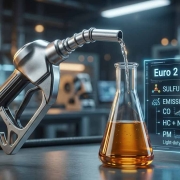
To make sense of diesel standards, it helps to separate fuel sulfur content from vehicle emissions limits. Fuel sulfur affects combustion quality and after-treatment compatibility, while Euro emissions rules regulate tailpipe pollutants from approved vehicle categories.
Table 3: Passenger-car diesel emissions limits by Euro stage (regulatory context)
| Euro Stage | CO (g/km) | HC + NOx (g/km) | NOx (g/km) | PM (g/km) |
|---|---|---|---|---|
| Euro 2 | 1.0 | 0.70 | — | 0.08 |
| Euro 3 | 0.64–0.66 | 0.56 | 0.50 | 0.05 |
| Euro 4 | 0.50 | 0.30 | 0.25 | 0.025 |
What this table tells us
Euro 3 introduced an important shift:
- a separate NOx limit became more visible in diesel discussions
- PM limits tightened compared with Euro 2
- the direction of regulation clearly moved toward cleaner diesel use
Euro 4 continued that trend by tightening diesel pollutant limits much further.
Table 4: Euro 2 vs Euro 4 diesel comparison for general fuel and emissions context
| Factor | Euro 2 Diesel | Euro 4 Diesel |
|---|---|---|
| Common sulfur association | Higher | Much lower |
| NOx context | Older regulatory environment | Stricter regulatory environment |
| PM context | Higher PM burden | Lower PM burden |
| Fuel cleanliness | Lower | Higher |
| Engine compatibility | Better for older systems | Better for newer systems |
| After-treatment compatibility | Weak | Better |
| Market relevance today | Mostly legacy use | More commercially relevant historically and in cleaner markets |
| Environmental impact | Higher | Lower |
This is why sulfur reduction matters commercially. A lower-sulfur fuel helps the industry move toward stricter emissions performance.
Engine Compatibility and Practical Use Cases
Whether Euro 3 diesel is suitable depends on the engine, emissions technology, and regional operating environment.
Euro 3 diesel may be more suitable for:
- older diesel vehicles
- older industrial equipment
- markets where legacy diesel grades are still accepted
- users operating equipment without highly sensitive modern after-treatment systems
Euro 3 diesel may be less suitable for:
- engines designed around very low sulfur diesel
- systems using advanced catalysts or particulate filters
- highly regulated on-road fuel environments
- buyers needing EN590-grade compliance in modern European-style supply chains
In practice, matching fuel to engine specification is critical. Using a higher-sulfur fuel in a system designed for cleaner fuel may reduce performance, shorten component life, or create compliance issues.
If fuel storage and field performance matter to you, see D1 diesel, and D2 diesel.
Is Euro 3 Diesel Still Used in Global Markets?
Yes, in some markets Euro 3 diesel may still appear in commercial discussion, tender language, fuel supply contracts, or transitional fuel systems. But its relevance depends heavily on region.
Where it may still be relevant
- legacy fleets
- developing or transitioning fuel markets
- off-road or industrial environments where cleaner grades are not yet universal
- supply chains using older specification language
Where it is less relevant
- tightly regulated European-style road fuel markets
- markets dominated by ULSD
- applications requiring advanced low-emission diesel compatibility
- supply chains centered around modern EN590 diesel
For strategic market context, see Top 10 diesel-producing countries, Top 10 diesel-exporting countries, and Diesel price forecast.
Euro 3 Diesel and Related Standards Such as EN590, ULSD, D1, and D2
Many readers confuse Euro 3 diesel with other fuel naming systems.
Euro 3 diesel vs EN590 diesel
EN590 diesel is a European diesel fuel specification used widely in modern road-fuel markets. In current market practice, EN590 is associated with much cleaner diesel than what is usually meant by Euro 3 diesel.
Euro 3 diesel vs ULSD
Ultra-low sulfur diesel (ULSD) is typically far lower in sulfur than Euro 3 diesel. In many modern markets, ULSD represents a much cleaner standard.
Euro 3 diesel vs D2 diesel
D2 diesel is a commercial trade term used in some global fuel trading contexts. It does not automatically mean the same thing as Euro 3 diesel, even if buyers sometimes compare them.
Euro 3 diesel vs D1 diesel
D1 diesel is another market term, often associated with lighter distillate characteristics and different use cases. It should not be treated as interchangeable with Euro 3 diesel.
Euro 3 diesel vs biodiesel
Biodiesel is a renewable diesel-related fuel category or blend component and belongs to a different comparison framework. The sulfur and emissions conversation overlaps, but the product classification is different.
Advantages and Disadvantages of Euro 3 Diesel
Advantages
- cleaner than older high-sulfur diesel such as many Euro 2-era products
- can still be relevant for some older engines and transitional markets
- historically important in the evolution toward cleaner diesel
- may fit certain supply environments where ultra-clean grades are not required
Disadvantages
- higher sulfur than Euro 4 and newer low-sulfur fuels
- weaker compatibility with advanced emissions-control systems
- less attractive for modern regulated road-fuel markets
- environmentally weaker than cleaner diesel grades
- reduced long-term commercial relevance in stricter markets
Common Misconceptions About Euro 3 Diesel
Misconception 1: Euro 3 diesel always means one exact sulfur number
Not always. A common association exists, but actual sulfur ppm must be confirmed by specification and jurisdiction.
Misconception 2: Euro 3 is only a fuel specification
Not exactly. Euro 3 is fundamentally an emissions stage, though the market may use it informally as fuel-grade shorthand.
Misconception 3: Euro 3 diesel is fine for every modern diesel engine
Not necessarily. Many modern engines are designed for cleaner low-sulfur fuel and more advanced after-treatment compatibility.
Misconception 4: Euro 3 diesel and EN590 are the same
No. They are related only loosely in broader diesel-standard discussions; they are not the same standard.
Misconception 5: Sulfur is the only thing that matters
No. Sulfur is critical, but so are cetane, stability, cold-flow performance, contamination, storage condition, and overall refining quality.
Conclusion
Euro 3 diesel is best understood as a transitional diesel quality level associated with the Euro 3 era, commonly discussed in relation to sulfur content, emissions performance, and fuel cleanliness. In most practical market comparisons, it sits between Euro 2 diesel and Euro 4 diesel.
The most important commercial takeaway is simple:
- Euro 2 diesel is older and dirtier
- Euro 3 diesel is an intermediate step
- Euro 4 diesel is cleaner and generally more suitable for newer low-emission systems
Still, buyers should not rely on the label alone. The right approach is to verify:
- sulfur ppm
- product specification
- intended application
- engine compatibility
- regional compliance requirement
FAQ
1. What is Euro 3 diesel?
Euro 3 diesel is generally a diesel grade discussed in connection with the Euro 3 emissions era and commonly associated in market language with mid-level sulfur content between older Euro 2 diesel and cleaner Euro 4 diesel.
2. What is the sulfur content of Euro 3 diesel?
In many market discussions, Euro 3 diesel is commonly associated with about 350 ppm sulfur, but the exact specification can vary by country, regulation, and supplier.
3. What is the difference between Euro 2, Euro 3, and Euro 4 diesel?
The main difference is fuel cleanliness, especially sulfur level and the emissions context around each stage. Euro 2 is dirtier, Euro 3 is transitional, and Euro 4 is much cleaner.
4. Is Euro 3 diesel a fuel standard or an emissions standard?
Strictly speaking, Euro 3 is an emissions stage, but in commercial fuel markets it is often also used informally as shorthand for a sulfur-related diesel quality tier.
5. Is Euro 3 diesel still used today?
Yes, in some legacy or transitional markets. However, in many modern regulated road-fuel markets, cleaner grades such as ULSD and EN590-aligned diesel are more relevant.
6. Is Euro 3 diesel the same as EN590 diesel?
No. EN590 is a modern European diesel fuel specification, while Euro 3 diesel is usually discussed as an older emissions-era diesel category or commercial shorthand.
7. Is Euro 3 diesel suitable for modern engines?
Usually not ideal for the newest diesel engines that are designed for lower-sulfur fuel and advanced emissions-control systems. Always follow the engine manufacturer’s fuel specification.
8. Which is better, Euro 3 or Euro 4 diesel?
Euro 4 diesel is generally better because it is cleaner, lower in sulfur, and more compatible with newer diesel technology.
9. Why does sulfur matter in diesel fuel?
Sulfur affects emissions, fuel cleanliness, and compatibility with emissions-control systems. Lower sulfur generally helps reduce harmful pollutants and supports cleaner engine operation.
10. How can buyers confirm Euro 3 diesel quality?
Ask for the certificate of analysis, sulfur ppm result, refinery specification, and any applicable compliance documents. Do not rely only on the product name.
Global Petroleum Trade Solutions | Universal Trades
As a reputable international petroleum trading enterprise, Universal Trades specializes in the reliable procurement, export, and supply chain management of high-grade petroleum commodities, refined fuels, and industrial feedstocks designed to meet rigorous global standards.




Leave a Reply
Want to join the discussion?Feel free to contribute!