
Bitumen 85/100: Specification, Uses, Properties, and Comparison

Bitumen 85/100 is a penetration-grade petroleum asphalt commonly used in road construction and asphalt production. The number 85/100 refers to the penetration value of the binder, meaning the material is softer than harder grades such as Bitumen 60/70 and Bitumen 40/50, but usually a little softer or comparable in practical use to nearby soft paving grades like Bitumen 80/100.
For buyers, engineers, and contractors, the real value of Bitumen 85/100 is not just in the specification sheet. What matters is how the grade behaves in the field: how it handles temperature changes, how easy it is to mix and compact, how it supports pavement flexibility, and whether it suits the project climate and traffic load.
This article explains what Bitumen 85/100 means, where it performs best, how it compares with other grades, what tests matter most, and what commercial buyers should verify before placing an order.
What Is Bitumen 85/100?
Bitumen 85/100 is a refined hydrocarbon binder produced from crude oil during the petroleum refining process. It is classified by penetration grade, which measures how far a standard needle penetrates the sample under controlled conditions. A penetration value between 85 and 100 dmm indicates a relatively soft binder.
In simple terms, Bitumen 85/100 offers:
- Good flexibility at moderate and lower service temperatures
- Easier workability during mixing and laying
- Useful adhesion and binding performance in many paving applications
- Suitability for regions where a harder grade may become too brittle
It is widely used in road surfacing, asphalt mixes, maintenance works, and some industrial applications depending on local standards and formulation requirements.
What Does 85/100 Mean in Bitumen?
The term 85/100 represents the penetration range of the bitumen at 25°C, measured in tenths of a millimeter (dmm). In the standard test, a needle is loaded and allowed to penetrate the bitumen sample for a set time under controlled conditions.
A result between 85 and 100 means the binder is softer than grades with lower penetration values.
Practical Meaning of Penetration Grade
For non-laboratory users, the penetration number matters because it helps predict field behavior:
- Higher penetration number = softer binder
- Softer binder = better flexibility in cooler or moderate conditions
- Lower penetration number = harder binder
- Harder binder = better resistance to deformation in hotter climates and under heavier loads
This is why specification values should never be treated as paperwork only. They influence cracking risk, rutting resistance, workability, and long-term pavement performance.
Where Bitumen 85/100 Sits Among Common Grades
Bitumen 85/100 is generally considered a softer paving grade. It sits between very soft and medium paving binders and is often selected when flexibility and easier application are more important than maximum hardness.
Compared with nearby grades:
- Bitumen 80/100: very close in softness and application range
- Bitumen 60/70: harder and more common for warmer climates or heavier traffic
- Bitumen 40/50: significantly harder, used where higher stiffness is needed
In some markets, buyers also compare it with Bitumen 90/15, Bitumen 115/15, or industrial grades, but those products serve different technical purposes and should not be treated as direct paving equivalents.

Main Properties of Bitumen 85/100
The performance of Bitumen 85/100 is shaped by several physical and rheological properties. Procurement teams should understand not only the numbers, but why each one matters.
1. Penetration
Penetration defines softness and relative consistency. For Bitumen 85/100, the binder is soft enough to remain workable and flexible in many paving conditions.
Why it matters:
- Helps determine climate suitability
- Affects low-temperature flexibility
- Influences handling and compaction behavior
2. Softening Point
The softening point indicates the temperature at which bitumen begins to soften significantly.
Why it matters:
- Higher softening point usually improves high-temperature stability
- Lower softening point may improve flexibility but can reduce resistance to deformation in hot conditions
3. Ductility
Ductility measures how far the bitumen can stretch before breaking.
Why it matters:
- Higher ductility supports flexibility
- Important for reducing cracking risk in pavements exposed to movement or thermal stress
4. Viscosity
Viscosity affects pumping, mixing, spraying, coating, and compaction.
Why it matters:
- Too viscous: difficult to handle and compact
- Too fluid: reduced control during application
- Proper viscosity improves plant efficiency and construction quality
5. Flash Point
Flash point indicates the temperature at which vapors may ignite.
Why it matters:
- Critical for safe storage and heating
- Important for plant operation and transport safety
6. Solubility
Solubility helps confirm purity and consistency.
Why it matters:
- Higher solubility generally indicates fewer unwanted impurities
- Useful for quality assurance and supplier verification
7. Loss on Heating
This shows how the binder changes after heating exposure.
Why it matters:
- Indicates volatility and durability tendencies
- Helps assess whether the product remains stable during production and application
Typical Bitumen 85/100 Specifications
Exact specification ranges can vary by refinery, national standard, and buyer requirement, but a typical technical data sheet for Bitumen 85/100 may include the following:
| Property | Typical Requirement | Unit | Why It Matters |
|---|---|---|---|
| Penetration at 25°C | 85-100 | dmm | Defines the grade and relative softness |
| Softening Point | around 42-52 | °C | Indicates heat sensitivity and temperature resistance |
| Ductility at 25°C | minimum 100 | cm | Reflects flexibility and crack resistance |
| Flash Point | minimum 232 | °C | Supports heating and handling safety |
| Solubility in CS2 or TCE | minimum 99.0 | % | Confirms product purity |
| Loss on Heating | limited by standard | wt% | Shows stability during heating |
| Specific Gravity | approx. 1.01-1.06 | g/cm3 | Useful for handling and volume-to-mass calculations |
Important note: buyers should always request the supplier’s latest test certificate, not rely only on a website table.
Test Methods Buyers Should Check
| Test | Common Method | Unit | What It Tells You |
|---|---|---|---|
| Penetration | ASTM D5 / EN equivalent | dmm | Softness and grading |
| Softening Point | ASTM D36 | °C | High-temperature behavior |
| Ductility | ASTM D113 | cm | Flexibility and stretchability |
| Flash Point | ASTM D92 | °C | Safety during heating |
| Solubility | ASTM D2042 | % | Purity of binder |
| Loss on Heating | ASTM D6 or equivalent | % | Stability after heating |
| Specific Gravity | ASTM D70 | g/cm3 | Density for handling and design |
For export cargoes, test reports are often supported by pre-shipment inspection, third-party laboratory verification, and batch-specific documentation.
Applications of Bitumen 85/100
Bitumen 85/100 is mainly used where a softer paving binder is technically appropriate. Common uses include:
- Asphalt concrete production
- Road surfacing in moderate climates
- Surface dressing and maintenance works
- Rural and secondary roads
- Pavement layers requiring flexibility
- Some waterproofing or industrial formulations where permitted by specification
In practical terms, this grade is often chosen when contractors want easier mixing and laying performance without moving to an excessively soft or specialty product.
Related materials that buyers often compare for application fit include Cutback Bitumen, Emulsion Bitumen, especially when the project involves spray application, priming, or cold/more convenient field handling.
Is Bitumen 85/100 Suitable for Hot or Cold Climates?
Climate suitability is one of the most important grade-selection decisions.
Better Suited For:
- Moderate climates
- Mild to relatively cool regions
- Roads where flexibility is important
- Projects with moderate traffic and controlled design conditions
Use With Caution In:
- Very hot climates
- Roads with heavy axle loads
- Locations with severe rutting risk
- High-temperature pavement surfaces without proper mix design control
A softer binder can help resist cracking in cooler conditions, but it may deform more easily in extreme heat if the pavement structure and aggregate design are not optimized.
That is why bitumen selection should always consider:
- Local climate profile
- Traffic intensity
- Pavement layer type
- Aggregate characteristics
- Mix design method
- Construction quality
If the project operates in very warm conditions, the buyer may compare alternatives such as Bitumen 60/70, Bitumen 50/70, or Bitumen 40/50. For polymer-enhanced performance, Polymer Modified Bitumen may offer a better solution.

Bitumen 85/100 vs Other Grades
The biggest buying mistake is choosing a grade based only on availability or price. The correct grade depends on performance needs.
| Grade | Relative Hardness | Workability | Flexibility in Cooler Conditions | High-Temperature Rut Resistance | Typical Use Profile |
|---|---|---|---|---|---|
| Bitumen 85/100 | Soft | High | Good | Moderate to lower | Moderate climates, flexible paving needs |
| Bitumen 80/100 | Soft | High | Good | Moderate to lower | Similar use range, widely used in some export markets |
| Bitumen 60/70 | Medium | Good | Moderate | Better | General road construction in warmer climates |
| Bitumen 40/50 | Hard | Moderate | Lower | High | Heavy-duty or hotter climate applications |
Bitumen 85/100 vs 80/100
These grades are very close and often compared in export discussions. Local standards and supplier offerings determine whether one or both are available. In many commercial situations, the difference is not dramatic, but the exact project specification must control the purchase.
Bitumen 85/100 vs 60/70
This is a more meaningful decision. Bitumen 60/70 is harder and usually performs better under hotter temperatures and heavier traffic. Bitumen 85/100 is softer and often easier to work with in milder environments.
Bitumen 85/100 vs 40/50
Bitumen 40/50 is much harder and more deformation-resistant, but less flexible. It is generally selected for demanding thermal and traffic conditions, not for projects where softer binder behavior is beneficial.
Advantages of Bitumen 85/100
Bitumen 85/100 offers several practical advantages when used in the right context:
- Good flexibility in moderate and cooler service conditions
- Easier pumping, mixing, and compaction than harder grades
- Suitable for many conventional road construction applications
- Useful for reducing brittleness risk in some pavement systems
- Often familiar to contractors working in soft-grade paving environments
From a construction perspective, easier workability can improve laying consistency and compaction quality when jobsite control is good.
Limitations of Bitumen 85/100
No bitumen grade is universally best. Bitumen 85/100 also has limitations:
- Lower resistance to rutting than harder grades in very hot climates
- May not be ideal for heavy-duty pavements without careful mix design
- Performance depends strongly on aggregate quality and construction practices
- Can be over-selected by buyers who focus only on flexibility and ignore temperature profile
This is why technical selection should come before commercial negotiation.

How Bitumen 85/100 Is Produced
Bitumen 85/100 is typically produced through crude oil refining, usually as a residue from atmospheric and vacuum distillation, followed by refinery process control to achieve the target penetration range and related properties.
Depending on refinery configuration, production may involve:
- Crude distillation
- Vacuum residue processing
- Air adjustment or blending control
- Final quality testing before release
Although buyers do not need full refinery-process detail, they should understand one important point: consistent quality depends on process control, feedstock stability, and testing discipline.
For industrial users exploring non-paving binders, related products like Oxidized Bitumen serves different purposes and should not be confused with penetration-grade paving bitumen.
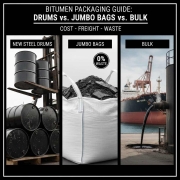
Packaging Options for Bitumen 85/100
Bitumen 85/100 is commonly supplied in several packaging and delivery formats:
- New steel drums
- Jumbo bags
- Polyamide bags
- Bulk shipment in tankers
- Bulk vessel cargo for export volumes
The right option depends on destination, unloading facilities, shipment size, and buyer handling capability.
Drums
Best for:
- Smaller export shipments
- Buyers without bulk tank infrastructure
- Easier unitized handling
Considerations:
- Higher packaging cost per ton
- More waste and disposal management
- Need to confirm net weight and drum quality
Jumbo Bags
Best for:
- Flexible export logistics
- Easier container loading
- Buyers seeking lower packaging weight ratio than drums
Considerations:
- Need correct handling equipment
- Must confirm temperature and stacking suitability
Bulk
Best for:
- Large-volume buyers
- Terminal-to-terminal or refinery-scale supply
- Lower packaging cost
Considerations:
- Requires heated storage and unloading capability
- Demands stronger logistics coordination
Buyers dealing with storage tanks, terminals, or industrial fuel/heating systems may also review related topics such as Bitumen Packaging.
Storage and Handling Recommendations
Bitumen quality can degrade if it is stored or heated improperly. Good storage practice matters almost as much as original quality.
Key recommendations:
- Avoid overheating for long periods
- Maintain controlled storage temperature
- Keep tanks clean and dry
- Prevent contamination from water, dust, or residues
- Use proper circulation if storage is extended
- Follow supplier heating guidelines
Poor storage can change viscosity, increase oxidation, and reduce application performance even when the original shipment met specification.
Quality Assurance: How to Verify Bitumen 85/100 Before Purchase
Commercial buyers should verify quality using documents, inspection, and supplier controls.
Ask for:
- Recent technical data sheet
- Certificate of analysis for the actual batch
- Test report from refinery or approved lab
- Packing list and net weight confirmation
- Origin details
- Inspection terms
- Loading photos or video when relevant
Confirm:
- Penetration range matches 85/100
- Softening point is consistent with expected grade behavior
- Ductility is acceptable
- Flash point meets safe handling requirements
- No unusual deviation in solubility or loss on heating
- Packaging type and net weight are clearly defined
Strong Buyer Practice
Use an independent inspection company for large or repeated orders, especially for export cargoes.
Common Buying Mistakes
Many procurement issues happen before the cargo even ships. The most common mistakes include:
- Buying by lowest price only
- Ignoring climate suitability
- Accepting generic test sheets instead of batch-specific reports
- Failing to confirm packaging net weight
- Not defining inspection terms in the contract
- Confusing penetration grades with oxidized or cutback grades
- Overlooking discharge capability at destination
A grade that is technically wrong for the project can create much bigger losses than a small price difference per ton.
Questions to Ask a Bitumen 85/100 Supplier
Before placing an order, buyers should ask:
- Is the product refinery-produced or blended?
- What standard and test methods are used?
- Can you provide a fresh certificate of analysis for the lot?
- What is the exact packaging type and net weight?
- Is third-party inspection accepted?
- What is the typical loading quantity per container or vessel?
- What are the storage and heating recommendations?
- What is the country of origin?
- What are the lead time and supply consistency expectations?
For international buyers, these questions reduce both technical and commercial risk.
Market and Price Factors
The price of Bitumen 85/100 changes based on several variables:
- Crude oil market trends
- Refinery supply and regional availability
- Packaging type
- Order volume
- Freight cost
- Export destination
- Seasonal demand
- Inspection and documentation requirements
This is why buyers should compare offers on a landed-cost basis, not only FOB or ex-works headline price.
When studying procurement economics, related internal resources such as Bitumen Price, and Gilsonite may also support broader sourcing decisions depending on the buyer’s use case.

When Should You Choose Bitumen 85/100?
Bitumen 85/100 is a smart choice when:
- The project specification requires a soft penetration grade
- The climate is moderate or not severely hot
- Pavement flexibility is important
- The contractor wants good workability during mixing and laying
- The traffic and service conditions do not demand a much harder binder
You should consider another grade when:
- The road is exposed to very high pavement temperatures
- Traffic loads are heavy and rut resistance is a major concern
- The design engineer recommends a harder or modified binder
- The specification clearly calls for a different penetration or performance grade
Final Buying Perspective
Bitumen 85/100 is not simply “soft bitumen.” It is a practical paving binder with a clear role in the market. When selected correctly, it can deliver balanced workability, flexibility, and pavement performance. When selected poorly, especially in unsuitable climate or traffic conditions, it can create preventable durability issues.
The best buying decision comes from combining four things:
- Correct technical grade selection
- Verified laboratory compliance
- Suitable packaging and logistics
- Reliable supplier performance
That combination matters more than any single headline price.
FAQ
What is Bitumen 85/100 used for?
Bitumen 85/100 is mainly used in road construction, asphalt production, surface dressing, and paving works where a relatively soft penetration-grade binder is required.
Is Bitumen 85/100 softer than Bitumen 60/70?
Yes. Bitumen 85/100 is softer than Bitumen 60/70 because it has a higher penetration value.
What does 85/100 mean in bitumen?
It refers to the penetration range, measured in tenths of a millimeter, indicating how soft the binder is under standard test conditions.
Is Bitumen 85/100 suitable for hot climates?
It can be used in some warm regions depending on traffic and mix design, but in very hot climates or heavy-load roads, a harder grade may be more suitable.
What is the difference between Bitumen 85/100 and 80/100?
They are very similar soft penetration grades. The exact difference depends on the specification range and supplier standard, so buyers should check the project requirement carefully.
How is Bitumen 85/100 packed?
It is commonly supplied in steel drums, jumbo bags, poly bags, tankers, or bulk vessel shipments depending on order size and logistics.
What tests should buyers check before purchasing Bitumen 85/100?
Buyers should review penetration, softening point, ductility, flash point, solubility, loss on heating, and batch-specific lab reports.
Can Bitumen 85/100 be exported internationally?
Yes. It is traded internationally in drums, jumbo bags, and bulk shipments, especially for road construction and asphalt applications.
What is Bitumen 85/100?
Bitumen 85/100 is a penetration-grade asphalt binder with a penetration value between 85 and 100 dmm, commonly used in road construction and asphalt production.
What does the 85/100 grade mean?
The 85/100 number refers to the penetration range measured under standard conditions at 25°C, showing that the bitumen is a relatively soft grade.
Where is Bitumen 85/100 commonly used?
It is commonly used in asphalt mixes, road surfacing, pavement construction, and maintenance applications in moderate climates.
Is Bitumen 85/100 better than 60/70?
Not universally. Bitumen 85/100 is softer and more flexible, while Bitumen 60/70 is harder and often better for hotter climates or heavier traffic.
Is Bitumen 85/100 suitable for cold weather?
It is generally more suitable than harder grades for moderate to cooler conditions because its softer consistency can support better flexibility.
How is Bitumen 85/100 supplied?
It is usually supplied in drums, jumbo bags, poly bags, tankers, or bulk shipments depending on buyer requirements and logistics setup.
What should buyers verify before ordering Bitumen 85/100?
Buyers should verify batch test reports, penetration value, softening point, ductility, packaging details, inspection terms, and supplier reliability.
What affects the price of Bitumen 85/100?
Price is affected by crude oil trends, refinery supply, packaging type, volume, destination, freight cost, and market demand.
Related Articles
- Causes of Leakage in Export Bitumen Drums: Analyzing why drums leak and how to prevent it.
- Bitumen 40/50 vs 60/70: Comparing technical specifications and field performance.
- Bitumen 60/70 vs 80/100: Evaluating the differences between these popular grades.
- Most Common Bitumen Grades: An overview of the most demanded grades globally.
- Bitumen Shelf Life: Factors affecting the durability and quality of stored bitumen.
- Bitumen Quality Testing: Essential lab tests to verify bitumen standards.
- Simple Guide to Choosing the Right Bitumen: Key criteria for selecting the perfect grade.
- Applications of Bitumen: A comprehensive guide to bitumen’s industrial uses.
- Global Bitumen Price Forecast: Analyzing market trends and price drivers.
- Cold Bitumen and Hot Bitumen: Key differences in application and performance.
- Bitumen Refinery: Understanding the role of refineries in the supply chain.
- Top Bitumen Exporting Countries: Who leads the global bitumen export market?
- Top Bitumen Producing Countries: Overview of major global bitumen producers.
- Bitumen Production Process: A brief guide on how bitumen is refined.
- Differences Between Quality and Substandard Bitumen: How to identify high-quality bitumen.
- Petroleum Products: Exploring the role of bitumen among oil derivatives.
- Introduction to Bitumen Types and Applications: A broad guide to bitumen categories.
- Best Bitumen for Roof Waterproofing: Selecting the right grade for effective insulation.
- Bitumen Articles: Explore our complete archive of technical bitumen content.
Global Petroleum Trade Solutions | Universal Trades
As a reputable international petroleum trading enterprise, Universal Trades specializes in the reliable procurement, export, and supply chain management of high-grade petroleum commodities, refined fuels, and industrial feedstocks designed to meet rigorous global standards.







Leave a Reply
Want to join the discussion?Feel free to contribute!