
N150 Base Oil: Uses, and Technical Specifications

In the modern lubricant manufacturing sector, formulating high-performance engine oils and industrial fluids requires high-purity raw materials. As environmental standards tighten and automotive engine designs demand lower volatility and higher oxidative stability, traditional mineral lubricants are undergoing a major shift.
Within the broader spectrum of refining and the Introduction to Petroleum Products, N150 base oil has emerged as a cornerstone grade. Classified as a premium Group II light neutral base stock, it offers an exceptional balance of low volatility, high saturation, and cost-effective performance.
This comprehensive guide breaks down the technical profile of N150 base oil, compares it to alternative grades, and outlines crucial procurement insights for B2B buyers, distributors, and blenders.
What is N150 Base Oil?
N150 base oil is a high-purity, light-colored neutral oil categorized under the API Group II classification. Unlike traditional solvent-refined lubricants, N150 is manufactured using advanced hydroprocessing technology.
To understand its role, it helps to review the Introduction to Base Oil Types. While a standard Group 1 Base Oil is produced via solvent extraction, Group II oils like N150 undergo severe hydrocracking and hydroisomerization. This advanced Base Oil Production Process virtually eliminates sulfur, nitrogen, and aromatic impurities, converting them into highly stable saturated hydrocarbons.

As a highly refined Mineral Base Oil, N150 offers performance characteristics that bridge the gap between traditional mineral stocks and a highly processed Group 3 Base Oil or a premium Synthetic Base Oil like a Group 4 Base Oil (PAO) and specialized Group 5 Base Oil formulations.
Technical Specifications and Properties
The “150” in N150 denotes its approximate Saybolt Universal Viscosity (SUS) at 100°F, translating to a specific kinematic viscosity range at 40°C.
Understanding N150 base oil viscosity is critical for blenders who need to maintain precise rheological properties under varying thermal conditions. Because N150 has a highly uniform paraffinic structure—as explored in the comparison of Paraffinic vs. Naphthenic Base Oil—it provides excellent viscosity-temperature behavior.
Below is a typical specification table for N150 base oil. For technical teams archiving data, this serves as a reliable reference sheet similar to what you would find in an official base oil specifications PDF:
| Property | Typical Value | Test Method (ASTM) |
|---|---|---|
| Appearance / Color | Clear and Bright / ≤L0.5 | ASTM D1500 |
| Density @ 15°C (g/cm³) | 0.850 – 0.865 | ASTM D4052 |
| Kinematic Viscosity @ 40°C (cSt) | 28.0 – 32.0 | ASTM D445 |
| Kinematic Viscosity @ 100°C (cSt) | 5.2 – 5.5 | ASTM D445 |
| Viscosity Index (VI) | 100 – 112 | ASTM D2270 |
| Flash Point (COC, °C) | ≥210 | ASTM D92 |
| Pour Point (°C) | ≤−12 | ASTM D97 |
| Sulfur Content (ppm) | <100 (typically <30< 30) | ASTM D2622 |
| Saturates (%) | >98 | ASTM D2007 |
| Noack Volatility (wt%) | 14 – 18 | ASTM D5800 |
Main N150 Base Oil Uses
Because of its high saturates, exceptional oxidative stability, and low volatility, N150 serves as a versatile fluid in several formulation families. Key base oil examples of its application include:
- Passenger Car Motor Oils (PCMO): N150 is widely utilized as a core blending component for modern, low-viscosity multi-grade engine oils (e.g., 5W-30, 10W-40) because it resists thermal breakdown and minimizes deposit formation.
- Industrial Hydraulic Fluids: Its high Viscosity Index (VI) ensures that hydraulic systems maintain consistent pressure and fluid film thickness across a broad operating temperature range.
- Gear Oils and Transmission Fluids: It serves as an excellent carrier fluid for anti-wear and extreme-pressure additives in automotive and industrial gearboxes.
- Process and Metalworking Oils: Its low sulfur and low aromatic content make it safer and more environmentally friendly for open-system machining and manufacturing operations.
Comparison of N150 Base Oil with SN150 and N500
One of the common questions in the lubricant market is how N150 base oil differs from SN150, and whether these two grades can be used interchangeably. In addition, many industrial buyers compare N150 with heavier base oil grades such as N500, SN300 Base Oil, and SN500 Base Oil.
In general, the differences between these base oils are related to refining technology, chemical composition, viscosity level, and end‑use applications.
N150 vs. SN150 Base Oil
From a viscosity standpoint, N150 and SN150 Base Oil are very similar. Both typically have a kinematic viscosity of around 30 cSt at 40°C. However, the main difference lies in their refining process and chemical structure.
| Property | N150 Base Oil | SN150 Base Oil |
|---|---|---|
| Base Oil Group | Group II | Group I |
| Refining Process | Hydrocracking and hydroprocessing | Solvent refining |
| Saturates Content | >90% | Lower than Group II oils |
| Sulfur Content | Very low (<0.03%) | Higher than N150 |
| Oxidation Stability | Excellent | Moderate |
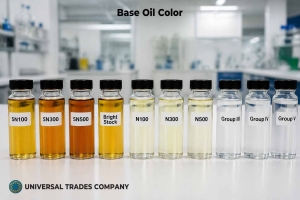
| Color & Purity | Lighter and more refined | Darker |
| Additive Solvency | Moderate | Better due to higher aromatics |
| Typical Applications | Modern engine oils and high‑performance lubricants | Basic industrial lubricants |
Overall, N150 is generally preferred for modern lubricant formulations due to its higher purity and stronger oxidation resistance.
However, SN150 still remains a cost‑effective option in certain industrial formulations because its higher aromatic content provides slightly better natural additive solvency.
N150 vs. N500 Base Oil
N500 base oil is considered a heavier Group II base oil grade. While N150 is categorized as a light neutral oil, N500 has significantly higher viscosity and is used in heavier lubricant formulations.
| Property | N150 Base Oil | N500 Base Oil |
|---|---|---|
| Grade Type | Light Neutral | Heavy Neutral |
| Viscosity @ 40°C | ~28 – 32 cSt | ~90 – 110 cSt |
| Primary Applications | Light engine oils, hydraulic oils | Heavy-duty diesel and industrial lubricants |
| Role in Formulation | Improves flow and viscosity balance | Increases viscosity and oil film thickness |
In lubricant blending, manufacturers often combine light and heavy base oils to achieve the target viscosity grade. For example, blending N150 with N500 or combining lighter oils with SN300 Base Oil and SN500 Base Oil is a common approach in lubricant formulation.
In some lighter formulations, grades such as SN70 Base Oil may also be evaluated alongside N150 to fine‑tune the final viscosity of the finished lubricant.
Frequently Asked Questions (FAQ)
What is N150 base oil?
N150 is a light neutral Group II base oil produced via severe hydrotreating. It features high saturate levels (), minimal sulfur content (), and excellent thermal and oxidative stability.
What is the difference between N150 and SN150?
While both have similar viscosities, N150 belongs to Group II and is hydrocracked, offering higher purity and better oxidation resistance. SN150 belongs to Group I and is solvent-refined, featuring higher sulfur and aromatic content.
What is the HS Code for N150 base oil?
The standard international HS Code for N150 base oil is typically 2710.19.99 (classified under lubricating oil base stocks).
How does N150 base oil viscosity perform under heat?
With a Viscosity Index (VI) of 100 to 112, N150 exhibits excellent viscosity stability, meaning it experiences less thinning at high operating temperatures compared to Group I stocks.
Conclusion
N150 base oil represents a vital link in modern lubricant formulation. By offering low volatility, excellent thermal stability, and clean-burning characteristics, it enables blenders to meet rigorous international standards without the high cost of fully synthetic alternatives.
When sourcing N150, always request an up-to-date Certificate of Analysis (COA) to verify key parameters like Noack volatility, sulfur content, and viscosity index to safeguard your manufacturing quality.
Global Petroleum Trade Solutions | Universal Trades
As a reputable international petroleum trading enterprise, Universal Trades specializes in the reliable procurement, export, and supply chain management of high-grade petroleum commodities, refined fuels, and industrial feedstocks designed to meet rigorous global standards.










Leave a Reply
Want to join the discussion?Feel free to contribute!