
Euro 5 Diesel: Meaning, Sulfur Content & Specifications
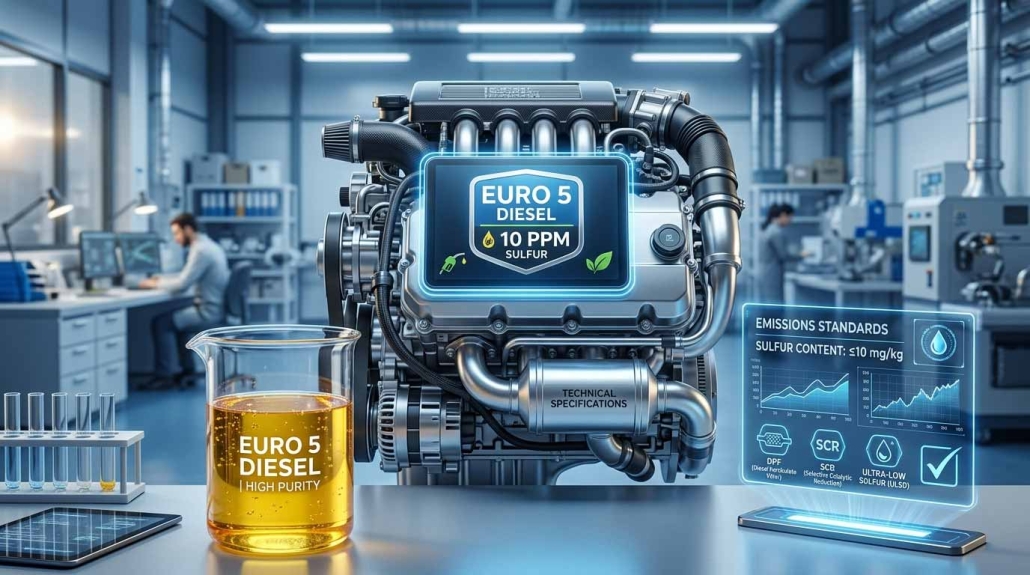
Euro 5 diesel is a low‑sulfur diesel fuel standard commonly associated with a maximum sulfur content of about 10 ppm (parts per million). The main purpose of this standard is to reduce harmful emissions from diesel engines while allowing modern emission‑control technologies—such as Diesel Particulate Filters (DPF) and Selective Catalytic Reduction (SCR)—to operate effectively.
The shift toward Euro 5 diesel represents a major step in improving fuel quality and environmental performance within global petroleum products markets. Lower sulfur content not only reduces pollution but also improves compatibility with modern engines designed to meet stricter emission standards.
Quick Answer: What Is Euro 5 Diesel?
Euro 5 diesel generally refers to ultra‑low sulfur diesel fuel with a sulfur limit of approximately 10 ppm designed for modern diesel engines.
Key points:
- Maximum sulfur content: typically ≤10 ppm
- Category: ultra‑low sulfur diesel fuel
- Relation to ULSD: Euro 5 diesel is usually considered a type of Ultra‑low sulfur diesel (ULSD)
- Relation to EN590: many Euro 5 fuels meet the EN590 diesel specification used in Europe
- Environmental benefit: significantly lower sulfur dioxide and particulate emissions
- Engine compatibility: supports modern diesel emission systems such as DPF and SCR
What Does Euro 5 Diesel Mean?
The term Euro 5 originally comes from European emission standards for vehicles, which regulate how much pollution cars and trucks are allowed to emit. However, in everyday fuel markets the phrase “Euro 5 diesel” is often used informally to describe high‑quality low‑sulfur diesel fuel compatible with Euro 5 vehicles.
It is important to distinguish between two related but different concepts:
1. Vehicle emission standards
Euro standards (Euro 1 to Euro 6) primarily regulate vehicle exhaust emissions, including:
- Nitrogen oxides (NOx)
- Carbon monoxide (CO)
- Hydrocarbons (HC)
- Particulate matter (PM)
2. Fuel quality standards
Fuel standards define the chemical and physical properties of diesel fuel, including:
- sulfur content
- density
- viscosity
- cetane number
- contamination levels
In practical terms, the most important indicator of Euro 5‑type diesel fuel is its very low sulfur content. For a deeper explanation of sulfur levels in fuels, see Diesel sulfur content.
Euro 5 Diesel Sulfur Content
The defining characteristic of Euro 5 diesel is its very low sulfur concentration.
Typical sulfur limits:
- Euro 4 diesel: up to about 50 ppm sulfur
- Euro 5 diesel: around 10 ppm sulfur or lower
Reducing sulfur from 50 ppm to 10 ppm significantly improves air quality and allows modern emission‑control systems to work properly.
Why sulfur reduction matters
Lower sulfur content reduces several types of pollution:
- Sulfur dioxide (SO₂) emissions
- formation of fine particulate matter (PM)
- catalyst poisoning in exhaust systems
Modern diesel engines rely heavily on after‑treatment technologies. These include:
- Diesel particulate filters (DPF)
- Selective catalytic reduction (SCR)
- oxidation catalysts
High sulfur levels can damage these systems or reduce their efficiency. This is why most modern markets now rely on Ultra‑low sulfur diesel (ULSD).
Euro 5 Diesel Specifications and Fuel Analysis
Fuel buyers and fuel traders often evaluate diesel using a certificate of analysis (COA) issued by a laboratory. This document lists the technical properties of the fuel.
Typical parameters include:
- sulfur content
- Cetane number
- density at 15°C
- flash point
- kinematic viscosity
- distillation temperature range
- water content
- ash content
- carbon residue
- lubricity
- oxidation stability
- biodiesel (FAME) content
- cold flow properties such as cloud point or CFPP
Many of these characteristics depend on refining steps within the Diesel production process.
For example:
- A higher cetane number improves combustion quality and engine starting.
- Proper viscosity ensures good fuel injection.
- Low water and contamination levels prevent engine damage.
Most European markets regulate these parameters through the EN590 diesel specification.
Table 1: Euro 4 vs Euro 5 vs Euro 6 Diesel — General Comparison
| Feature | Euro 4 Diesel | Euro 5 Diesel | Euro 6 Diesel |
|---|---|---|---|
| Typical sulfur content | Up to ~50 ppm | Around ~10 ppm | Often ~10 ppm |
| Fuel category | Low sulfur diesel | Ultra‑low sulfur diesel | Ultra‑low sulfur diesel |
| Environmental impact | Moderate emissions | Much cleaner combustion | Cleaner vehicles with advanced controls |
| Particulate emissions | Higher | Lower | Lowest with advanced engines |
| DPF compatibility | Limited | Fully compatible | Fully compatible |
| SCR / AdBlue systems | Rare | Common | Standard in many vehicles |
| Suitable engine generation | Older diesel engines | Modern diesel engines | Latest emission‑controlled engines |
| Market availability | Some developing regions | Global standard in many markets | Used with newest vehicles |
| Main advantage | Widely compatible | Low sulfur and cleaner combustion | Lowest vehicle emissions |
| Limitation | Higher pollution | Slightly higher refining cost | Requires advanced engine technology |
Table 2: Euro 4 vs Euro 5 vs Euro 6 Diesel — Technical Specification Comparison
| Parameter | Euro 4 Diesel | Euro 5 Diesel | Euro 6 Diesel |
|---|---|---|---|
| Sulfur content | ≤50 ppm | ≤10 ppm | ≤10 ppm |
| Cetane number | ≥51 | ≥51 | ≥51 |
| Density at 15°C | 820–845 kg/m³ | 820–845 kg/m³ | 820–845 kg/m³ |
| Flash point | ≥55°C | ≥55°C | ≥55°C |
| Kinematic viscosity (40°C) | 2.0–4.5 mm²/s | 2.0–4.5 mm²/s | 2.0–4.5 mm²/s |
| Water content | ≤200 mg/kg | ≤200 mg/kg | ≤200 mg/kg |
| Total contamination | ≤24 mg/kg | ≤24 mg/kg | ≤24 mg/kg |
| Lubricity | ≤460 µm | ≤460 µm | ≤460 µm |
| FAME content | Up to 7% (in some markets) | Up to 7% typical | Up to 7% typical |
| Cold filter plugging point | Seasonal grade dependent | Seasonal grade dependent | Seasonal grade dependent |
| Ash content | ≤0.01% | ≤0.01% | ≤0.01% |
Actual specifications may vary depending on regional regulations, refinery practices, and the specific version of the EN590 standard.
Euro 5 Diesel vs EN590 Diesel
EN590 is the main European standard defining diesel fuel properties.
In many cases:
- Euro 5 diesel meets EN590 requirements
- EN590 defines properties such as density, viscosity, sulfur limits, and contamination levels
However, the two terms are not identical:
- Euro 5 refers primarily to vehicle emission standards
- EN590 refers specifically to diesel fuel specifications
For fuel purchases, buyers should always request a certificate of analysis verifying parameters such as sulfur content, density, and water levels.
Euro 5 Diesel vs ULSD
ULSD (Ultra‑Low Sulfur Diesel) refers to diesel fuel with very low sulfur levels, typically 15 ppm or lower depending on the country.
Euro 5 diesel generally falls into this category because:
- its sulfur limit is typically 10 ppm
However, terminology varies across regions, so buyers should confirm sulfur content rather than relying only on product labels.
Euro 5 Diesel vs Euro 4 Diesel
The most important difference between these fuels is sulfur content.
- Euro 4 diesel: around 50 ppm sulfur
- Euro 5 diesel: around 10 ppm sulfur
This fivefold reduction significantly improves environmental performance and engine compatibility.
Fleets operating modern diesel trucks or passenger cars typically prefer Euro 5 diesel because it:
- supports DPF systems
- reduces particulate emissions
- improves exhaust after‑treatment performance
For a detailed technical explanation, see Comparison of Euro 4 and Euro 5 diesel.
Euro 5 Diesel vs Euro 6 Diesel
Euro 6 standards focus mainly on stricter vehicle emission limits, especially for nitrogen oxides (NOx).
However, the diesel fuel used for Euro 6 vehicles often has similar sulfur levels (around 10 ppm) to Euro 5 diesel.
The main difference lies in vehicle technology, including:
- advanced SCR systems
- AdBlue injection
- improved DPF filters
More technical details can be found in Comparison of Euro 5 and Euro 6 diesel.
Euro 5 Diesel, DPF, SCR, and AdBlue
Modern diesel engines rely on multiple emission‑control technologies.
Diesel Particulate Filter (DPF)
DPF systems capture soot particles from exhaust gases. High sulfur fuel can increase soot formation and damage these filters.
Selective Catalytic Reduction (SCR)
SCR systems inject AdBlue (urea solution) into the exhaust to convert NOx emissions into harmless nitrogen and water.
Low sulfur fuel such as Euro 5 diesel ensures that these systems operate efficiently and remain durable.
Is Euro 5 Diesel B7 or B10?
The designations B7 and B10 refer to the percentage of biodiesel (FAME) blended with petroleum diesel.
For example:
- B7 = 7% biodiesel
- B10 = 10% biodiesel
These values are separate from Euro emission standards. A fuel labeled Euro 5 could technically be B0, B7, or another blend depending on national regulations.
More information about renewable diesel blends can be found in Biodiesel.
How to Identify Euro 5 Diesel Quality
Fuel buyers should evaluate several factors before purchasing diesel.
Important checks include:
- certificate of analysis from an accredited laboratory
- sulfur level (around 10 ppm)
- cetane number
- density
- flash point
- water content
- contamination levels
- fuel appearance and diesel color
- storage conditions
Improper storage or contamination can significantly reduce fuel quality, so following a proper Diesel storage guide is important.
Fuel users should also understand the Characteristics of low-quality diesel to avoid operational problems.
Table 3: Euro 5 Diesel Buyer Checklist
| Parameter | Why it matters | Typical concern | What buyers should request |
|---|---|---|---|
| Sulfur content | Determines emissions and engine compatibility | High sulfur fuel | Laboratory test showing ≤10 ppm |
| Cetane number | Influences combustion quality | Hard starting or engine knock | Certificate of analysis |
| Density | Affects energy content | Off-spec blending | Lab measurement |
| Water content | Causes corrosion and injector damage | Water contamination | Karl Fischer test result |
| Total contamination | Indicates cleanliness | Storage contamination | Filtration test |
| Flash point | Safety during transport and storage | Safety hazards | Verified flash point value |
| Fuel appearance | Detects contamination | Dark or cloudy fuel | Visual inspection report |
Can Older Engines Use Euro 5 Diesel?
Most older diesel engines can operate normally using low‑sulfur diesel fuel.
However:
- some older engines relied on sulfur for lubrication
- extremely low sulfur fuel may require improved lubricity additives
In practice, modern diesel fuels already include additives to maintain proper lubrication.
Can Euro 5 Engines Use Euro 4 Diesel?
Using higher‑sulfur diesel in engines designed for Euro 5 standards can cause problems such as:
- reduced DPF efficiency
- higher particulate emissions
- catalyst damage
While occasional use may not immediately cause failure, continuous use of higher‑sulfur fuel can significantly increase maintenance costs.
Euro 5 Diesel in Global Markets
Euro 5‑quality diesel is widely available in many regions due to stricter environmental regulations.
However, fuel standards vary worldwide:
- Developed markets generally use ULSD or EN590‑type diesel
- Some regions still use Euro 2 diesel, Euro 3 diesel, or Euro 4 diesel
Global supply trends are influenced by refining capacity and international trade. Insights into production and exports can be found in Top 10 diesel-producing countries and Top 10 diesel-exporting countries.
Market prices also fluctuate depending on crude oil costs and refinery output, which are analyzed in Diesel price forecast reports.
Related Diesel Types and Comparisons
Diesel fuel exists in several different categories depending on climate, refining process, and intended use.
Examples include:
- D1 diesel for lighter distillate applications
- D2 diesel, a common commercial diesel grade
- Winter diesel, designed to prevent fuel gelling in cold temperatures
Readers interested in broader fuel classifications can explore Introduction to different types of diesel and their applications.
For broader energy comparisons, see Diesel vs gasoline comparison and Diesel vs kerosene comparison.
Common Misconceptions About Euro 5 Diesel
Several misunderstandings exist around Euro diesel standards.
Misconception 1: Euro 5 diesel and Euro 5 vehicles are the same thing.
Reality: Euro standards mainly regulate vehicle emissions, while fuel quality standards such as EN590 define fuel properties.
Misconception 2: Euro 5 diesel always means B7 biodiesel.
Reality: biodiesel blend percentage depends on national regulations.
Misconception 3: Euro 6 diesel always has lower sulfur than Euro 5.
Reality: in many markets both use 10 ppm sulfur diesel.
Misconception 4: Fuel color alone proves fuel quality.
Reality: appearance may indicate contamination, but laboratory analysis is required for confirmation.
Conclusion
Euro 5 diesel represents a major improvement in fuel quality compared with older diesel grades. Its low sulfur content—typically around 10 ppm—enables cleaner combustion and supports advanced emission‑control technologies such as DPF and SCR systems.
While the term Euro 5 originates from vehicle emission standards, it is widely used in fuel markets to describe high‑quality ultra‑low sulfur diesel compatible with modern engines.
For fuel buyers, the most reliable approach is to verify technical parameters using a certificate of analysis rather than relying only on product names. As environmental regulations continue to evolve, fuels like Euro 5 diesel serve as an important transition toward cleaner and more sustainable transportation.
FAQ
What is Euro 5 diesel?
Euro 5 diesel generally refers to diesel fuel compatible with Euro 5 emission standards, typically containing around 10 ppm sulfur.
What is the sulfur content of Euro 5 diesel?
The sulfur content is usually 10 ppm or lower, depending on regional fuel standards.
Is Euro 5 diesel the same as ULSD?
In many markets yes. Euro 5 diesel typically qualifies as ultra‑low sulfur diesel (ULSD) because of its low sulfur level.
Is Euro 5 diesel the same as EN590 diesel?
Not exactly. EN590 is a fuel specification, while Euro 5 refers to vehicle emission standards. However, many Euro 5 fuels meet EN590 requirements.
Is Euro 5 diesel B7 or B10?
B7 or B10 refers to the percentage of biodiesel blend, not the Euro emission level.
What is the difference between Euro 4 and Euro 5 diesel?
Euro 5 diesel has much lower sulfur content (about 10 ppm) compared with Euro 4 diesel (about 50 ppm).
What is the difference between Euro 5 and Euro 6 diesel?
The main difference is vehicle emission limits, not necessarily fuel sulfur levels.
Can Euro 4 vehicles use Euro 5 diesel?
Yes. Most Euro 4 engines can operate normally using lower‑sulfur fuel.
Can Euro 5 engines use Euro 4 diesel?
Using higher‑sulfur diesel may damage emission‑control systems and increase maintenance costs.
Does Euro 5 diesel require AdBlue?
AdBlue is required for SCR systems in certain vehicles, not because of the fuel itself.
Is Euro 5 diesel suitable for DPF vehicles?
Yes. Low sulfur diesel is essential for proper DPF operation.
How can I check if diesel is Euro 5 quality?
Check the certificate of analysis showing sulfur content around 10 ppm and confirming other diesel specifications.
Is Euro 5 diesel better than D2 diesel?
In most cases yes, because it usually contains lower sulfur and cleaner specifications.
Does diesel color show whether it is Euro 5?
No. Color alone cannot confirm sulfur level or fuel quality.
Related Articles
- Diesel sulfur content: Understand the critical role of sulfur levels in diesel fuel and their direct environmental impact.
- Euro 2 diesel: Explore the characteristics and historical significance of this older diesel fuel standard.
- Euro 3 diesel: Learn about the technical specifications and emission regulations associated with the Euro 3 diesel era.
- Euro 4 diesel: Discover the key properties, performance factors, and environmental considerations of Euro 4 diesel fuel.
- Comparison of Euro 3 and Euro 4 diesel: See how emission standards and fuel quality requirements evolved between these two generations.
- Comparison of Euro 4 and Euro 5 diesel: Analyze the major differences in fuel quality and their impact on modern engine systems.
- Comparison of Euro 5 and Euro 6 diesel: Understand the transition from Euro 5 to the stricter Euro 6 standards and their respective fuel requirements.
Global Petroleum Trade Solutions | Universal Trades
As a reputable international petroleum trading enterprise, Universal Trades specializes in the reliable procurement, export, and supply chain management of high-grade petroleum commodities, refined fuels, and industrial feedstocks designed to meet rigorous global standards.







Leave a Reply
Want to join the discussion?Feel free to contribute!