
Guide to Base Oil Export (SN 150 to SN 600): Quality Analysis, Virgin vs. Recycled, Packaging, and Supply Terms

A complete commercial and technical manual for lubricant blenders, international traders, and procurement managers sourcing Group I solvent neutrals (SN 150, SN 300, SN 500, SN 600) across global hubs.
1. The Global Landscape of Base Oil Trading
Base oils serve as the foundational building block for finished lubricants, typically making up 70% to 99% of a lubricant’s finished volume. In cross-border commodity markets, solvent neutral (SN) paraffinic mineral oils—predominantly classified under API Group I—remain indispensable workhorses. Despite rising demand for high-viscosity-index Group II and Group III hydrocracked cuts, API Group I base oils command critical market share across industrial, marine, heavy-duty gear, and regional automotive segments throughout the Middle East, South Asia, Africa, and Turkey.
Navigating cross-border procurement requires balancing tight technical parameters, volatile price benchmarks, and stringent customs logistics. Whether sourcing for a high-volume blending facility or an import-export distribution network, understanding grade-specific performance and trade terms is essential for securing bottom-line margins.
2. API Classifications: Group I vs. Group II & Group III
The American Petroleum Institute (API) categorizes base oils into five main groups based on saturates content, sulfur level, and Viscosity Index (VI):
- Group I: Saturates < 90%, sulfur > 0.03%, and VI between 80 and 120. Manufactured via solvent extraction and solvent dewaxing. Highly prized for superior solvency, additive treatability, and high-load film strength. Read more on Group I base oil characteristics.
- Group II: Saturates ≥ 90%, sulfur ≤ 0.03%, and VI 80 to 120. Refined using modern hydroprocessing techniques. Learn more about Group II base oils and their thermal-oxidative stability.
- Group III: Severe hydrocracked or Gas-to-Liquid (GTL) oils exhibiting VI ≥ 120. Check our complete breakdown of Group III synthetic base oils.
In addition, molecular structures define behavior: review our comparison on paraffinic vs. naphthenic base oils to evaluate pour-point and solvency trade-offs.
3. Deep Dive into Solvent Neutral Grades: SN 150 to SN 600
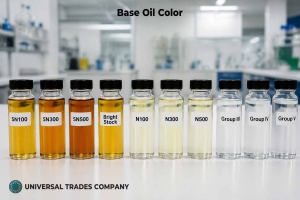
Solvent Neutral (SN) grades are designated primarily by their nominal Saybolt Universal Seconds (SUS) viscosity measured at 100°F (37.8°C). For comprehensive industry thresholds, consult our guide to base oil grades and detailed base oil technical specifications.
| Parameter / Test Method | SN 150 | SN 300 | SN 500 | SN 600 |
|---|---|---|---|---|
| Kinematic Viscosity @ 40°C (cSt) (ASTM D445) | 28.0 – 32.0 | 58.0 – 65.0 | 95.0 – 110.0 | 115.0 – 135.0 |
| Kinematic Viscosity @ 100°C (cSt) (ASTM D445) | 5.0 – 5.5 | 8.0 – 8.8 | 10.5 – 12.0 | 12.0 – 13.5 |
| Viscosity Index (VI) min. (ASTM D2270) | 95 | 95 | 95 | 90 – 95 |
| Flash Point COC min. (°C) (ASTM D92) | 195 – 205 | 215 – 225 | 230 – 245 | 240 – 250 |
| Pour Point max. (°C) (ASTM D97) | -9 to -12 | -6 to -9 | -6 to -9 | -3 to -6 |
| Color max. (ASTM D1500) | 1.0 – 1.5 | 1.5 – 2.0 | 2.0 – 2.5 | 2.5 – 3.0 |
| Density @ 15°C (kg/l) (ASTM D4052) | 0.860 – 0.875 | 0.875 – 0.885 | 0.880 – 0.895 | 0.885 – 0.900 |
Application Profile by Grade
- SN 150: A light neutral cut critical for low-viscosity passenger car motor oils (PCMO), automatic transmission fluids (ATF), transformer cooling oils, and hydraulic fluids. Explore SN 150 base oil technical properties.
- SN 300: The intermediate workhorse balancing moderate volatility with high film load. Explore specific formulation needs via SN 300 base oil applications.
- SN 500: The standard heavyweight solvent neutral utilized globally for heavy-duty diesel engines (HDDO), industrial gear sets, and tractor fluids. See our full specification profile on SN 500 export grade.
- SN 600: A high-viscosity heavy cut favored in marine cylinder oils, industrial circulating oils, and open-gear compounds. Details available at SN 600 base oil specifications.
4. Virgin vs. Recycled (Re-refined) Base Oil: Commercial Due Diligence
A vital sourcing decision involves selecting between virgin refined base stocks and re-refined / recycled base oils. Examine the complete market dynamics in our report on virgin vs. recycled base oil.
- Virgin Base Oil: Distilled directly from crude vacuum gas oil (VGO) or lube cut fractions. Guarantees tight distillation curves, low evaporative loss (Noack), reliable additive response, and consistent color stability over time.
- Re-refined (Recycled) Base Oil: Produced from spent automotive and industrial lubricants. High-tier facilities utilizing hydrofinishing produce Group I and II oils meeting standard kinematic viscosities; however, inconsistent feedstock can introduce oxidation precursors, sulfur spikes, or unstable color degrade.
- Price Differentials: Re-refined grades typically trade at a $60 to $180 per metric ton discount compared to virgin solvent neutrals, making strict COA verification indispensable.
5. Packaging, Handling, and Export Logistics
Selecting the optimal containerization mode reduces unit freight costs while protecting product integrity against moisture, oxidation, and contamination:
- Flexitanks (20ft Dry Containers): Single-use, multi-layer polyethylene bladders holding 18 to 22 metric tons (~21,000 to 24,000 liters). Cost-effective for ocean freight, eliminating cleaning and demurrage fees.
- Steel Drums (208-liter / 55-gallon): Tight-head new or reconditioned steel drums packed 80 units per 20ft container (approx. 14.5 to 16 metric tons). Optimal for smaller regional buyers and retail blenders lacking bulk discharge pumps.
- IBC Totes (1,000 Liters): Rigid intermediate bulk containers offering convenient storage and handling for mid-tier lubricant compounding.
- Bulk Vessel / ISO Tank Containers: Utilized for direct terminal-to-terminal shipments ranging from 1,000 to 5,000 metric tons per charter.
6. Quality Control, Inspection, and Verification (COA / SGS)
Independent inspection mitigates cross-border cargo risks. Prior to issuing commercial release or bill of lading (B/L), cargo samples must be drawn and tested by accredited international surveyors (e.g., SGS, Saybolt, or Bureau Veritas):
- Composite Sampling: Samples drawn from shore tanks or vessel manifolds following ASTM D4057 methods.
- Critical Pass/Fail Benchmarks: Particular scrutiny is given to Flash Point (to verify no light ends contamination), Water Content via Karl Fischer titration (ASTM D6304, standard ≤ 100 ppm), and total acid number (TAN).
- Certificate of Analysis (COA): Refineries issue batch COAs, but independent surveyor inspection reports serve as the binding document under documentary letters of credit.
7. Supply Terms, Incoterms 2020, and Market Pricing
Base oil pricing is pegged to global benchmark reports (ICIS, Argus, Platts) with trade quotes driven by crude and vacuum gas oil (VGO) spreads. Review our economic forecast on base oil market price trends.
Standard export terms include:
- FOB (Free on Board): Exporter delivers product on board the buyer’s nominated vessel or container terminal at load port.
- CFR / CIF (Cost, Insurance & Freight): Supplier manages marine freight to buyer’s discharge port (e.g., Jebel Ali, Mumbai/Nhava Sheva, Mersin, Karachi, Durban).
- Payment Structures: Confirmed, irrevocable Letters of Credit (LC at sight) or partial Telegraphic Transfer (T/T advance deposit with balance against non-negotiable shipping documents).
8. Frequently Asked Questions (FAQ)
What is the shelf life of exported virgin base oils?
When stored in sealed drums, IBCs, or clean tanks under ambient temperatures without moisture intrusion or direct sunlight, virgin solvent neutral base oils have a typical shelf life of 24 to 36 months without significant property degradation.
How can buyers distinguish virgin base oil from high-quality recycled oil?
Virgin oils exhibit uniform color stability, low sulfur variance, and virtually undetectable traces of additive breakdown metals (such as zinc, phosphorus, and calcium). Laboratory testing via inductively coupled plasma (ICP) spectroscopy and UV stability tests quickly identifies re-refined sources.
What is the minimum order quantity (MOQ) for base oil exports?
Standard containerized shipments (Flexitank or drummed) usually require a minimum order of one 20ft container (approx. 16 to 21 metric tons). Bulk vessel parcel shipments usually start at 500 to 1,000 metric tons per grade.
Are base oils classified as hazardous goods for ocean transport?
No. API Group I, II, and III base oils have high flash points (> 195°C) and are classified as non-hazardous, non-regulated cargo under IMO / IMDG regulations, allowing transport in standard flexitanks and general cargo vessels.
What are the primary commercial uses for SN 500 base oil?
SN 500 is used primarily in formulating mono-grade and multi-grade heavy-duty diesel engine oils (15W-40, 20W-50), industrial gear oils (ISO VG 150 to 320 blends), rubber processing, and agricultural machinery lubricants.
Can heating pads be utilized when discharging high-viscosity cuts like SN 600?
Yes. In colder discharge destinations, flexitanks carrying high-viscosity oils such as SN 500 and SN 600 can be fitted with low-pressure steam or hot-water heating pads to restore viscosity before rapid pumping.
Source High-Purity Base Oils with Guaranteed Specifications
Universal Trades supplies export-grade virgin and re-refined solvent neutrals (SN 150, SN 300, SN 500, SN 600) tailored to your regional blending requirements. Enjoy competitive pricing, rigorous SGS inspection, and flexible packaging solutions.







Leave a Reply
Want to join the discussion?Feel free to contribute!