
Top 10 Largest Petroleum Coke Producing Countries (2026 Market Analysis)
Petroleum coke (petcoke) is a carbon‑rich solid produced during the refining of heavy crude oil in delayed coker units. As global refineries process heavier and more sulfur‑rich crude grades, petcoke output has steadily increased. Today it is a critical feedstock for industries such as aluminum smelting, cement production, power generation, and steel manufacturing.
Understanding petroleum coke production by country is important for traders, manufacturers, and industrial buyers because supply concentration, refinery capacity, and crude oil quality all influence global petcoke trade flows.
The global petcoke market in 2026 continues to expand due to refinery upgrades, growth in Asian refining capacity, and steady demand from cement and aluminum industries.
Global Petroleum Coke Production Overview
Petcoke production is directly tied to refinery configuration. Complex refineries with high Nelson Complexity Index (NCI) values and large delayed coker units generate significantly higher volumes of petcoke. Countries with heavy crude processing capabilities—particularly the United States, China, and India—dominate global output.
The material itself falls into two primary categories:
- Fuel‑grade petroleum coke (high sulfur, primarily used in cement kilns and power plants)
- Anode‑grade petroleum coke (low sulfur, used to produce calcined petroleum coke (CPC) for aluminum anodes)
For readers interested in deeper technical differences, see related resources on types of petroleum coke and their applications and differences between petroleum coke and coal.
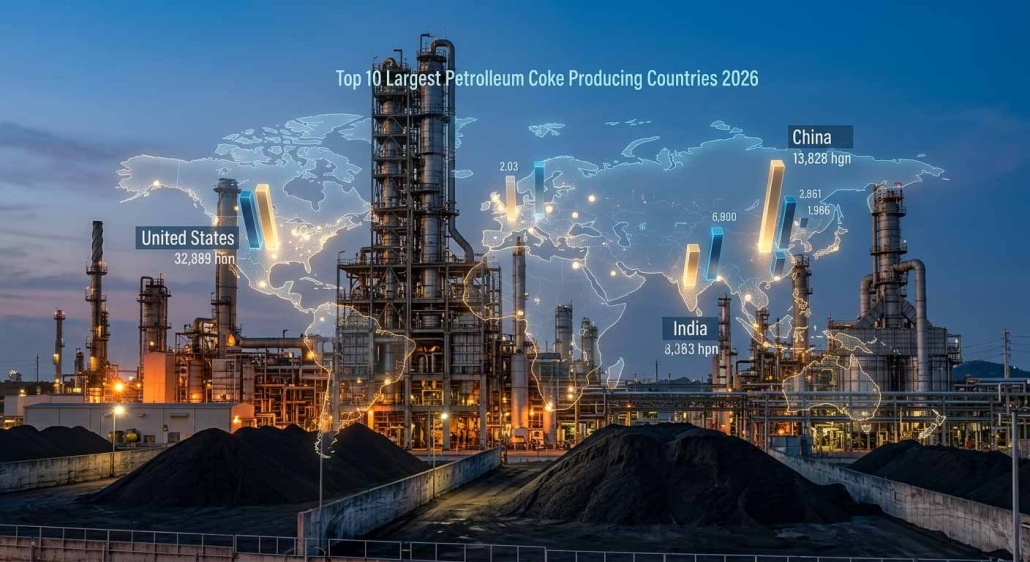
Top 10 Petcoke‑Producing Countries in 2026
Global petcoke production in 2026 is estimated at approximately 190–210 million tonnes per year, depending on refinery utilization rates and crude slate composition.
| Rank | Country | Production Volume (Mtpa) | Share of Global Production |
|---|---|---|---|
| 1 | United States | 65 | 31% |
| 2 | China | 40 | 19% |
| 3 | India | 22 | 10% |
| 4 | Saudi Arabia | 15 | 7% |
| 5 | Russia | 12 | 6% |
| 6 | South Korea | 10 | 5% |
| 7 | Japan | 9 | 4% |
| 8 | Iran | 8 | 4% |
| 9 | Brazil | 7 | 3% |
| 10 | Canada | 6 | 3% |
Expert Interpretation
Several structural factors explain this distribution:
1. Refinery Complexity and Coking Capacity
The United States leads global petcoke production due to its large number of sophisticated refineries along the Gulf Coast. Facilities in Texas and Louisiana process heavy crude imports using large delayed coking units.
China and India have rapidly expanded refining capacity in the past decade, increasing their role in petcoke production by country rankings.
2. Heavy Crude Processing
Countries processing heavier crude oils—such as Canadian oil sands or Venezuelan crude—generate more coke as a refining by‑product.
3. Domestic Industrial Demand
China and India consume significant volumes internally, particularly in cement kilns and power generation.
Supply Chain Implications
Because production is concentrated in relatively few countries, global buyers often depend on exports from:
- United States Gulf Coast
- Middle Eastern refining hubs
- Emerging Asian refineries
This concentration creates logistical sensitivity to freight rates, port congestion, and geopolitical disruptions.
Global Petcoke Production by Region
| Region | Estimated Production (Mtpa) | Share of Global Production |
|---|---|---|
| Asia | 75 | 36% |
| North America | 72 | 34% |
| Middle East | 25 | 12% |
| Europe | 18 | 9% |
| South America | 12 | 6% |
| Africa | 4 | 3% |
Regional Market Dynamics
Asia is now the largest regional producer due to refinery expansions in China, India, and South Korea. However, much of this production is consumed domestically.
North America, especially the United States, remains the dominant export hub for green petroleum coke. Gulf Coast terminals handle a large share of global petcoke shipments.
The Middle East has also emerged as a strategic supplier as new refining complexes integrate delayed coking technology.
From a trade perspective, concentration in a few refining regions means disruptions—such as refinery shutdowns or sanctions—can rapidly influence global supply.
Readers interested in broader refinery markets may also explore related topics such as top oil‑producing countries and leading oil and gas companies, which shape upstream supply feeding these refineries.
Comparison of Fuel‑Grade vs Anode‑Grade Petroleum Coke
| Characteristic | Fuel‑Grade Petcoke | Anode‑Grade Petcoke |
|---|---|---|
| Sulfur Content | 3–7% | <2% |
| Main Use | Cement, power plants | Aluminum anodes |
| Processing | Usually burned directly | Converted into calcined petroleum coke |
| Market Value | Lower | Higher |
| Key Buyers | Cement producers | Aluminum smelters |
Petcoke sulfur levels are one of the most important quality parameters. Low‑sulfur petcoke is required to produce calcined petroleum coke, which is a key input in aluminum production.
More detailed technical information can be found in resources covering calcined petroleum coke and green petroleum coke.
Production Drivers
Heavy Crude Processing
As global reserves increasingly shift toward heavier crude oils, refineries rely more heavily on coking technology to convert heavy residues into lighter fuels. This trend directly increases petcoke output.
Refinery Complexity (Nelson Index)
Countries with refineries that have a high Nelson Complexity Index can process difficult crude grades efficiently and produce greater volumes of secondary products—including petcoke.
Expansion of Delayed Coking Units
Many large refining projects in Asia and the Middle East have integrated delayed coking capacity, enabling them to maximize product yield and improve profitability.
Industry Applications
Aluminum Production
Low‑sulfur petcoke is calcined into CPC (calcined petroleum coke), which is used to manufacture anodes for aluminum smelting.
Cement Industry
Fuel‑grade petcoke is widely used in cement kilns because of its high calorific value and relatively low cost compared with coal.
Power Generation
Some industrial boilers and power plants use petcoke as a fuel source, particularly in regions with limited coal availability.
Steel Industry
In certain metallurgical processes, petcoke can substitute for coke or coal in reducing environments.
These applications highlight the importance of petcoke within the broader petroleum products value chain.

Trade and Geopolitical Considerations
Export Concentration
A significant portion of globally traded petcoke originates from the United States. This creates structural dependency for importing countries in Asia and Europe.
Sanctions and Trade Restrictions
Sanctions affecting countries like Iran or Russia can disrupt supply chains and redirect global petcoke trade flows.
Freight and Logistics
Bulk shipping costs strongly influence petcoke pricing. Freight routes from the Gulf Coast to Asia remain among the most important global corridors.
Regional refining hubs also influence fuel markets linked to top diesel‑producing countries and largest gasoline‑producing countries, which indirectly shape refinery operations.
Market Outlook 2026–2030
Several long‑term trends will influence the petcoke industry:
1. Energy Transition Policies
Stricter emissions regulations may limit the use of high‑sulfur fuel‑grade coke in certain regions.
2. Growth of Asian Refining
Asia will likely remain the fastest‑growing refining center, increasing both production and consumption.
3. Aluminum Industry Demand
The aluminum sector—driven by electric vehicles and infrastructure projects—will continue to support demand for anode‑grade petroleum coke.
4. Heavy Crude Supply
As heavy crude processing expands, petcoke output is expected to remain structurally strong despite energy transition pressures.
Conclusion
Petroleum coke remains an essential by‑product of modern refining and a strategic raw material for several heavy industries. The global petcoke market in 2026 is dominated by countries with advanced refining capacity, large delayed coking units, and access to heavy crude supplies.
For industrial buyers and traders, understanding petroleum coke production by country, regional supply hubs, and quality differences between fuel‑grade and anode‑grade coke is critical when evaluating sourcing strategies.
Companies operating in the petroleum trading sector play a key role in connecting green petcoke exporters, calcined petroleum coke suppliers, and industrial consumers worldwide.
Businesses seeking reliable sourcing, technical specifications, or long‑term supply partnerships should work with experienced petroleum trading firms that understand both the refining landscape and global petcoke logistics.
Global Petroleum Trade Solutions | Universal Trades
As a reputable international petroleum trading enterprise, Universal Trades specializes in the reliable procurement, export, and supply chain management of high-grade petroleum commodities, refined fuels, and industrial feedstocks designed to meet rigorous global standards.







Leave a Reply
Want to join the discussion?Feel free to contribute!