
Top 10 Largest Fuel Oil Producing Countries (2026 Overview)
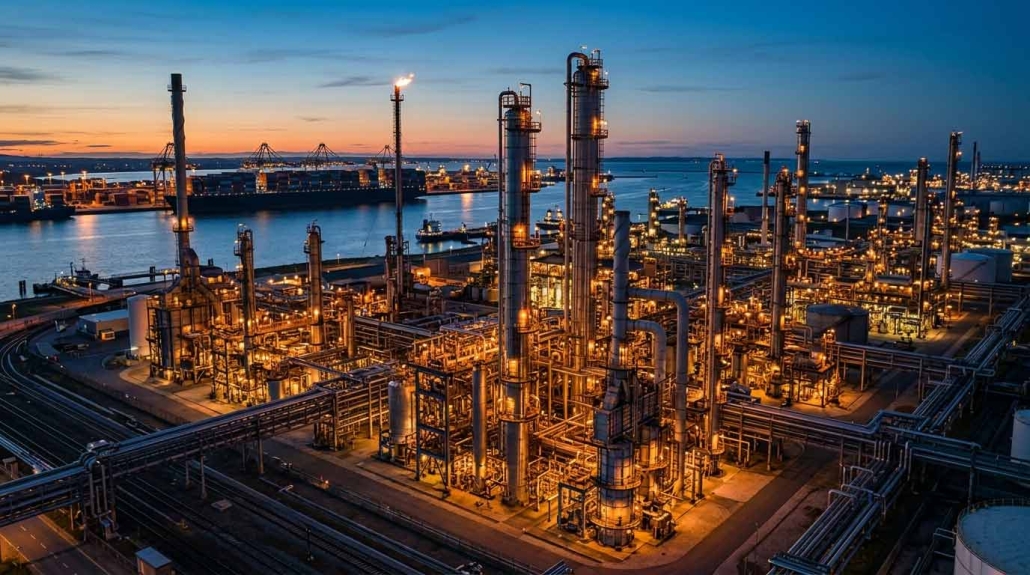
Fuel oil—often called residual fuel oil or heavy fuel oil (HFO)—is one of the heaviest products produced in crude oil refining. It is created after lighter fuels such as gasoline, diesel, and jet fuel are distilled from crude. This dense hydrocarbon product is widely used as bunker fuel for marine shipping, industrial boilers, and power generation in some regions.
Tracking global fuel oil production helps analysts understand refinery behavior, refinery yields, and how crude quality affects petroleum product output. Countries with large refining sectors or heavy crude processing typically generate the most fuel oil. Many of these nations also appear in rankings of the World’s largest oil producers and host some of the World’s largest oil refineries.
Fuel oil production also reflects broader refining economics. When refiners maximize light fuels such as gasoline or diesel, residual streams decline. Conversely, heavy crude processing or lower refinery complexity can increase output of bunker fuel and other heavy crude distillates.
Global Fuel Oil Production Leaders
The countries below represent the largest estimated producers of fuel oil, based primarily on refinery throughput, refining configuration, and petroleum product output data reported in global energy statistics.
| Rank | Country | Estimated Fuel Oil Production (kb/d) | Global Share (%) |
|---|---|---|---|
| 1 | United States | ~950 | 15% |
| 2 | China | ~900 | 14% |
| 3 | Russia | ~850 | 13% |
| 4 | India | ~500 | 8% |
| 5 | Saudi Arabia | ~420 | 7% |
| 6 | South Korea | ~360 | 6% |
| 7 | Japan | ~320 | 5% |
| 8 | Iran | ~300 | 5% |
| 9 | Singapore | ~260 | 4% |
| 10 | Brazil | ~230 | 4% |
| Other Countries | ~1,800 | 29% | |
| OPEC Countries (Total) | ~1,300 | 21% | |
| Total Global Fuel Oil Exports | ~4,000 kb/d | — |
Estimates derived from refinery throughput and petroleum product output trends reported in global energy statistics.
Many of these countries also dominate broader refining rankings, appearing among the Top countries in petroleum products production and operating facilities owned by major players among the Top oil and gas companies.
Why These Countries Produce the Most Fuel Oil
The Refining Giants
The United States, China, and Russia dominate global refining capacity. Their massive refining systems process enormous volumes of crude oil, which inevitably generates significant quantities of residual fuel oil.
- The United States leads global refining capacity, with complex refineries capable of processing both light and heavy crude.
- China’s rapid expansion of refinery infrastructure has made it one of the largest producers of refined products.
- Russia historically produced large volumes of fuel oil due to refinery configurations and heavy crude processing.
These countries also rank among the World’s largest oil consumers, meaning much of their production feeds domestic industry, transport, and export markets.
The OPEC Powerhouses
Several OPEC members also appear among the largest producers of fuel oil. Saudi Arabia and Iran, for example, operate large refining sectors and process heavy crude streams that generate residual products.
Countries with vast upstream resources—many of which appear among the Top countries by oil reserves—often refine crude domestically to capture more value along the petroleum supply chain.
However, OPEC producers increasingly invest in advanced refining units such as hydrocrackers and cokers. These upgrades convert heavy residues into higher‑value fuels like diesel and gasoline, reducing the share of residual fuel oil over time.
Major Asian Refining Hubs
Asia hosts several global refining hubs with large fuel oil output.
- South Korea and Japan operate highly sophisticated export‑oriented refineries.
- Singapore acts as one of the world’s largest marine bunkering centers, supplying marine fuel to global shipping fleets.
- India has expanded refining capacity rapidly and is now a major exporter of refined products.
These countries also rank among the Top diesel producing countries and Top gasoline producing countries because their refineries produce large volumes of both light and heavy fuels.
Regional Fuel Oil Production
Fuel oil production varies widely by region depending on refinery complexity, crude quality, and energy demand patterns.
| Region | Estimated Share of Global Fuel Oil Production |
|---|---|
| Asia-Pacific | ~38% |
| North America | ~22% |
| Europe | ~15% |
| Middle East | ~13% |
| Latin America | ~7% |
| Africa | ~5% |
Asia dominates global fuel oil output primarily because of its massive refining sector and strong maritime fuel demand. Large shipping hubs require significant supplies of bunker fuel, especially for international marine transport.
The Middle East is another important region due to its expanding refining infrastructure and abundant crude supply. Several countries in the region are investing heavily in integrated refining and petrochemical complexes.
Understanding these regional dynamics helps analysts interpret trends in Petroleum product prices in different countries and broader global energy markets.
Fuel Oil in the Broader Refinery Product Mix
Fuel oil sits at the heavier end of the petroleum product spectrum. It is typically produced after lighter fractions are separated during crude distillation.
Key refinery outputs include:
- Gasoline and light naphtha
- Jet fuel and kerosene
- Diesel and middle distillates
- Residual fuel oil
Readers exploring refining products may also find it helpful to review topics such as Introduction to types of petroleum products, Introduction to Gasoline, and Top kerosene producing countries.
Residual streams can also be processed further into products such as bitumen, which is used in road construction. For more detail, see Introduction to Bitumen.
Refinery by‑products may also be upgraded into lubricant feedstocks such as base oils, discussed in Introduction to various Base Oils.
The Future of Fuel Oil Production
Global demand for fuel oil is evolving rapidly due to environmental regulations and changes in refinery technology. One of the most significant shifts came from the IMO 2020 marine fuel regulations, which drastically reduced the allowed sulfur content in shipping fuels.
As a result:
- Many refineries installed upgrading units to convert residual fuel oil into cleaner products.
- Demand for low‑sulfur marine fuel blends increased.
- Some traditional heavy fuel oil markets declined.
At the same time, fuel oil remains essential for certain power generation systems, marine engines, and industrial applications.
Future production trends will also depend on crude prices, refinery investments, and broader energy demand forecasts such as the Crude oil price forecast for 2026.
For readers interested in deeper market insights, additional analysis can be found in our collection of Fuel oil articles covering refining economics and petroleum markets.
FAQ
What is fuel oil used for?
Fuel oil is primarily used for marine bunker fuel, industrial boilers, and power generation. Some countries also use it for heating and backup electricity generation.
Is fuel oil the same as heating oil?
Not exactly. Heating oil is a lighter distillate fuel, closer to diesel. Traditional fuel oil or heavy fuel oil is a residual product left after lighter fuels are refined.
Why do some countries produce more fuel oil than others?
Fuel oil output depends largely on refinery configuration, crude oil type, and refining capacity. Countries with large refineries or heavy crude processing typically generate more residual fuel oil.
Global Petroleum Trade Solutions | Universal Trades
As a reputable international petroleum trading enterprise, Universal Trades specializes in the reliable procurement, export, and supply chain management of high-grade petroleum commodities, refined fuels, and industrial feedstocks designed to meet rigorous global standards.







Leave a Reply
Want to join the discussion?Feel free to contribute!