
Top Naphtha Producing Countries in 2026
Naphtha is a light petroleum fraction produced during crude oil refining, typically boiling between gasoline and kerosene cuts. It plays a critical role as a petrochemical feedstock for steam crackers and as a blending component in gasoline. As global demand for plastics, synthetic fibers, and automotive fuels grows, naphtha remains one of the most strategically important petroleum products in the refining value chain.
In 2026, global naphtha production is closely linked to refining capacity expansion, crude slate optimization, and rising petrochemical integration—particularly in Asia and the Middle East. Countries with advanced refining infrastructure and strong downstream integration dominate the global landscape.
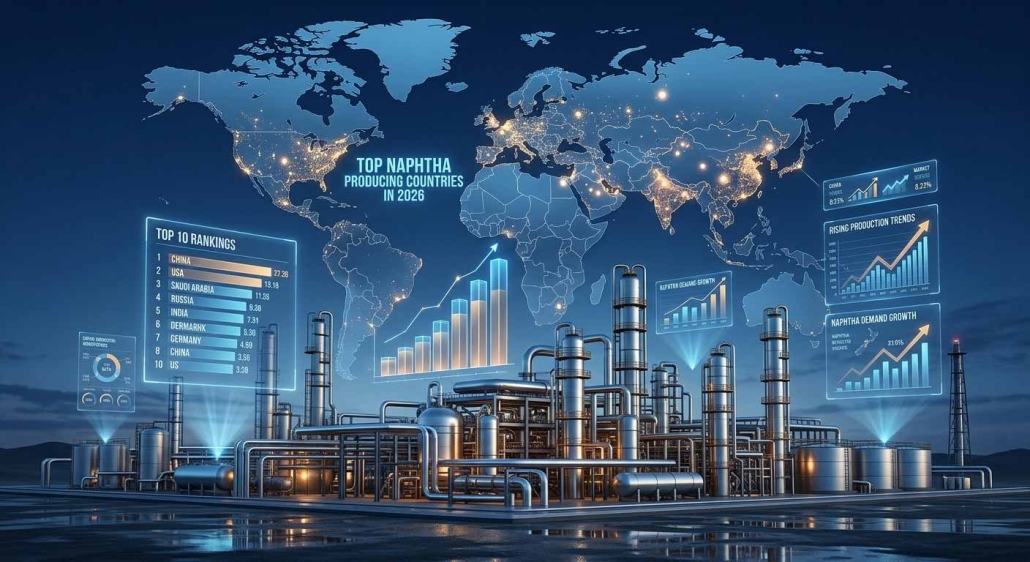
Top 10 Naphtha‑Producing Countries in 2026
Global naphtha output in 2026 is estimated at approximately 1,850–1,950 million tonnes per year (Mtpa), depending on refinery utilization rates and crude input quality.
| Rank | Country | Production Volume (Mtpa) | Share of Global Production |
|---|---|---|---|
| 1 | China | 280 | 14.5% |
| 2 | United States | 260 | 13.5% |
| 3 | India | 150 | 7.8% |
| 4 | Saudi Arabia | 140 | 7.2% |
| 5 | Japan | 120 | 6.2% |
| 6 | South Korea | 115 | 6.0% |
| 7 | Russia | 110 | 5.7% |
| 8 | Iran | 95 | 4.9% |
| 9 | Germany | 85 | 4.4% |
| 10 | Brazil | 70 | 3.6% |
Production Analysis
China and the United States lead due to massive refining capacity and integrated petrochemical complexes. China’s independent “teapot” refiners and mega complexes significantly boost naphtha availability for domestic steam crackers.
The Middle East, particularly Saudi Arabia and Iran, benefits from vertically integrated operations linking upstream production with petrochemical expansion. These developments are closely tied to the strategies of the Largest Oil Producers in the World and the Top Companies in Oil and Gas.
Asia remains the primary consumption hub, driving regional production growth. Countries like South Korea and Japan maintain large export-oriented petrochemical sectors despite limited domestic crude production.
Investors analyzing refinery competitiveness should also review the Largest Oil Refineries in the World and trends in Top Countries in Petroleum Product Production.
Global Naphtha Production by Region
| Region | Estimated Production (Mtpa) | Share of Global Production |
|---|---|---|
| Asia | 750 | 38% |
| North America | 420 | 21% |
| Europe | 310 | 16% |
| Middle East | 270 | 14% |
| South America | 110 | 6% |
| Africa | 70 | 4% |
Regional Insights
Asia dominates due to strong petrochemical demand and refining expansion. China, India, Japan, and South Korea anchor this growth.
North America, led by the U.S., benefits from shale-driven light crude availability, increasing light-end yields including naphtha.
The Middle East is expanding refinery-to-chemicals projects, increasing regional self-sufficiency and export capability.
Europe maintains steady production but faces structural refining constraints linked to energy transition policies and margin pressures.
For pricing benchmarks, traders frequently compare regional spreads alongside the Prices of Petroleum Products in Different Countries and insights from broader Naphtha Articles.

What Makes the Best Crude Oil in the World?
The quality of crude oil significantly affects naphtha yield and refining economics.
API Gravity
Higher API gravity (above 35°) indicates lighter crude. Light crude yields higher proportions of gasoline-range products and naphtha.
Sulfur Content
Low sulfur (“sweet”) crude reduces desulfurization costs and improves refining efficiency. Light sweet crude typically commands a premium.
Refining Yield
Crude oils with favorable distillation curves maximize high-value products such as gasoline, naphtha, and jet fuel. Refiners closely monitor product slates, particularly when optimizing gasoline blending streams, as discussed in More Articles About Gasoline and Top Countries in Gasoline Production.
Impact on Naphtha Output
Light sweet crudes typically produce higher naphtha yields compared to heavy sour crudes. However, complex refineries can upgrade heavier feedstocks to optimize light-end production.
Understanding crude quality is essential for forecasting margins, especially alongside projections like the Crude Oil Price Forecast for 2026.
Key Market Trends in the Global Naphtha Market
Petrochemical Demand Growth
Steam crackers in Asia continue to rely heavily on naphtha feedstock. While ethane cracking has expanded in North America, naphtha remains dominant in Asia and Europe.
Refinery Upgrades
Refineries are investing in residue upgrading and hydrocracking to improve product flexibility. Integration with petrochemical units enhances margins.
Crude Slate Changes
The global shift toward lighter crude production—particularly from U.S. shale—affects naphtha supply balances.
Competition with Alternative Feedstocks
LPG and ethane compete with naphtha in steam cracking. Feedstock economics often determine utilization rates.
Future Outlook for Naphtha Production
Demand Growth
Global naphtha demand is expected to grow at 2–3% annually through 2030, primarily driven by petrochemical expansion in Asia.
Refining Investments
Major refinery-to-chemicals projects in China, India, and the Middle East will increase integrated naphtha output.
Energy Transition Impacts
While electrification may reduce gasoline demand long term, petrochemical demand remains resilient. Plastics, synthetic materials, and industrial chemicals continue to underpin structural growth.
Producers are also diversifying portfolios into base oils and specialty products, as outlined in the Introduction to Types of Base Oil and broader coverage of Introduction to Bitumen.
Conclusion
The Top Naphtha Producing Countries 2026 landscape reflects a highly integrated global refining and petrochemical system. China and the United States lead global output, while the Middle East strengthens its downstream footprint. Asia remains the dominant demand center, shaping global trade flows.
Crude quality, refinery complexity, and petrochemical integration determine competitive advantage. As refining economics evolve alongside the energy transition, naphtha will remain a strategic pillar of the global petroleum products market.
For deeper analysis, explore our related resources on global refining, crude markets, and specialized Naphtha Articles.
Global Petroleum Trade Solutions | Universal Trades
As a reputable international petroleum trading enterprise, Universal Trades specializes in the reliable procurement, export, and supply chain management of high-grade petroleum commodities, refined fuels, and industrial feedstocks designed to meet rigorous global standards.








Leave a Reply
Want to join the discussion?Feel free to contribute!