
Calcined Petroleum Coke (CPC): The Essential Carbon Backbone
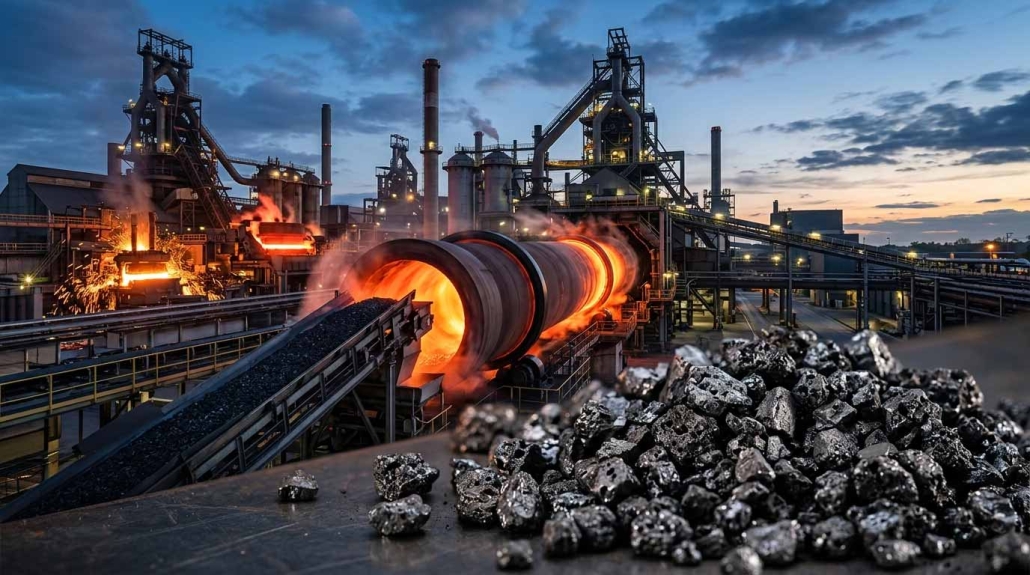
Calcined Petroleum Coke (CPC) is a refined carbon material transformed through high‑temperature processing to serve as a cornerstone for steel, aluminum, and electrode production. But first—is CPC toxic?
In its solid, stable form, CPC is not considered toxic. It does not readily react with skin or water and contains negligible volatile compounds. The only occupational caution concerns dust generation: prolonged inhalation of fine CPC dust may irritate the respiratory tract. With standard industrial ventilation and protective equipment, CPC is safe and environmentally stable, making it a reliable carbon source across industries.
For related context, see our introduction to petroleum products.
Chemical and Physical Characteristics of CPC
CPC results from the calcination of Green Petroleum Coke (GPC), removing volatile hydrocarbons at about 1300°C. The result is a dense, crystalline carbon with exceptional purity.
Key properties include:
- Fixed carbon: up to 98–99%
- Low sulfur and ash content: minimizes contamination in smelting
- High electrical conductivity: ideal for aluminum anodes and steel furnaces
- Stable crystalline structure: resists oxidation and mechanical wear
- Excellent thermal conductivity: crucial for energy‑intensive processes
Its unique blend of purity and conductivity explains why CPC dominates among types of petroleum coke.

Industrial Applications
Beyond its use in aluminum smelters, CPC has diverse industrial roles:
- Steelmaking: as a recarburizer, restoring carbon in molten steel
- Foundry operations: improving casting quality and graphite nucleation
- Electrode manufacturing: forming high‑density carbon anodes
- Chemical processes: serving as feedstock for carbon‑based compounds
Both its availability and performance make it a preferred replacement for synthetic graphite in cost‑sensitive operations.
Explore more articles on petroleum coke for extended industrial applications.
Production Process: From Crude Oil to Calcined Coke
The CPC manufacturing cycle follows this transformation sequence:
Crude Oil → Vacuum Distillation & Heavy Residue Extraction → Coking Unit (Thermal Cracking) → Green Petroleum Coke (GPC) → Calcination Process (1300°C) → Calcined Petroleum Coke (CPC)
Heavy residues from oil refining undergo thermal cracking in a coking unit, producing porous GPC. The material is then fed into rotary kilns where calcination expels water and hydrocarbons, increasing density and carbon purity.
Learn more in our guide to Green Petroleum Coke and the difference between Green and Calcined Petroleum Coke.
CPC vs. Other Major Coke Types
| Property | Calcined Petroleum Coke (CPC) | Green Petroleum Coke (GPC) | Metallurgical / Coal Coke |
|---|---|---|---|
| Fixed Carbon (% wt) | 98–99 | 85–90 | 80–88 |
| Volatile Matter (% wt) | <0.5 | 10–15 | <2 |
| Sulfur Content (% wt) | 0.3–1.0 | 1.5–3.0 | 0.5–1.2 |
| Density (g/cm³) | 2.0+ | 1.4–1.6 | 1.1–1.4 |
| Structure | Crystalline, dense | Porous, sponge‑like | Granular, hard |
| Major Use | Aluminum & Steel Electrode | Feedstock & Fuel | Blast Furnaces |
While GPC retains residual volatiles and serves mainly as fuel, CPC’s purity and conductivity enable technical uses where performance trumps price.
A deeper review of the difference between coal and petroleum coke sheds more light on their carbon efficiency.
Advantages and Disadvantages of CPC
Pros
- Superior purity: reduces impurities in metals and alloys
- Excellent conductivity & heat resistance
- Stable supply chain: derived from petroleum refining
- Cost‑effective: lower cost per carbon unit than synthetic graphite
Cons
- Energy‑intensive production: calcination requires significant heat input
- Dust control: fine particles need proper filtration
- Sulfur variation: depending on crude source, desulfurization may be needed
Despite these drawbacks, CPC remains the preferred choice for critical carbon reinforcement across heavy industry.
Role in the Steel Industry
In steelmaking, CPC functions primarily as a carbon raiser in the Electric Arc Furnace (EAF) process.
When scrap steel is melted, carbon levels decrease. Adding CPC restores the desired carbon grade, improving overall tensile strength and controlling the metallurgical balance. Its consistent high carbon yield and low sulfur content ensure impurity‑free output.
Moreover, CPC assists in forming a foaming slag layer, stabilizing temperature and reducing heat loss—an efficiency technique every metallurgist values.
For extended insight, explore more articles on petroleum products covering carbon optimization strategies.
Conclusion
Calcined Petroleum Coke bridges energy refining and industrial metallurgy, turning residual hydrocarbons into high‑value carbon solids.
Its purity, conductivity, and stability make it an irreplaceable material for modern steel and aluminum production—a testament to how advanced refining transforms by‑products into strategic industrial resources.
For in‑depth technical references, see our introduction to types of petroleum coke.
Global Petroleum Trade Solutions | Universal Trades
As a reputable international petroleum trading enterprise, Universal Trades specializes in the reliable procurement, export, and supply chain management of high-grade petroleum commodities, refined fuels, and industrial feedstocks designed to meet rigorous global standards.





Leave a Reply
Want to join the discussion?Feel free to contribute!