
Sulfur Content in Diesel Fuel: Standards, and Key Buying Considerations
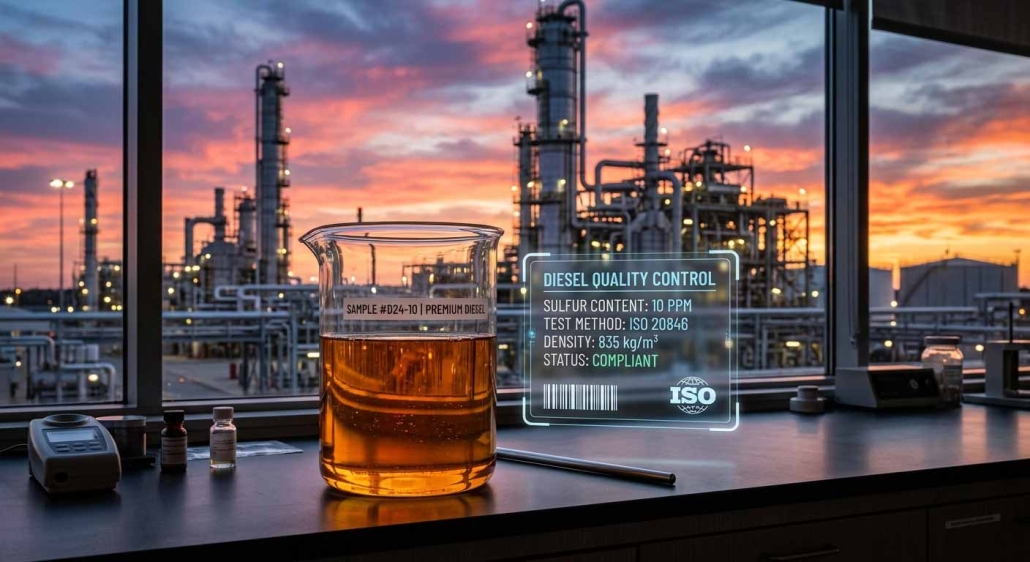
Summary: Sulfur is one of the most critical quality parameters in diesel trading, with a direct impact on pricing, customs acceptance, and engine reliability. This article reviews the applicable standards and test methods for sulfur in diesel and offers practical guidance to help buyers avoid sourcing off-spec fuel.
The Technical and Commercial Importance of Sulfur in Diesel Fuel
Sulfur occurs naturally in crude oil and is reduced during refining through advanced processes such as hydrodesulfurization. In the global petroleum products market, sulfur concentration is typically measured in ppm (parts per million) or mg/kg.
Reducing sulfur is not only an environmental requirement; it is also an engineering necessity. In modern engines, excessive sulfur can damage catalytic systems and diesel particulate filters (DPF), significantly increasing maintenance costs. For a broader understanding of diesel classifications, you can read Introduction to Diesel Fuel Types and Their Applications.
Comparison of Permissible Sulfur Limits Across Standard Fuel Grades
In international trade, fuel classifications are largely defined by sulfur content. Buyers should identify the standard required by the destination market before concluding any transaction.
| Standard / Fuel Grade | Maximum Sulfur Content | Main Application | Typical Target Market |
|---|---|---|---|
| EN590 Diesel | 10 ppm | Modern road transport | Europe, Gulf countries |
| Ultra-Low Sulfur Diesel (ULSD) | 15 ppm | EPA-compliant markets | North America |
| D1 Diesel | Variable (low) | High-speed engines / special applications | Niche markets |
| D2 Diesel | Variable (usually higher) | Heavy industry and power generation | Global trade, depending on specification |
| High-Sulfur Export Diesel | 500 to 5000 ppm | Legacy industrial use and certain marine applications | Increasingly restricted worldwide |
Note: Today, the 10 ppm standard, aligned with Euro 5 and Euro 6 requirements, has become the primary benchmark for transactions at major trading ports.
Test Methods and Quality Verification
Unlike some parameters such as diesel color, sulfur content cannot be determined by visual inspection. For accurate measurement, reference laboratories use methods such as X-ray fluorescence spectroscopy (XRF). These tests are an integral part of diesel production and quality control in modern refineries.
The results are typically recorded in a Certificate of Analysis (COA). Buyers should be able to interpret these reports properly to avoid receiving poor-quality or non-compliant diesel.
Table B: COA Checklist for Verifying Sulfur Parameters
When reviewing the technical documentation of a cargo, pay close attention to the following:
| Check Item | Why It Matters Contractually | Preferred Status in the Report |
|---|---|---|
| Sulfur Content | Confirms compliance with the agreed specification | A value at or below the contractual limit, e.g. 9.8 for a 10 ppm cap |
| Test Method | Confirms international validity of the analysis | Recognized standards such as ASTM D4294 or ISO 20846 |
| Sample Point | Helps verify the integrity of the full cargo | Sampling location clearly stated, e.g. shore tank or vessel tank |
| Test Date | Confirms freshness and relevance of the analysis | Date should match the cargo loading period |
Managing Contamination Risk in the Supply Chain
One of the most common challenges discussed in Diesel Storage Guidelines is cross-contamination. If a tank has not been properly cleaned, or if 10 ppm diesel is pumped through a pipeline that previously carried high-sulfur fuel, the entire cargo may fall out of specification. Even a small residue from the previous product can increase sulfur from 10 ppm to 30 ppm, leading to customs rejection at the destination.
In addition, when blending diesel with other components such as biodiesel, care must be taken to ensure that the final product still complies with the applicable legal sulfur limits.

Buyer’s Guide
For a successful purchase, simply referring to the product as “diesel” is not enough. A professional trader should ensure that the following details are clearly included in the purchase documentation.
Buyer’s Technical Checklist
- Unit precision: Use wording such as “Max 10 ppm” or “Max 10 mg/kg.”
- Combustion quality indicators: In addition to sulfur, agree on the cetane number, which defines ignition quality.
- Seasonal suitability: For deliveries to cold-climate markets, specify winter diesel requirements.
- Supplier validation: Review production capacity and reliability in the top 10 diesel-producing countries.
- Market analysis: Align pricing with diesel price forecasts and broader global market volatility.
Case Study: Legal Consequences of Ignoring Technical Specifications
In one international transaction, a buyer loaded a cargo bound for Europe without clearly specifying the sulfur limit in the sales contract. Upon arrival, inspectors found that the sulfur content was 15 ppm, while the local standard required 10 ppm. The result was substantial environmental penalties, return-shipment costs, and reputational damage for the buyer’s brand.
Frequently Asked Questions (FAQ)
Q: Does lowering sulfur reduce the lubricity of diesel fuel?
A: Yes. Sulfur removal can reduce lubricity, but refineries usually compensate for this by adding lubricity additives.
Q: What is the main difference between ULSD and regular diesel?
A: The main difference is sulfur concentration. Ultra-Low Sulfur Diesel (ULSD) contains a maximum of 15 ppm sulfur, while older grades may contain 500 ppm or more.
Q: Will using high-sulfur diesel in modern engines cause immediate engine failure?
A: No. The engine may continue to run, but the exhaust after-treatment system, especially the DPF, can be damaged quickly, leading to high repair costs in the short term.
Q: What is the most reliable way to draft a sulfur clause in a B2B contract?
A: The best practice is to reference a recognized international standard, for example:
“Sulfur content shall not exceed 10 mg/kg, tested as per ISO 20846.”
Q: Do crude oil price movements affect the premium on low-sulfur diesel grades?
A: Yes. As indicated by diesel price forecasts, stricter regulations typically increase demand for lower-sulfur grades, widening the price spread between compliant low-sulfur fuels and conventional alternatives.
Global Petroleum Trade Solutions | Universal Trades
As a reputable international petroleum trading enterprise, Universal Trades specializes in the reliable procurement, export, and supply chain management of high-grade petroleum commodities, refined fuels, and industrial feedstocks designed to meet rigorous global standards.










Leave a Reply
Want to join the discussion?Feel free to contribute!