
Why Base Oil Color Matters in Quality Evaluation
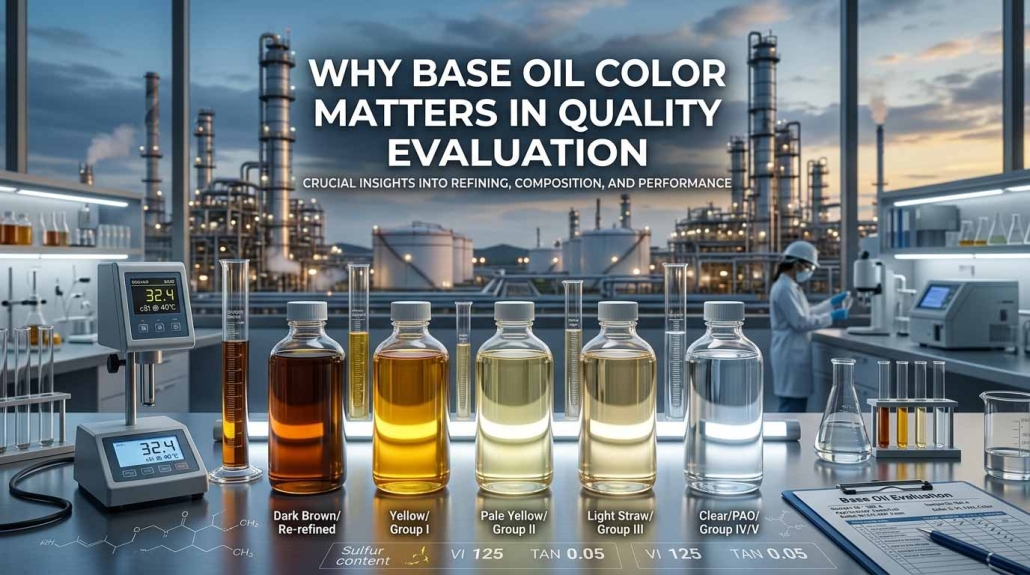
Base oil color is one of the fastest and simplest visual indicators used by lubricant manufacturers, traders, industrial buyers, and quality engineers. Although color alone does not determine performance, it often provides valuable clues about refining depth, contamination levels, oxidation, and overall product purity. In industrial markets where product consistency and quality assurance are critical, understanding what different colors mean can help buyers make informed decisions and avoid costly mistakes.
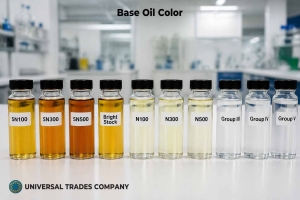
What Determines the Color of Base Oil?
Base oil color is influenced by a variety of chemical and mechanical factors. While modern refining processes increasingly produce clearer and lighter base oils, several underlying components still affect visual appearance.
1. Refining Processes
The depth and complexity of the refining process play the biggest role in determining color.
- Solvent extraction (Group I) leaves more aromatics → typically yellowish.
- Hydrocracking (Group II) removes more sulfur and aromatics → lighter yellow.
- Hydroisomerization (Group III) produces very clear, almost colorless base oils.
- Synthetic processes (Group IV & V) typically yield water‑clear products.
More advanced refining removes impurities that typically contribute to darker color.
2. Sulfur and Aromatic Content
Compounds such as sulfur and polycyclic aromatic hydrocarbons (PAHs) tend to impart a darker yellow or even brownish tint.
- Higher aromatics → darker color
- Lower aromatics → clearer, more transparent oil
This relationship is especially visible in the differences between Group I and Group II base oils.
3. Contaminants and Oxidation
Exposure to:
- Heat
- Oxygen
- Metal surfaces
- Water
- Storage tank contamination
…can cause oil to oxidize or degrade, shifting the color toward orange or brown.
4. Virgin vs. Recycled Base Oils
Virgin base oils are produced from fresh crude oil, whereas recycled (re‑refined) oils are processed from used lubricants.
- Virgin oils generally have a consistent, predictable color.
- Re‑refined oils may range from brown to yellow, depending on the purification technology used.
For more information on refining differences, refer to your site’s Base Oil Production Process section.
Typical Color of Different Base Oil Groups
Understanding the baseline color of each base oil group helps buyers quickly identify potential quality problems and also evaluate whether a shipment matches its specification.
Re‑refined (Recycled) Base Oil
- Color: Brown → Yellow
- Reason: Residual contaminants and limitations in purification technology
- Notes: Higher‑quality recycling plants can achieve near‑Group I color
Group I Base Oils
- Color: Yellow; becomes lighter as viscosity increases
- Important Note: SN500 and SN600 are often much clearer, sometimes appearing almost water‑like
- Reason: Lower degree of refining, higher aromatics
Group II Base Oils
- Color: Slightly yellow, but cleaner and brighter than Group I
- Reason: Hydrocracking removes more impurities
- Notes: Often used in applications requiring high oxidation stability
Group III Base Oils
- Color: Very clear; nearly colorless
- Reason: Hydroisomerization produces extremely pure molecules
- Notes: Often used in synthetic‑like lubricants
Group IV (PAO) and Group V (Esters)
- Color: Crystal clear; water‑like
- Reason: Chemically synthesized rather than refined
- Notes: Groups III, IV, and V generally have similar color characteristics
For more detail on these base oil families, see your internal resource on Introduction to Base Oil Types.
Base Oil Color by Grade (Table)
Below is a clear, practical table showing common base oil grades and their typical color characteristics.
| Base Oil Type / Group | Common Grades | Typical Color | Notes on Clarity / Appearance |
|---|---|---|---|
| Re‑refined Base Oil | Various (e.g., SN150 RR) | Brown → Yellow | Heavily depends on recycling technology and filtration |
| Group I | SN150 | Yellow | More aromatics, less refining |
| SN300 | Pale yellow | Cleaner than SN150 | |
| SN500 | Very light yellow → nearly clear | Approaches water‑like clarity | |
| SN600 | Very light yellow → clear | High clarity with proper refining | |
| Group II | N150 | Light yellow | Cleaner than Group I |
| N500 | Pale yellow → almost clear | High purity from hydrocracking | |
| Group III | 4 cSt, 6 cSt | Clear, colorless | Highly refined; premium clarity |
| Group IV | PAO 4, PAO 6, PAO 8 | Crystal clear | Synthetic; almost transparent |
| Group V | Ester oils | Clear | Similar to Group III/IV in appearance |
This table can help buyers quickly confirm whether a shipment visually matches expected standards. For deeper technical comparison, refer to the internal Base Oil Articles section.
Important Industry Notes About Color
These points summarize widely accepted industrial truths:
- Re‑refined base oils vary wildly in color based on purification depth—brown to yellow is normal.
- Group I base oils are generally yellow, but SN500 and SN600 are noticeably lighter and more transparent.
- Group II oils have a bright, pale‑yellow tone due to lower sulfur and aromatics.
- Groups III, IV, and V are usually nearly colorless, appearing almost like water.
Color is not everything—but it’s an essential first indicator.
Does Lighter Color Always Mean Higher Quality?
Not always.
While a lighter color can indicate:
- Fewer contaminants
- Better refining
- Lower sulfur
- Better oxidative stability
…it does not automatically guarantee superior performance.
For example:
- A light‑colored Group II oil may still have lower viscosity index (VI) than a darker Group I oil.
- A clear synthetic ester (Group V) may not be compatible with certain additives or seal materials.
- A shipment that is clear but oxidized internally will degrade during use despite looking good.
Thus, buyers must pair color inspection with other parameters like:
- Viscosity @ 40°C / 100°C
- Viscosity Index (VI)
- Sulfur content
- Flash point
- Pour point
- TAN (Total Acid Number)
For more background on related petroleum products, your readers can check Gasoil Articles and Kerosene Articles, where color also plays a role in quality assessment.
How Buyers and Traders Use Color in Quality Evaluation
1. Visual Inspection
Color is often checked during:
- Offloading at terminals
- Sampling from trucks or flexi bags
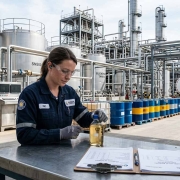
- Routine QC at blending plants
A simple comparison against known samples often reveals immediate red flags.
2. Relation to Refining Technology
The buyer can infer the production method:
- Yellowish → Group I
- Pale yellow → Group II
- Clear → Group III/IV/V
This helps confirm supplier claims and prevent mislabeling.
3. Detecting Contamination
Color shifts may indicate:
- Oxidation
- Fuel contamination
- Water ingress
- Metal particles
- Degraded additives
A darker color than expected is often reason enough to request additional testing or reject a shipment.

Conclusion
Base oil color provides essential insights into refining quality, purity, contamination levels, and overall product health. Although it should never be the sole indicator of quality, it is a reliable first‑level test widely used across the lubricant and petrochemical supply chain.
To properly evaluate base oil quality, buyers should consider both:
- Color
- Technical specifications (VI, sulfur, viscosity, TAN, and oxidation stability)
Combining visual inspection with laboratory analysis ensures optimal performance, consistent blending results, and reliable product quality.
FAQ (Common Buyer Questions)
1. Is darker base oil always lower quality?
Not necessarily, but it often signals higher aromatics or insufficient refining.
2. Why does SN500 appear clearer than SN150?
Higher‑viscosity Group I grades often undergo additional refining, producing a lighter color.
3. Should color alone be used to approve a shipment?
No. Color should accompany viscosity, VI, sulfur, TAN, and flash point checks.
4. Do synthetic base oils always look water‑clear?
Groups III, IV, and V are typically very clear, but minor variations can occur depending on additives or storage conditions.
5. Can recycled base oil match virgin oil color?
High‑tech re‑refining plants can achieve near‑virgin clarity, but many facilities produce yellow to brown results.
Global Petroleum Trade Solutions | Universal Trades
As a reputable international petroleum trading enterprise, Universal Trades specializes in the reliable procurement, export, and supply chain management of high-grade petroleum commodities, refined fuels, and industrial feedstocks designed to meet rigorous global standards.





Leave a Reply
Want to join the discussion?Feel free to contribute!