
180 cSt vs 280 cSt vs 380 cSt Fuel Oil: Technical Differences, Specs & Sourcing Guide
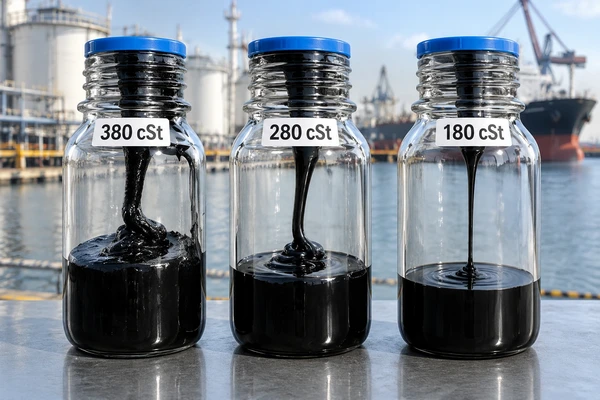
Quick Take: When evaluating heavy fuel oil (mazut) grades—180 cSt, 280 cSt, and 380 cSt—procurement managers must look beyond commercial nomenclature. Kinematic viscosity measured at 50°C dictates storage, pumping, and preheating requirements. While 180 cSt offers easier handling in legacy plants with limited heating capacity, 380 cSt dominates modern marine bunkering and large industrial burners due to its superior energy density and cost efficiency, provided the fuel-handling system is engineered for higher viscosity.
Introduction: Understanding Heavy Fuel Oil Viscosity Designations
Heavy fuel oil, widely traded internationally as mazut or bunker fuel, is categorized primarily by its kinematic viscosity. In B2B petroleum procurement, understanding the technical differences between 180 cSt, 280 cSt, and 380 cSt is essential for maintaining burner efficiency, preventing pump cavitation, and protecting industrial boilers and marine diesel engines.
Viscosity is not an indicator of overall fuel quality, sulfur content, or calorific value by itself. Instead, it measures a fluid’s resistance to flow. To explore broader quality parameters, refer to our detailed guide on Fuel Oil Specifications Explained and our analysis of Fuel Oil Sulphur Content.
What Does cSt Mean? Temperature and Commercial Naming
The unit cSt stands for centistokes, a metric unit of kinematic viscosity equivalent to 1 mm²/s. In accordance with standard testing protocols (such as ASTM D445 and ISO 3104), residual fuel oil viscosity is universally referenced at 50°C (122°F):
- 180 cSt: Maximum kinematic viscosity of 180 mm²/s at 50°C.
- 280 cSt: An intermediate commercial designation (often reflecting regional refinery cutter stock blends) with a maximum viscosity of 280 mm²/s at 50°C.
- 380 cSt: Maximum kinematic viscosity of 380 mm²/s at 50°C, serving as the workhorse standard for modern marine bunkering (Understanding Fuel Oil CST: Why 380 CST is a Standard for Bunkering).
Crucially, buyers must note that viscosity decreases exponentially as temperature increases. Pumping heavy fuel oil requires maintaining storage and pipeline temperatures well above ambient levels to ensure proper fluid flow before it reaches the injection nozzles.
Side-by-Side Comparison: 180 cSt vs. 280 cSt vs. 380 cSt
| Parameter / Feature | 180 cSt Grade | 280 cSt Grade | 380 cSt Grade |
|---|---|---|---|
| Max Viscosity (at 50°C) | 180 mm²/s (ISO-aligned) | 280 mm²/s (Commercial cut) | 380 mm²/s (ISO-aligned RMG/RMK) |
| Primary Market & Application | Older industrial boilers, legacy kilns, medium-sized power plants. | Regional industrial setups, specialized bunkering blends. | Modern deep-sea bunkering, large utility boilers, cement plants. |
| Storage Temp. Range | 45°C – 55°C | 50°C – 60°C | 55°C – 70°C |
| Preheating Requirement | Moderate (90°C – 110°C at burners) | Moderate-to-High (105°C – 120°C) | High (115°C – 135°C at burners) |
| Pumping & Filtration | Standard heavy-duty gear pumps; standard duplex strainers. | Requires jacketed piping and robust suction strainers. | Heated transfer lines, positive displacement pumps, fine 30-micron filtration. |
| Cost & Availability | Generally higher unit cost due to lower cutter stock blending ratios. | Competitive regional pricing; depends on refinery cat-cracker yield. | Most economical per gigajoule in bulk global bunker markets. |
Detailed Analysis of Each Grade
1. Fuel Oil 180 cSt
Advantages: Easier to handle in facilities with modest thermal oil or steam heating infrastructure. It requires lower preheating temperatures to reach the optimal atomization viscosity (10 to 20 cSt at the burner tip).
Limitations: Typically carries a higher market premium per metric ton compared to heavier grades because it incorporates a larger share of distillate cutter stocks.
When NOT to select: Avoid if your facility is optimized for high-viscosity burning and you seek maximum thermal energy per dollar in large-scale operations.
Read more about its specific technical profile in our dedicated Fuel Oil (Mazut) CST 180 Guide.
2. Fuel Oil 280 cSt
Advantages: Serves as a practical middle-ground option for industrial plants transitioning between mid-range and heavy residual fuels. It bridges pricing gaps in regional spot markets.
Limitations: Because 280 cSt is frequently a regional commercial blend rather than a strict global ISO benchmark, batch-to-batch consistency in density and asphaltene stability must be verified closely via Certificate of Analysis (CoA).
When NOT to select: Do not use if your bunker supplier or local refinery cannot provide a certified kinematic viscosity test report at 50°C.
3. Fuel Oil 380 cSt
Advantages: High energy density and maximum economic efficiency for high-volume consumers. It represents the global benchmark for commercial shipping (Understanding Fuel Oil CST: Why 380 CST is a Standard for Bunkering).
Limitations: Demands robust thermal management. Inadequate storage tank heating can lead to asphaltene precipitation, filter clogging, and pump failure.
When NOT to select: Never procure 380 cSt if your facility lacks jacketed fuel lines, efficient steam/electric heaters, or adequate atomization pressure.
Price per Metric Ton vs. Total Delivered-and-Used Cost
A common procurement error is purchasing fuel solely based on the lowest price per metric ton. Evaluating total delivered-and-used cost requires accounting for:
- Thermal Energy for Heating: Heavier grades (380 cSt) require sustained energy input in storage tanks and pipelines.
- Pumping & Maintenance: Higher viscosity increases wear on fuel pumps, seals, and atomizers if fuel treatment plants (centrifuges and heaters) are mismanaged.
- Compatibility & Stability: Mixing incompatible bunker batches can cause sludge formation, blocking filters instantly. Review our guide on How to Choose the Right Fuel Oil Grade.
Can You Tell Fuel Oil Grades Apart by Looking at Them?
A common misconception among first-time buyers is that heavy fuel oil grades can be identified visually—for instance, assuming that 380 cSt is darker or thicker in a glass jar than 180 cSt. In reality, visual appearance does not indicate viscosity grade. Color, opacity, and sheen are influenced by crude oil origin, refining history (such as visbreaking or cracking severity), temperature, and lighting conditions. Two samples of 180 cSt and 380 cSt can appear identical to the naked eye. Reliable verification requires laboratory testing per ASTM D445. Learn more in our guide on How to Test Fuel Oil Quality Before Buying.
B2B Procurement Checklist
- Reference Temperature & Test Method: Confirm viscosity is tested at 50°C via ASTM D445 or ISO 3104.
- Certificate of Analysis (CoA): Require independent lab verification for sulfur content, density at 15°C, flash point, water and sediment (W&S), and pour point.
- Emissions Compliance: Check sulfur limits against destination regulations or emission control areas (ECAs), distinguishing between Low-Sulfur (LSFO) and High-Sulfur Fuel Oil (HSFO).
- Logistics & Incoterms: Define delivery terms (FOB, CFR, CIF) and vessel heating capabilities.
Frequently Asked Questions (FAQ)
1. Is 380 cSt fuel oil of lower quality than 180 cSt?
No. Viscosity measures flow resistance, not chemical quality. 380 cSt simply contains higher proportions of heavier residual fractions, providing excellent energy density when heated correctly.
2. Can I burn 380 cSt fuel oil in an installation designed for 180 cSt?
Only if your system has sufficient heating capacity to lower the viscosity to the required 10 to 20 cSt range at the burner nozzles. Otherwise, higher viscosity will cause poor atomization and incomplete combustion.
3. Is 280 cSt a recognized ISO standard grade?
While major ISO 8217 residual categories include RMG 180 and RMG/RMK 380, “280 cSt” is frequently used as a commercial supplier designation rather than a standalone ISO classification number. Always verify exact specification limits on the CoA.
4. How does sulfur content correlate with 180, 280, and 380 cSt grades?
There is no fixed correlation. Both 180 cSt and 380 cSt can be produced as High-Sulfur Fuel Oil (HSFO) or Low-Sulfur Fuel Oil (LSFO) depending on the refining process and desulfurization methods.
Request for Quotation (RFQ)
Choosing between 180 cSt, 280 cSt, and 380 cSt fuel oil depends directly on your equipment’s thermal capabilities, storage infrastructure, and economic objectives. For reliable sourcing, professional grade verification, and competitive pricing, explore our Universal Trades Products Page.
Ready to place an order or discuss your specifications? Contact our commercial team directly via WhatsApp with your required volume, destination port, and target specifications.








Leave a Reply
Want to join the discussion?Feel free to contribute!