
Euro 6 Diesel: Standards, Sulfur, Emissions, and Specifications

Euro 6 diesel is the benchmark for modern low-emission diesel fuel and vehicle compliance in many global markets. For fuel buyers, traders, fleet operators, and everyday readers, understanding Euro 6 is no longer optional: it sits at the intersection of fuel quality, emissions control, engine durability, and regulatory compliance.
In simple terms, Euro 6 is part of Europe’s latest major emissions framework for road vehicles, but in practice it is closely tied to the quality of diesel fuel used in those engines—especially ultra-low sulfur diesel (ULSD) with a sulfur limit of 10 ppm. That low sulfur level is essential because advanced aftertreatment systems such as DPF, SCR, and AdBlue-assisted emissions control cannot function properly with higher-sulfur fuel.
This guide explains what defines Euro 6 diesel, how it compares with Euro 5 and Euro 7, the role of sulfur and EN590 specifications, the technologies behind compliance, and what fuel professionals should evaluate before buying or supplying product.
What Is Euro 6 Diesel?
The term Euro 6 diesel is commonly used in two connected ways:
- Vehicle emissions compliance under Euro 6 regulations
- Diesel fuel quality suitable for Euro 6-compliant engines, usually aligned with EN590 diesel and ULSD diesel standards
Strictly speaking, Euro 6 is a vehicle emission standard, not a standalone fuel specification. However, Euro 6 engines depend on very clean diesel fuel to meet their required emissions levels. In practical industry use, “Euro 6 diesel” usually refers to road diesel with sulfur content capped at 10 ppm and quality characteristics compatible with modern low-emission diesel engines.
For readers comparing fuel grades, Euro 6 diesel is best understood as ultra-low sulfur automotive diesel designed for advanced emissions systems.
Evolution of European Diesel Emission Standards
European diesel standards evolved in stages to reduce harmful pollutants such as nitrogen oxides (NOx) and particulate matter (PM). Each step tightened engine and fuel quality requirements.
Table 1 — Euro Emission Standard Comparison
| Standard | Approx. Introduction | NOx Limit (Diesel Passenger Cars) | PM Limit | PN Limit | General Impact |
|---|---|---|---|---|---|
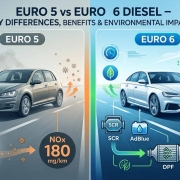
| Euro 5 | 2009 | 0.180 g/km | 0.005 g/km | 6.0×10116.0 \times 10^{11}/km | Major PM reduction, DPF became common |
| Euro 6 | 2014 | 0.080 g/km | 0.005 g/km | 6.0×10116.0 \times 10^{11}/km | Large NOx reduction, SCR adoption increased |
| Euro 7* | Upcoming | More stringent real-world control | Expected tighter | Expected tighter | Broader real-driving and lifecycle compliance |
*Euro 7 implementation details vary by vehicle category and timeline, and practical market rollout continues to evolve.
Before Euro 5 and Euro 6, earlier categories such as Euro 2 diesel, Euro 3 diesel, and Euro 4 diesel reflected progressive reductions in sulfur and tailpipe pollutants. If your content strategy includes historical comparisons, it is useful to also reference Euro 5 diesel because Euro 5 was the direct precursor to Euro 6.
What Defines Euro 6 Diesel Fuel?
From a fuel perspective, Euro 6 diesel is defined less by a separate “Euro 6 fuel law” and more by the combination of:
- Ultra-low sulfur content
- Compliance with automotive diesel fuel standards, especially EN590
- Suitability for advanced aftertreatment systems
- Controlled physical and chemical properties for combustion quality and emissions performance
The most important point is that Euro 6 engines require clean, stable, low-sulfur fuel. High sulfur levels can poison catalysts, increase particulate formation, and shorten the life of exhaust aftertreatment components.
In commercial fuel trade, buyers often cross-check Euro 6 suitability against:
- Sulfur content
- Cetane number
- Density
- lubricity
- flash point
- distillation behavior
- cold-flow properties depending on climate
These parameters also matter when comparing automotive diesel with other commercial grades such as D1 diesel and D2 diesel, which may be discussed differently in export or non-European trading contexts.
Sulfur Content and ULSD Requirements
One of the defining features of Euro 6 diesel sulfur content is the maximum sulfur limit of 10 ppm. This is the same sulfur threshold generally associated with ULSD diesel in regulated road-fuel markets.
Why does sulfur matter so much?
- Higher sulfur increases SOx emissions
- It contributes to formation of sulfate particulates
- It damages or reduces efficiency of catalysts and filters
- It prevents modern emissions systems from operating as designed
For this reason, the shift from higher-sulfur diesel to ULSD was not just a fuel quality upgrade—it was a necessary foundation for Euro 6 technology.
If you are publishing a wider content cluster, this section should internally connect to deeper resources on diesel sulfur content, petroleum products, and the diesel production process, because sulfur reduction begins at the refining stage through hydrotreating and related upgrading processes.
Key Technologies Used in Euro 6 Diesel Engines
Euro 6 compliance is not achieved by fuel quality alone. It depends on a combination of engine calibration, combustion control, and exhaust aftertreatment.
Diesel Particulate Filter (DPF)
A DPF captures soot and fine particulate matter from diesel exhaust. This is one reason Euro 5 and Euro 6 were so effective in reducing PM emissions. However, DPFs work best with low-ash, low-sulfur fuel. Excess sulfur can increase deposit formation and regeneration problems.
Selective Catalytic Reduction (SCR)
SCR is the main technology used to reduce NOx emissions in many Euro 6 diesel vehicles. It injects a urea-based fluid into the exhaust stream, where it helps convert NOx into nitrogen and water.
AdBlue Systems
AdBlue is the commercial name commonly used for the aqueous urea solution employed in SCR-equipped vehicles. Without AdBlue, many Euro 6 diesel systems cannot maintain low NOx emissions under normal operating conditions.
Exhaust Gas Recirculation (EGR)
Though not always the headline technology, EGR remains important in many diesel engines by lowering combustion temperatures and helping reduce NOx formation at the source.
Real Driving Emissions (RDE) Tests
A major turning point in Euro 6 emission standards was the expansion from laboratory-only testing to RDE evaluation. Real Driving Emissions testing aims to verify that vehicles remain compliant not only in controlled test cells but also in actual road conditions. This mattered because earlier compliance strategies sometimes performed well in the lab but less well in real use.
Euro 6 Sub-Standards: 6b, 6c, 6d-TEMP, and 6d
The Euro 6 framework includes several sub-stages, and this is often overlooked in basic articles.
- Euro 6b: Early phase of Euro 6 implementation
- Euro 6c: Tighter alignment with updated laboratory procedures, including WLTP-related transition
- Euro 6d-TEMP: Transitional stage incorporating real-driving emissions conformity factors
- Euro 6d: More mature and stringent real-world compliance stage
For consumers, these sub-categories affect how “clean” a Euro 6 vehicle may be in practice. For fuel professionals, the key takeaway is that later Euro 6 vehicles are even more dependent on stable, very low-sulfur diesel of correct quality.
Euro 5 vs Euro 6 vs Euro 7 Comparison
The phrase “Euro 6 vs Euro 5 diesel” is one of the most searched comparisons because Euro 6 introduced a dramatic cut in NOx emissions.
Table 2 — Diesel Fuel Technical Specifications
| Parameter | Euro 5-Compatible Road Diesel | Euro 6-Compatible Road Diesel | Euro 7-Oriented Market Expectation* |
|---|---|---|---|
| Sulfur content | Max 10 ppm in ULSD markets | Max 10 ppm | Max 10 ppm or equivalent low-sulfur requirement |
| Cetane number | Typically min 51 under EN590 | Typically min 51 under EN590 | Likely similar baseline with tighter performance control |
| Density at 15°C | Typically 820–845 kg/m³ | Typically 820–845 kg/m³ | Likely similar, depending on regional spec |
| Lubricity (HFRR) | Max 460 µm | Max 460 µm | Expected similarly controlled |
| Flash point | Usually min 55°C | Usually min 55°C | Likely comparable |
| Distillation (95% recovered) | Typically max 360°C | Typically max 360°C | Likely similar or optimized for emissions performance |
| Aromatics | Controlled by market/specification | Controlled by market/specification | Continued emphasis on cleaner combustion |
*Euro 7 is primarily an emissions regime; fuel requirements remain closely associated with existing low-sulfur road diesel specifications rather than a dramatically separate retail fuel grade.
The main difference between Euro 5 and Euro 6 is not that sulfur suddenly changed from high to low—by the time Euro 5 and Euro 6 dominated regulated road markets, 10 ppm sulfur fuel was already established in many regions. The larger difference is how much more demanding Euro 6 is in terms of NOx control, aftertreatment efficiency, and real-world emissions performance.
Euro 7, meanwhile, is expected to increase scrutiny on:
- Real-world performance
- Broader operating conditions
- Durability over vehicle life
- Potentially tighter total emissions management
Fuel Quality Specifications and Laboratory Analysis
A serious article on Euro 6 diesel specifications should go beyond sulfur alone. Buyers and technical teams evaluate multiple test parameters before accepting a cargo or storage batch.
Core laboratory parameters
- Sulfur (ppm): verifies ULSD compliance
- Cetane number: indicates ignition quality; related to smoother combustion
- Density: affects energy content and volumetric trade
- Lubricity: critical for fuel injection equipment protection
- Flash point: important for safety and handling
- Distillation profile: affects volatility and combustion behavior
- Cold flow properties: important for seasonal and regional use
This is where internal links to cetane number, winter diesel, and diesel storage guide become highly relevant.
For example, a fuel may meet sulfur requirements yet still cause performance issues if its cold-flow properties are unsuitable for low-temperature regions. Likewise, poor storage practices can degrade otherwise compliant product through water contamination, microbial growth, or sediment formation.
Table 3 — Euro Standard Timeline
| Euro Standard | Introduction Period | Key Diesel-Related Significance |
|---|---|---|
| Euro 1 | Early 1990s | Beginning of structured EU tailpipe regulation |
| Euro 2 | Mid-1990s | Tighter pollutant limits than Euro 1 |
| Euro 3 | Around 2000 | Further controls, growing focus on diesel pollutant reduction |
| Euro 4 | Mid-2000s | Stronger reduction in PM and NOx |
| Euro 5 | Around 2009 | DPF adoption accelerated; PM standards tightened |
| Euro 6 | From 2014 | Major NOx reduction; SCR and RDE importance increased |
| Euro 7 | Upcoming | Expanded real-world and lifecycle emissions control |
Environmental Impact of Euro 6 Diesel
Euro 6 diesel has significantly reduced emissions compared with older generations, especially in urban air-quality terms. Its main environmental strengths include:
- Lower particulate emissions
- Much lower NOx limits than Euro 5
- Better compatibility with emissions-control systems
- Lower sulfur-related pollution
That said, Euro 6 diesel is not emissions-free. Carbon dioxide remains tied to fuel consumption, and real-world environmental performance depends on:
- Vehicle maintenance
- Fuel quality
- AdBlue availability in SCR systems
- Proper DPF operation
- Driving conditions
A balanced technical article should therefore present Euro 6 as a major improvement, but not as the end of the emissions story.
Global Adoption of Euro 6 Diesel
Although “Euro” standards originated in Europe, Euro 6-equivalent diesel quality has influenced markets far beyond the EU. Many importing countries, especially those modernizing vehicle fleets or urban fuel quality regulations, have moved toward 10 ppm sulfur road diesel.
However, adoption is uneven. Some markets still use higher-sulfur diesel in non-road, marine, off-grid, or legacy vehicle sectors. This creates a practical issue for exporters and traders: always verify whether the buyer requires:
- EN590 road diesel
- ULSD automotive diesel
- lower-grade diesel for industrial use
- export categories such as D2 or other non-EU commercial descriptions
Future of Diesel Standards: Euro 7
Interest in Euro 7 diesel standards has grown because the next regulatory phase is expected to place even more emphasis on:
- real-world emissions
- broader temperature and load ranges
- durability over longer service intervals
- tighter control of pollutants beyond the traditional lab cycle
Euro 7 does not necessarily mean a radically new sulfur specification at the fuel pump. Instead, it will likely continue to rely on very clean low-sulfur diesel while demanding better vehicle performance under a wider range of real conditions.
For this reason, Euro 6 diesel remains highly relevant today: it is the operating foundation for current low-emission diesel systems and a stepping stone toward Euro 7 compliance.
Practical Considerations for Fuel Buyers and Traders
For commercial buyers, “Euro 6 diesel” should never be accepted as a vague marketing label. Always confirm the exact specification.
Checklist for buyers
- Verify sulfur content: must be max 10 ppm for Euro 6-compatible road use
- Check standard reference: EN590 or equivalent regional road-diesel specification
- Review COQ/COA: sulfur, density, cetane, flash point, lubricity, distillation
- Confirm seasonal suitability: especially for cold climates and winter diesel needs
- Evaluate storage and handling
- Understand end use: passenger vehicles, heavy-duty fleets, generators, or export resale
- Clarify blend content: some markets include renewable components or biodiesel blending
For general readers, the practical message is simpler: if a vehicle is designed for Euro 6 road use, it needs clean low-sulfur diesel of the proper grade. Using off-spec fuel can increase maintenance costs and damage emissions systems.
This is also where comparative content such as diesel vs gasoline and diesel vs kerosene helps readers understand why diesel quality standards are so application-specific.
FAQ: Euro 6 Diesel
What is Euro 6 diesel?
Euro 6 diesel generally refers to diesel fuel suitable for Euro 6-compliant vehicles, typically ultra-low sulfur road diesel with a 10 ppm sulfur limit and EN590-type quality characteristics.
What is the sulfur content of Euro 6 diesel?
The maximum sulfur content is typically 10 ppm.
Is Euro 6 diesel the same as ULSD?
In most regulated road-fuel markets, Euro 6-compatible diesel is effectively a form of ULSD diesel, since both rely on very low sulfur content.
What is the difference between Euro 5 and Euro 6 diesel?
Fuel sulfur may be similarly low in both regulated markets, but Euro 6 emission standards are much stricter, especially for NOx, and rely more heavily on systems like SCR, DPF, and AdBlue.
What is EN590 and why does it matter?
EN590 is the main European specification for automotive diesel fuel. It defines key fuel quality properties required for modern diesel vehicle performance and emissions compatibility.
What is the role of AdBlue in Euro 6 vehicles?
AdBlue is used in SCR systems to reduce NOx emissions by converting them into nitrogen and water.
Is Euro 7 diesel available?
Euro 7 is primarily a regulatory emissions framework rather than a completely separate consumer diesel fuel grade. It builds on the clean-fuel foundation already used for Euro 6 systems.
Conclusion
Euro 6 diesel represents far more than a fuel label. It is the practical combination of 10 ppm sulfur ULSD quality, EN590-aligned fuel characteristics, and compatibility with advanced emissions technologies such as DPF, SCR, and AdBlue systems.
Compared with older diesel standards, Euro 6 delivers major reductions in NOx and particulate emissions, while also demanding better fuel cleanliness, stronger quality control, and greater attention to real-world performance. For traders and buyers, that means verifying specification details rather than relying on generic naming. For everyday readers, it means understanding that modern diesel engines depend on very specific fuel quality to stay efficient, compliant, and durable.
In short, Euro 6 diesel remains the current reference point for clean road diesel in many markets—and the foundation on which future Euro 7 diesel standards will continue to build.
Global Petroleum Trade Solutions | Universal Trades
As a reputable international petroleum trading enterprise, Universal Trades specializes in the reliable procurement, export, and supply chain management of high-grade petroleum commodities, refined fuels, and industrial feedstocks designed to meet rigorous global standards.






Leave a Reply
Want to join the discussion?Feel free to contribute!