
Best Transportation Methods for Petroleum Products: Road, Rail, Sea & Pipelines
Transporting petroleum products efficiently and safely is one of the most critical components of the global energy supply chain. Whether dealing with gasoline, diesel, kerosene, bitumen, sulfur, or any other refined product, choosing the right transport method can significantly impact cost, delivery time, safety, and environmental performance.
As explained in our Introduction to Petroleum Products, these materials are highly sensitive, flammable, and must be moved under strict quality and safety standards. This article provides the most comprehensive comparison of transportation options available today—road, rail, sea, and pipelines—so logistics managers, traders, and industrial buyers can make informed decisions.
For more educational resources, visit: More Articles About Petroleum Products.
Why Petroleum Transportation Matters
Every day, millions of barrels of gasoline, diesel, kerosene, and other products must be delivered from refineries to distribution hubs, industrial consumers, and international markets. The efficiency of transportation directly affects:
- Final product prices
- Supply security
- Environmental impact
- Delivery reliability
- Safety throughout the chain
Fluctuations in global conditions—such as international freight rates, bunker fuel prices, or cross‑border regulations—also influence transport costs. (See also: Price of Petroleum Products in Different Countries)
Overview of Transportation Methods
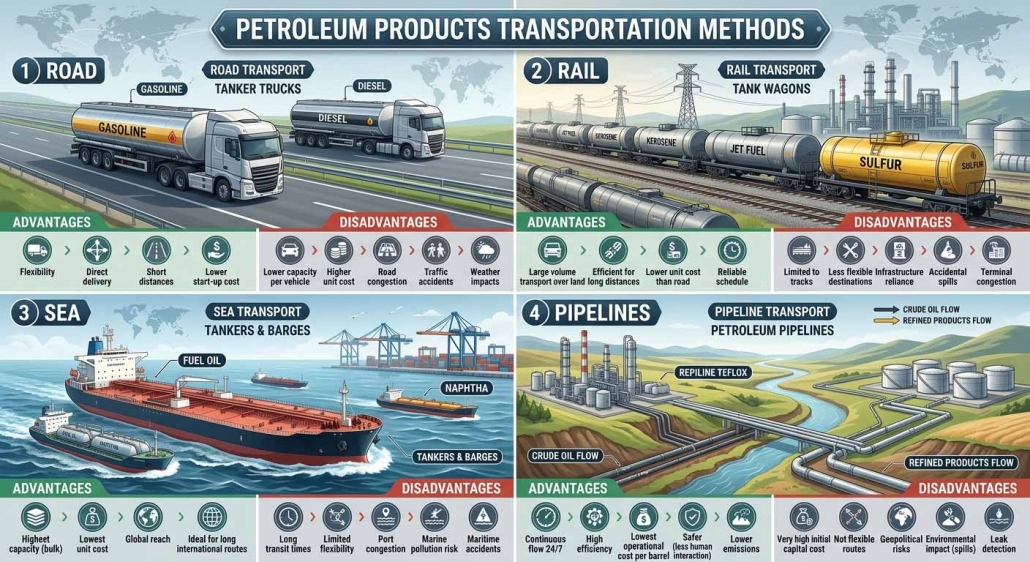
This guide analyzes four primary methods used worldwide:
- Road Transport (Tanker Trucks)
- Rail Transport (Tank Wagons)
- Sea Transport (Oil Tankers & Barges)
- Pipelines (Crude & Refined Product Pipelines)
Below is a detailed comparison.
Comparison Table: Advantages & Disadvantages of Petroleum Transportation Methods
| Method | Advantages | Disadvantages |
|---|---|---|
| Road (Tanker Trucks) | – Highly flexible routes and delivery points
– Ideal for short distances – Fast loading/unloading – Good for distributing fuels like gasoline and diesel to retail stations |
– Higher cost per ton/km
– Sensitive to road conditions and traffic – Greater risk of accidents and spills |
| Rail (Tank Wagons) | – Cost‑effective for medium to long distances
– Safer and more stable than road – Environmentally cleaner – Suitable for bulk products like kerosene, fuel oil, and sulfur |
– Limited route flexibility
– Requires loading/unloading terminals – Slower than trucks for short distances |
| Sea (Tankers, Barges) | – Best for long‑distance and international trade
– Extremely large capacity (millions of barrels) – Lowest cost per ton for long routes – Ideal for transporting crude, bitumen, and heavy fuels |
– Long transit times
– Weather‑dependent – Higher operational regulations – Port congestion risks |
| Pipelines | – Cheapest method for large, continuous volumes
– Safest & most environmentally friendly – Very low labor and operational costs – Ideal for gasoline, diesel, jet fuel |
– Very high upfront construction cost
– Fixed routes only – Requires continuous monitoring – Not ideal for small‑volume, variable shipments |
Cost Comparison: Which Method Is the Most Expensive and Which Is the Cheapest?
Highest Transportation Cost: Road (Tanker Trucks)
Road transportation has the highest per‑unit cost due to:
- Fuel consumption
- Driver wages
- Vehicle maintenance
- Limited capacity per truck
- Traffic and delay risks
It is best suited for short-range distribution, such as delivering gasoline and diesel to fuel stations or moving kerosene and bitumen within a region.
Lowest Transportation Cost: Pipelines
Pipelines are the cheapest transportation method in the long term because:
- Minimal labor requirement
- Continuous flow
- Low energy consumption
- Low maintenance costs
Pipelines are ideal for gasoline, diesel, jet fuel, and similar refined products.
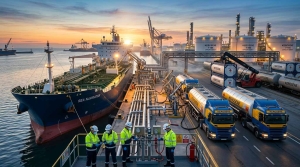
Detailed Analysis of Each Transportation Method
Road Transport (Tanker Trucks)
Road transport remains the most flexible and widely used option for last‑mile delivery.
Best for:
Gasoline, diesel, kerosene, bitumen (heated tankers), sulfur (in bulk or containerized form)
When to choose road transport:
- Deliveries to gas stations
- Remote areas without rail or pipeline access
- Urgent short-distance shipments
Rail Transport (Tank Wagons)
Rail is a reliable, cost-effective bulk transport option for countries with good rail infrastructure.
Best for:
Fuel oil, kerosene, diesel, industrial sulfur, export shipments to ports
Sea Transport (Tankers & Barges)
Ideal for international trade and large-volume shipments.
Commonly used for bitumen, crude oil, marine fuels, and bulk petroleum products.
Best for:
Long-distance import/export, offshore refineries, cross‑continent shipments
Pipelines
Pipelines represent the backbone of many major fuel distribution networks.
Best for:
Gasoline, diesel, aviation fuel, kerosene
(Not ideal for bitumen due to viscosity, unless heated pipelines are used)
Choosing the Best Transportation Method for Each Petroleum Product
- Gasoline → Pipelines → Road for final distribution
- Diesel → Pipelines / Rail
- Kerosene (Jet Fuel) → Pipelines
- Bitumen → Road (heated trucks) / Sea for export
- Sulfur → Rail or sea (bulk)
Expert Tips for Businesses & Logistics Managers
- Use rail or pipeline whenever possible to reduce costs.
- Use sea transport for international or intercontinental shipments.
- Ensure proper certifications and safety compliance for hazardous materials.
- Monitor global freight price trends.
- Use insulated or heated transport for high-viscosity products like bitumen.
FAQ: Petroleum Product Transportation
What is the safest method of transporting petroleum products?
Pipelines—lowest accident risk and best environmental performance.
Which method is best for long-distance exports?
Sea transport using tankers.
What is the fastest delivery method?
Road transport for short distances.
Which products require special handling?
Bitumen (heated transport), sulfur (corrosive), gasoline (highly flammable).
Global Petroleum Trade Solutions | Universal Trades
As a reputable international petroleum trading enterprise, Universal Trades specializes in the reliable procurement, export, and supply chain management of high-grade petroleum commodities, refined fuels, and industrial feedstocks designed to meet rigorous global standards.







Leave a Reply
Want to join the discussion?Feel free to contribute!