
Which Country Has the Best Oil in the World?
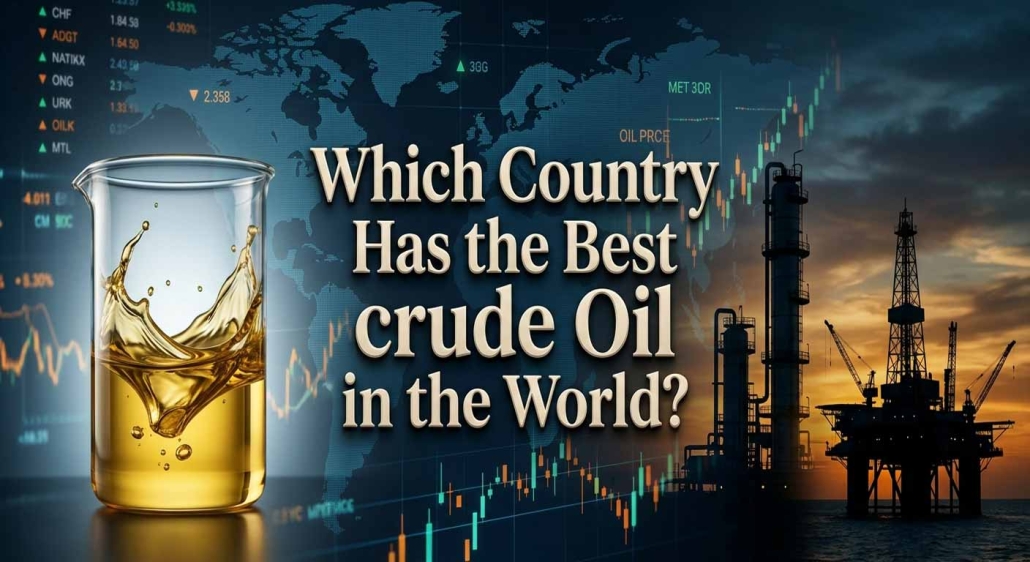
When discussing the energy market, people often ask, “Which country has the best oil in the world?” The answer, however, depends entirely on how you define “best.” If you look at volume, the Largest oil producers dominate the conversation. But if you are looking for purity, ease of refining, and market premium, the focus shifts from quantity to quality.
In the petroleum industry, “best” usually refers to Light Sweet Crude. This type of oil requires the least amount of energy to process into high-value fuels like gasoline and diesel, making it the most sought-after variety on the global market.
The Criteria for Crude Oil Quality
To determine which nation produces the highest quality crude oil, experts look at two primary physical properties: API Gravity and Sulfur Content.
- API Gravity: This measures how heavy or light the petroleum liquid is compared to water. If its API gravity is greater than 10, it is light and floats on water; if less than 10, it is heavy and sinks. Light crude is prized because it yields a higher percentage of gasoline and diesel during the distillation process.
- Sulfur Content: This determines whether the oil is “sweet” or “sour.” Sweet crude contains less than 0.5% sulfur. Low-sulfur oil is significantly easier to refine and is less corrosive to Largest oil refineries in the world, making it environmentally friendlier and more cost-effective.
Light Sweet Crude: The World’s Gold Standard
The global benchmark for the best oil in the world is often cited as West Texas Intermediate (WTI) or Brent Blend. However, in terms of raw geological purity, many experts point toward Malaysia (Tapis Blend) and Nigeria (Bonny Light).
While the Top countries in terms of oil and gas reserves—like Venezuela and Saudi Arabia—possess massive quantities, their oil often requires complex refining. For instance, Venezuelan oil is notoriously “heavy” and “sour,” requiring sophisticated technology to convert it into usable petroleum products.
Which Country Actually Has the Best Oil?
If we define “best” as the highest commercial value and lowest refining cost, the following countries stand out:
| Benchmark | Country/Region | API Gravity | Sulfur | Quality |
|---|---|---|---|---|
| Tapis Blend | Malaysia | ~45 | 0.04% | Very Light Sweet |
| Bonny Light | Nigeria | ~35 | 0.14% | Light Sweet |
| Saharan Blend | Algeria | ~44 | 0.10% | Very Light Sweet |
| Brent Blend | North Sea (UK/Norway) | ~38 | 0.37% | Light Sweet |
| West Texas Intermediate (WTI) | United States | ~39.6 | 0.24% | Light Sweet |
| Azeri Light | Azerbaijan (Caspian Sea) | ~35 | 0.15% | Light Sweet |
| Murban | UAE (Abu Dhabi) | ~40 | 0.78% | Light |
| Es Sider | Libya | ~37 | 0.44% | Light Sweet |
| Kuwait Export Crude | Kuwait | ~31 | 2.5% | Medium Sour |
| Arab Light | Saudi Arabia | ~33 | 1.8% | Medium Sour |
- Malaysia: Tapis is often called the “world’s best oil.” It is exceptionally light and sweet, though production volumes are relatively small.
- Nigeria: Known for Bonny Light, Nigeria provides a high-quality product that is a favorite for European and American refineries.
- Norway & UK (North Sea): Brent Crude is the pricing benchmark for two-thirds of the world’s oil traded internationally.
- United States: The shale revolution has made the U.S. a leading producer of light sweet crude, specifically WTI.
When purchasing these grades, traders must often understand the Difference between FOB and CIF petroleum products to calculate the true cost of delivery to their specific region.
Beyond the Well: Refining and Products
The quality of the crude directly impacts the output of Introduction to types of petroleum products. High-quality crude yields better Introduction to types of base oil and requires less intensive processing to create high-octane fuels.
For those interested in specific sectors, you can explore More articles about gasoline or read our Introduction to types of diesel to see how crude quality affects the final fuel performance. Even heavier components have their place; for instance, the road construction industry relies heavily on Bitumen articles to understand the binders used in asphalt.
Market Trends and Price Forecasts
Quality and geography play a massive role in the Petroleum product prices in different countries. As the world moves toward stricter environmental regulations, the demand for “sweet” (low-sulfur) oil will likely increase.
Looking ahead, the Crude oil price forecast for 2026 suggests that while volatility remains, the premium for high-quality light crude will hold steady as refineries seek to minimize carbon footprints and processing costs.
Conclusion
There is no single “best” country for oil if you consider only volume. However, in terms of crude oil quality, countries like Malaysia, Nigeria, and the United States (WTI) produce the most “refinery-friendly” oil. While the quantity may lie in the Middle East and South America, the “best” oil in terms of purity remains the Light Sweet Crude found in specific geological basins across the globe.






It’s interesting how the definition of ‘best’ oil really depends on whether you value quantity or quality. Factors like API gravity and sulfur content clearly show why light sweet crude is so prized, but it also makes me think about how different markets might prioritize high-purity oil over sheer volume when making strategic decisions.