
How to Test Fuel Oil Quality Before Buying: Laboratory Testing Guide
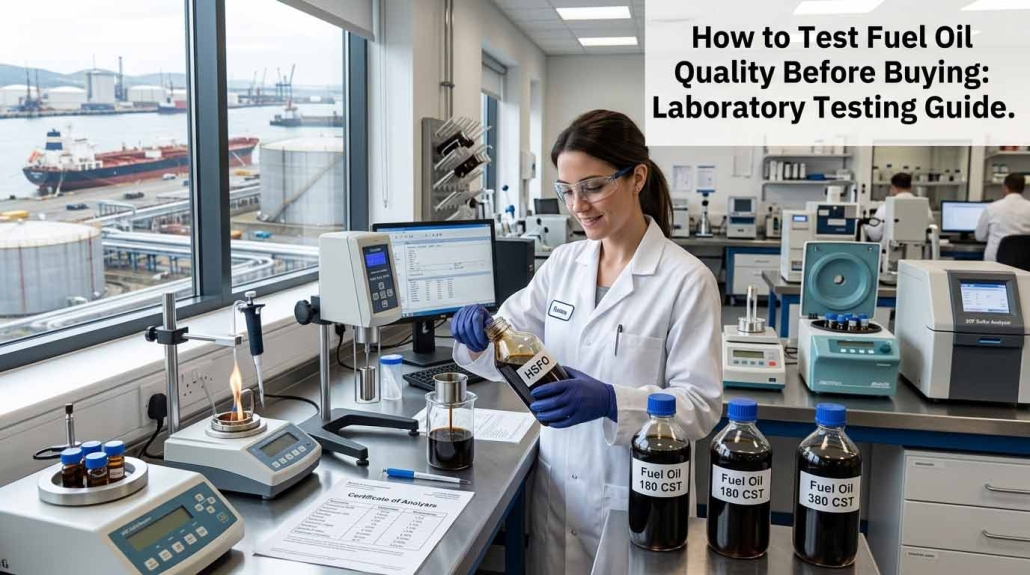
Fuel oil is one of the most widely traded petroleum products in global energy markets. It is used extensively in marine bunkering, power generation, industrial boilers, and heavy manufacturing. Because fuel oil is a residual petroleum product, its quality can vary significantly depending on refinery processes, crude oil source, and storage conditions.
For international buyers and traders, purchasing fuel oil without proper quality verification can lead to serious operational and financial risks, including engine damage, combustion inefficiency, regulatory violations, and cargo disputes. This is why fuel oil laboratory testing plays a crucial role in international petroleum trade.
Professional buyers typically rely on laboratory analysis and Certificates of Analysis (COA) to verify whether a shipment meets the required specifications. These laboratory tests evaluate key parameters such as viscosity, sulfur content, density, and contaminants that directly affect fuel performance and safety.
Understanding these parameters is essential not only for traders but also for engineers, procurement teams, and industrial users. If you are new to petroleum fuels, it is helpful to first explore the Introduction to fuel oil types and how heavy fuels differ from refined products like those discussed in our Diesel articles or Gasoline articles.

Overview of Fuel Oil and Common Grades
Fuel oil generally refers to heavy petroleum fractions remaining after lighter fuels such as gasoline, kerosene, and diesel are distilled during the refining process.
Common fuel oil grades are classified primarily by viscosity, measured in centistokes (CST) at 50°C.
Some widely traded grades include:
- Fuel Oil 180 CST (IFO 180)
- Fuel Oil 380 CST (IFO 380)
- High Sulfur Fuel Oil (HSFO)
- Low Sulfur Fuel Oil (LSFO)
Among these, Fuel Oil 380 CST is one of the most widely used bunker fuels in international shipping due to its balance between cost and performance. If you want to explore this grade in more detail, you can read our guide on Fuel Oil 380 CST.
Unlike lighter fuels such as kerosene or diesel, heavy fuel oils require heating before pumping or combustion due to their high viscosity. You can learn more about refined fuel products in our Kerosene articles.
Because fuel oil is less refined, it may contain metals, sediments, sulfur compounds, and other impurities, making laboratory testing essential before purchase.
Why Laboratory Testing is Essential Before Purchase
Fuel oil trading typically involves large cargo volumes, often shipped via tanker vessels. A single shipment may be worth millions of dollars, making quality verification critical.
Laboratory testing helps buyers:
- Confirm compliance with international standards such as ISO 8217
- Detect contamination or blending issues
- Verify that the supplier’s COA (Certificate of Analysis) is accurate
- Avoid operational problems in engines or boilers
- Ensure compliance with environmental sulfur regulations
Sulfur content is especially important due to environmental regulations in shipping. You can learn more about its industrial and environmental impact in our article on Sulfur and related Sulfur articles.
Independent laboratories such as SGS, Intertek, and Bureau Veritas are commonly used to verify cargo quality before loading or discharge.
Key Fuel Oil Quality Parameters
Fuel oil quality is determined through several laboratory tests that measure physical properties, chemical composition, and contamination levels.
Below is a simplified technical overview of the most important testing parameters.
| Parameter | What It Measures | Typical Acceptable Range (IFO 180 / IFO 380) | If Lower Than Standard | If Higher Than Standard | Why It Matters |
|---|---|---|---|---|---|
| Viscosity (CST @50°C) | Flow resistance of fuel | 180 CST / 380 CST max grade limit | Fuel may be over‑diluted with lighter fractions | Difficult pumping, poor atomization | Affects combustion efficiency and fuel handling |
| Density (kg/m³ @15°C) | Mass per unit volume | ~960–991 kg/m³ | May indicate blending with lighter fuels | Can cause purification difficulties | Important for engine injection and fuel separation |
| Sulfur Content (%) | Amount of sulfur compounds | Up to 3.5% for HSFO (lower in regulated zones) | Lower emissions but higher refining cost | Environmental non‑compliance and corrosion | Key regulatory and environmental parameter |
| Flash Point (°C) | Temperature at which fuel vapors ignite | Minimum 60°C | Safety risk in storage and handling | Usually acceptable but may indicate heavier fractions | Critical safety parameter |
| Pour Point (°C) | Lowest temperature at which fuel flows | Typically 24–30°C | Easier handling in cold climates | Fuel may solidify during storage | Important for storage and pumping |
| Water Content (%) | Amount of water contamination | Typically ≤0.5% | Rarely problematic | Reduced heating value and corrosion | Causes combustion problems |
| Ash Content (%) | Inorganic residues after combustion | ≤0.15% typical | Usually acceptable | Deposits in engines and boilers | Indicates contamination with solids |
| Carbon Residue (%) | Tendency to form carbon deposits | ~10–20% typical | Less deposit formation | Higher fouling in combustion systems | Affects engine cleanliness |
| Total Sediment (%) | Solid contaminants in fuel | ≤0.1% | Minimal risk | Filter clogging and engine wear | Key cleanliness indicator |
| Vanadium (ppm) | Metal contaminant from crude oil | ~50–400 ppm | Usually acceptable | High‑temperature corrosion in engines | Important for marine engines |
| Sodium (ppm) | Salt contamination | Typically ≤100 ppm | Minimal impact | Combined with vanadium causes corrosion | Indicator of seawater contamination |
| Aluminum + Silicon (Cat Fines) | Catalyst particles from refining | ≤60 ppm typical | Acceptable | Severe engine abrasion | One of the most dangerous contaminants |
Which Fuel Oil Parameters Are Most Critical?
Not all laboratory parameters carry the same importance. Some directly affect engine safety, environmental compliance, and trade acceptance, while others are secondary indicators.
Most Critical Parameters
These parameters should always be carefully verified before purchasing fuel oil:
Viscosity
Viscosity determines how easily the fuel can be pumped, heated, and atomized. Fuel that is too viscous may require excessive heating, while very low viscosity may indicate dilution with lighter fuels.
Sulfur Content
Sulfur regulations are strictly enforced in many maritime regions. Using fuel with excessive sulfur can result in heavy fines or operational restrictions.
Aluminum + Silicon (Cat Fines)
These particles originate from refinery catalysts and are extremely abrasive. High levels can cause severe engine wear and piston damage.
Water Content
Excess water reduces combustion efficiency and may cause corrosion and microbial growth.
Sediment
High sediment content leads to filter blockage and operational disruptions.
Secondary but Important Parameters
These parameters are also relevant but typically pose lower immediate risk:
- Density
- Pour point
- Ash content
- Carbon residue
- Trace metals such as vanadium and sodium
Although less critical individually, these parameters can influence long‑term engine maintenance and combustion efficiency.

How to Read a Fuel Oil COA (Certificate of Analysis)
A Certificate of Analysis (COA) is a laboratory report that summarizes the quality parameters of a fuel shipment.
When reviewing a COA, buyers should verify:
- Testing standards used (ASTM, ISO, or IP methods)
- Laboratory credibility (recognized inspection company)
- Consistency with contractual specifications
- Results within acceptable limits
A common mistake among inexperienced buyers is focusing only on viscosity and sulfur, while ignoring other critical contaminants such as cat fines or sediment.
Practical Tips for Fuel Oil Buyers and Traders
Experienced traders use several best practices to reduce risk when purchasing fuel oil.
Verify the Laboratory Source
Always ensure the COA comes from a recognized independent inspection company rather than solely relying on supplier documentation.
Compare Multiple Parameters
Unusual combinations of values may indicate blending or contamination.
For example:
- Low viscosity with high density may indicate improper blending
- High sodium levels may signal seawater contamination
Check Compatibility with Equipment
Marine engines, industrial burners, and boilers have specific fuel requirements. Fuel outside these specifications may cause operational issues.
Common Quality Problems in Fuel Oil Shipments
Fuel oil cargoes may sometimes fail quality tests due to several issues.
Water Contamination
Water may enter during storage or transportation, reducing fuel efficiency and increasing corrosion risk.
Catalyst Fines Contamination
Improper refinery filtration may leave catalyst particles in the fuel, which can severely damage engines.
Incompatible Blending
When different residual fuels are blended incorrectly, the mixture may become unstable, leading to sludge formation.
Storage Degradation
Long‑term storage may cause sediment formation or oxidation.
These issues highlight why laboratory testing before shipment and upon delivery is essential.
Conclusion
Testing fuel oil quality before purchasing is a critical step in international petroleum trading. Because fuel oil is a complex residual product, its properties can vary significantly depending on crude origin, refining processes, and storage conditions.
By carefully evaluating laboratory parameters such as viscosity, sulfur content, sediment levels, and catalyst fines, buyers can avoid costly operational problems and ensure compliance with international standards.
Understanding how to interpret a fuel oil COA and recognizing potential red flags empowers buyers, traders, and industrial users to make informed purchasing decisions.
As global energy markets evolve and environmental regulations become stricter, professional fuel testing will remain an essential part of responsible and profitable fuel oil trading.
Global Petroleum Trade Solutions | Universal Trades
As a reputable international petroleum trading enterprise, Universal Trades specializes in the reliable procurement, export, and supply chain management of high-grade petroleum commodities, refined fuels, and industrial feedstocks designed to meet rigorous global standards.









Leave a Reply
Want to join the discussion?Feel free to contribute!