
Granular vs Lumpy vs Powder Sulfur : Moisture Content Tolerances & Standards
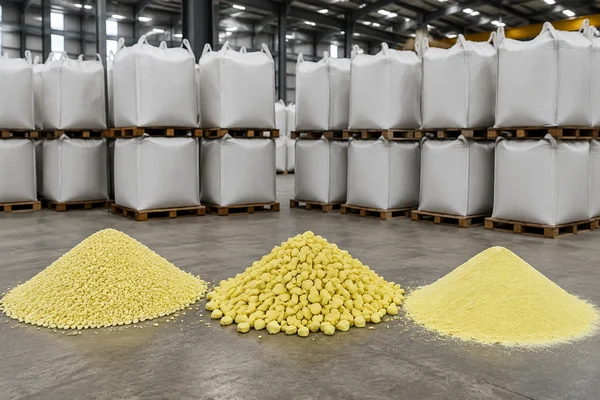
Comprehensive chemical matrix, multi-modal transport physics, IMSBC Code maritime compliance, and commercial dry-basis settlement standards for industrial procurement (>100 MT).
Direct Answer Key Distinction: Sulfur Morphology & Moisture Tolerances
Elemental sulfur (min 99.5% dry basis) differs fundamentally by morphology: Granular (formed pastilles, 2–6 mm, <0.5% moisture) provides low friability and dust-free mechanical feeding; Lump (crushed run-of-mine/cake, 10–100 mm) tolerates 1.0–2.0% moisture but exhibits high water retention; and Powder (75–150 μm, <0.2% moisture) maximizes surface reactivity for agricultural and vulcanization use. Moisture tolerance dictates chemical reactivity, transit corrosion, explosion index, and invoiced dry-weight settlement.
1. Morphology, Purity & Moisture Comparison Matrix
Recovered elemental sulfur derived from refinery Claus gas desulfurization processes adheres to rigorous physical and chemical metrics. Industrial selection between spherical formed pastilles, broken solid cakes, and micronized fractions determines storage attrition and operational handling costs. For foundational physical and thermal constants, refer to our comprehensive technical review on properties of sulfur.
| Analytical Parameter | Granular Sulfur | Lump Sulfur | Powdered Sulfur | Standard Test Method |
|---|---|---|---|---|
| Purity (% S, Dry Basis) | Min 99.5% – 99.8% | Min 99.50% | Min 99.8% – 99.95% | ISO 3261 / ASTM E247 |
| Moisture Content (% Max at Loading) | Max 0.50% (Typically ≤0.25%) | 1.00% – 2.00% (High absorption) | Max 0.10% – 0.20% | ASTM C1549 / ISO 1988 |
| Ash Content (% Max) | 0.03% – 0.05% | 0.05% – 0.08% | 0.02% – 0.04% | ASTM D482 (Mod.) |
| Hydrocarbons / Bitumen Residue (% Max) | Max 0.03% | Max 0.05% | Max 0.02% | Refinery Claus Spec |
| Acidity (as H₂SO₄, % Max) | ≤ 0.005% – 0.01% | ≤ 0.015% – 0.02% | ≤ 0.003% | Acid-Base Titration |
| Particle Size Distribution (PSD) | 2–6 mm spherical (pastilles/prilled) | 10–100 mm irregular fractured solid | 75–150 μm (100–325 mesh) | Sieve Analysis (ASTM E11) |
| Bulk Density (t/m³) | 1.05 – 1.15 t/m³ | 1.20 – 1.30 t/m³ | 0.75 – 0.90 t/m³ | ISO 7837 / Tap Density |
| Angle of Repose & Flowability | 28°–32° (Free-flowing, low dust) | 35°–45° (High bridging potential) | 40°–55° (Cohesive, caking risk) | Carr Index / Triaxial |
Note: Prilled sulfur forms a sub-category of spherical sulfur formed via air/water tower condensation, exhibiting low friability indices (<1.5% dust generation) compared with mechanically crushed lump sulfur.
2. Industry Application & Reactivity Decision Matrix
Procurement directors must balance process thermal efficiency, pneumatics, and capital equipment wear. Below is an engineering evaluation across critical industrial processes:
Sulfuric Acid & Claus Furnaces
Contact Process sulfuric acid plants mandate formed pastilles. Learn more on selecting the best sulfur for sulfuric acid production to avoid melter burner nozzle clogging, catalyst poison accumulation, and acid corrosion.
- Preferred Grade: Granular / Prilled (<0.5% moisture).
- Operational Risk: High lump moisture forms sulfurous acid (H_2SO_3), corroding pre-melters.
- Ash Ceiling: <0.05% to protect Vanadium Pentoxide (V_2O_5) catalyst beds.
Phosphate Fertilizers (SSP / TSP)
Acidulation of rock phosphate demands mass volume throughput. Bulk plants evaluate the total delivered cost against specialized processing parameters outlined under international agricultural sulfur standards.
- Preferred Grade: Lump or Granular based on logistics cost.
- Economic Tradeoff: Lump presents lower FOB cost but higher handling attrition.
- Storage Strategy: Covered pad storage required to mitigate run-off loss.
Rubber Vulcanization & Synthetics
Polymer elastomer cross-linking requires maximum particle surface area and zero particulate grit. Industrial users rely on technical parameters detailed in our guide on powdered sulfur and its uses.
- Preferred Grade: 200–325 mesh micronized powder (min 99.8% purity).
- Moisture Constraint: Strictly ≤0.10% to prevent porosity voids during curing.
- Additive Control: Mineral oil coating (1.0%–2.5%) applied to suppress dust ignition.
3. Moisture Tolerances, Net Weight Settlement & Commercial Claims
The “Water-Sponge Effect”: Lump vs. Granular Physics
Elemental sulfur is naturally hydrophobic, yet lump sulfur acts as a mechanical water-sponge due to its irregular macro-porosity, internal micro-fissures, and surface capillarity. In open-air storage pads or unsealed maritime transit, rainwater and ocean condensation pool within interstitial voids, elevating lump moisture from a factory baseline of 1.0% up to 2.5%–3.5%. Conversely, spherical granular sulfur pastilles shed moisture naturally; water runs off smooth exterior boundaries, limiting loaded moisture to ≤0.5% even during humid transshipment.
Commercial Dry-Basis Formula for Financial Settlement
When cargo arrives with moisture exceeding contractual specifications (typically certified via discharge port draft survey and ASTM moisture loss drying oven tests), invoices are adjusted via the dry weight equivalent equation:
Example: On a 10,000 MT lump sulfur cargo contracted at 1.0% base moisture, a discharge certificate showing 2.8% moisture results in an invoice deduction of 181.82 MT pure sulfur equivalent.
Vessel Hold Acidification & Hull Corrosion Risk
Moisture in sulfur cargoes does not merely present weight discrepancies; it initiates catastrophic acid corrosion. In the presence of ambient water and atmospheric oxygen, ubiquitous sulfur-oxidizing bacteria (notably Thiobacillus thiooxidans) catalyze the oxidation of elemental sulfur to sulfurous acid (H_2SO_3) and dilute sulfuric acid (H2 SO4). When cargo holds lack protective barriers, this acidic slurry severely pits mild steel ship hulls, internal bulkheads, and rail hoppers within days.
4. 100+ MT Bulk Logistics, Packaging & Maritime Standards
Executing bulk export transactions requires multi-modal discipline under the guide to buying export-grade sulfur and current market benchmarks found in our sulfur price outlook.
Breakbulk & Bulk Vessel Charters
Bulk marine transit (Handysize 25,000–35,000 DWT or Supramax 50,000–60,000 DWT) operates under the IMO IMSBC Code (International Maritime Solid Bulk Cargoes Code) where Solid Sulfur is designated as Group C Cargo.
- Hold Preparation: Strict double-coat lime-washing (calcium hydroxide slurry) on steel bulkheads to neutralize bacterial acid formation.
- Mechanical Trimming: Trimming shovels must reduce localized conical crests to prevent cargo shifting during high sea states.
- Gas Monitoring: Bilge water testing for pH depression and headspace gas monitoring for explosive Hydrogen Sulfide (H_2S) and Sulfur Dioxide (SO_2).
Container Payload & Packaging Optimization
For intermodal containerized transit, structural tare weights dictate maximum gross payload margins:
- Jumbo Bags (FIBC 1,000 kg – 1,200 kg): Heavy-duty UV-stabilized woven polypropylene. Type B/C static-dissipative liners required for powder grades. 20–22 MT per 20ft FCL (single tier); 26–27.5 MT per 40ft FCL (heavy-duty road limit compliant).
- 25 kg / 50 kg Polyethylene Sacks: 3-ply moisture-barrier PE/PP valve sacks, palletized, thermally shrink-wrapped. Ideal for industrial mesh powder handling.
- Container Bulk Liners (Sea Bulks): 20ft dry containers fitted with woven PE liner bags and tailboard bulkheads for dry pneumatic or conveyor loading.
SGS / Intertek Independent Inspection Protocol & Rejection Limits
Third-party certified sampling at loading ports governs Letter of Credit (LC) execution and export compliance. Cargo exceeding statutory rejection thresholds triggers immediate renegotiation or refusal:
| Quality Metric | Target Benchmark | Critical Rejection Limit | Testing Protocol |
|---|---|---|---|
| Purity (Dry Basis) | ≥ 99.50% | < 99.20% | ASTM E247 |
| Moisture Content | ≤ 0.50% (Granular) / ≤ 1.50% (Lump) | > 2.50% (Bulk Vessel Discharge) | ASTM C1549 Oven Loss |
| Total Ash Content | ≤ 0.03% | > 0.08% | ASTM D482 |
| Organic Hydrocarbons | ≤ 0.03% | > 0.10% (Indicates tar contamination) | Solvent Extraction |
5. Safety, Storage, Fire Prevention & Dust Management
Elemental sulfur presents severe combustible dust explosion hazards when suspended in air. Industrial operators must consult our dedicated sulfur safety guide and enforce operational warehouse protocols from our guide to sulfur storage.
NFPA 652 / NFPA 654 Combustible Dust Mandates
- Minimum Ignition Energy (MIE): Finely divided sulfur dust clouds can ignite at energies as low as 15–35 mJ. Low-velocity conveyance (<1.5 m/s) and grounded ducting are critical to eliminate electrostatic discharge.
- Deflagration Index (K_{st}): Pure sulfur exhibits a K_{st} of 150–175 bar·m/s (St Class 1 dust). Silos and baghouses require certified explosion venting directed away from operational personnel.
- Pyrophoric Iron Sulfide (FeS) Prevention: In poorly ventilated storage tanks, trace hydrogen sulfide (H_2S) reacts with oxidized steel to form pyrophoric FeS, which autoignites upon exposure to oxygen.
Electrical Classification
All motors, lighting, and switchgear in handling bays must comply with ATEX Zone 21/22 or NEC Class II, Division 1/2 dust-ignition-proof certifications.
Suppression Systems
High-pressure water jets must NEVER be used on sulfur dust fires as they suspend particulate clouds into explosive air mixtures. Use fine fog water mists or dry chemical agent Class D blankets.
Chemical Segregation
Strictly isolate sulfur storage from strong oxidizers (chlorates, nitrates, perchlorates), strong mineral bases, and combustible hydrocarbons to prevent spontaneous energetic reactions.
Technical & Procurement Clarifications
Frequently Asked Questions (FAQ)
Critical operational, commercial, and laboratory insights for industrial elemental sulfur buyers.
1. What is the contractually accepted moisture limit for granular sulfur in bulk maritime contracts?
The standard international ceiling for formed granular sulfur is 0.50% moisture content (ASTM C1549) at the loading port. Prime gas-refinery pastillated sulfur consistently tests below 0.25%. Any certified reading above 0.50% at discharge triggers standard commercial price adjustment clauses via dry-basis weight settlement.
2. Why is granular sulfur preferred over lump sulfur in modern sulfuric acid manufacturing?
Granular pastilles offer controlled flowability (angle of repose 28°–32°), minimal friability dust (<1.5%), and very low water retention. Lump sulfur, while chemically identical, fractures into fines that cause bridging in conveyers, plug sulfur melter burner nozzles, and carry retained moisture that accelerates catastrophic sulfurous acid (H_2SO_3) corrosion on melter coils.
3. How does lump sulfur handle rain and outdoor storage compared to granular grades?
Lump sulfur features high macro-porosity and fracture crevices that act like a mechanical sponge, absorbing and trapping rainwater up to 2.5%–3.5% by weight. Granular sulfur is hydrophobic and spherically shaped; water sheds across pastille surfaces and drains freely through bulk stockpiles, keeping retained internal moisture within the safe 0.3%–0.5% threshold.
4. How many metric tons of granular sulfur fit into a standard 20ft and 40ft container?
When packaged in 1,000 kg or 1,200 kg heavy-duty Jumbo Bags (FIBCs), a standard 20ft container holds 20.0 to 22.0 Metric Tons (single tier). In a 40ft container, payload is legally constrained by highway weight limits to 26.0 to 27.5 Metric Tons. Using specialized sea-bulk container liners loaded by belt throwers allows up to 24.0–26.0 MT in a single 20ft box.
5. What are the critical mesh sizes and oil-treatment specs for powdered sulfur in rubber vulcanization?
Elastomer compounding requires ultra-fine dispersion: typically 200 to 325 mesh (44–75 μm) with minimum 99.8% purity. To avoid explosive electrostatic discharge during intensive shear mixing, rubber-grade sulfur is treated with 1.0% to 2.5% specialized process oil (oil-treated insoluble or ground sulfur), suppressing airborne dust clouds.
6. What inspection and sampling protocols do SGS and Intertek follow for CoA validation?
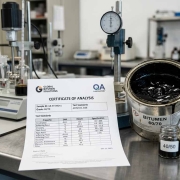
Surveillance follows ISO 1988 and ASTM E247 standards. Mechanical samplers or certified surveyors pull composite samples at regular conveyor intervals during loading. Key validated parameters include: Purity by difference or barium sulfate precipitation, Ash via muffle furnace ignition at 800°C (ASTM D482), Moisture via drying oven at 105°C (ASTM C1549), and Carbon/Hydrocarbons via solvent extraction.
7. Under which IMO IMSBC Code category is bulk sulfur transported, and what are vessel hold requirements?
Solid elemental sulfur is designated as IMSBC Code Group C (cargoes that neither liquefy nor possess chemical hazards in passive state). However, bulk carriers must execute mandatory lime-washing (calcium hydroxide slurry application) on steel holds before loading to neutralize localized sulfuric acid pitting, and maintain operational bilge drainage monitoring.
8. How does moisture accelerate steel degradation and tank pitting during transport?
In the presence of moisture (>0.5%) and atmospheric air, microbial action from sulfur-oxidizing bacteria (Acidithiobacillus thiooxidans) oxidizes S_8 into sulfurous and sulfuric acids. Furthermore, anaerobic zones between moist sulfur fines and ship bulkheads create severe galvanic concentration cells, corroding unlined carbon steel plates at rates exceeding 2.0 mm per annum.
9. What is the allowable limit for Hydrocarbon (Oil/Bitumen residue) in pure sulfur?
Contractual limit for Claus bright yellow sulfur is strictly ≤ 0.03% (300 ppm) hydrocarbons. Carbon residue above 0.05% produces dark/brown discoloration, causes carbonaceous sludge build-up in pre-melter decanters, and can contaminate commercial sulfuric acid batches, turning the final acid dark.
10. What anti-static and packaging precautions are mandated for Powdered Sulfur under NFPA 652?
Because micronized sulfur dust exhibits a low Minimum Ignition Energy (15–35 mJ), bulk FIBC bags must comply with Type C (groundable conductive) or Type D (static-dissipative) standards. Warehousing environments must maintain explosion relief vents (K_{st} 150–175 bar·m/s), non-sparking aluminum shovels, and ATEX/NEC Class II, Div 1 electrical fixtures.
Global Petroleum Trade Solutions | Universal Trades
As a reputable international petroleum trading enterprise, Universal Trades specializes in the reliable procurement, export, and supply chain management of high-grade petroleum commodities, refined fuels, and industrial feedstocks designed to meet rigorous global standards.






Leave a Reply
Want to join the discussion?Feel free to contribute!