
FOB vs CIF in Petroleum Trading: Buyer’s Guide
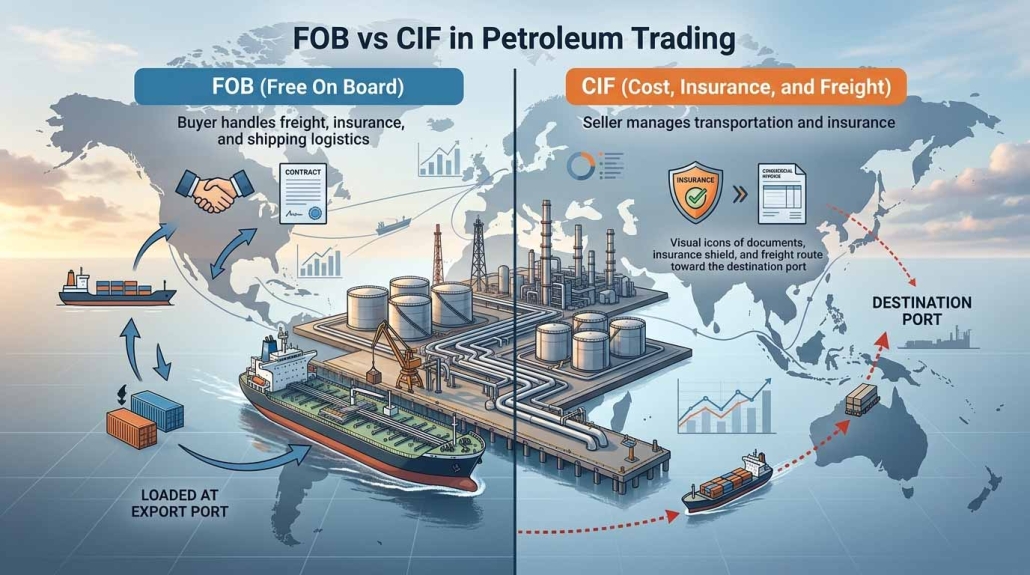
In international petroleum markets, delivery terms are just as important as product specifications or pricing formulas. Incoterms in petroleum trading define who is responsible for transportation, insurance, documentation, and risk at each stage of a shipment.
For buyers importing petroleum products such as diesel, gasoline, base oil, or bitumen, understanding the difference between FOB vs CIF in Petroleum Products Trading is essential for managing logistics costs and supply chain risks. These two petroleum shipping terms are widely used in global oil trade and can significantly influence purchasing decisions.
Companies involved in international oil product logistics often evaluate these delivery terms alongside market fundamentals such as production capacity and refining hubs. For example, buyers sourcing cargoes from major refining centers listed in Top Oil Refineries in the World or producers discussed in Top Oil Producing Countries must carefully determine whether FOB or CIF better suits their logistics strategy.
What Does FOB Mean in Petroleum Products Trading?
FOB (Free On Board) is one of the most commonly used Incoterms in petroleum trading. Under FOB petroleum shipping, the seller fulfills their obligation once the cargo is loaded onto the vessel at the agreed port of shipment.
Seller Responsibilities
The seller is responsible for:
- Producing and preparing the petroleum product
- Export documentation and customs clearance
- Transporting the cargo to the export terminal
- Loading the cargo onto the buyer’s nominated vessel
Buyer Responsibilities
The buyer takes responsibility for:
- Chartering the vessel
- Paying ocean freight
- Purchasing cargo insurance
- Managing transportation to the destination port
Risk Transfer
Risk transfers from seller to buyer once the cargo passes the ship’s rail at the loading port.
Why Traders Prefer FOB
Many experienced oil traders prefer FOB petroleum shipping because it provides greater control over shipping operations. Buyers with established logistics networks can negotiate competitive freight rates and optimize shipping schedules.
FOB is frequently used for large shipments such as diesel exports or base oil cargoes, where buyers already have established freight arrangements. Buyers often combine FOB purchases with market analysis such as Petroleum Product Prices in Different Countries to optimize procurement strategies.
For those seeking deeper insight into product categories, resources like Types of Diesel Fuel and Introduction to Base Oil Types help buyers evaluate product specifications before arranging shipments.
What Does CIF Mean in Petroleum Products Trading?
CIF (Cost, Insurance, and Freight) is another widely used delivery term in international petroleum transactions. Under CIF petroleum shipping, the seller is responsible for arranging and paying for transportation and insurance until the cargo reaches the destination port.
Seller Responsibilities
Under CIF terms, the seller must:
- Supply the petroleum product
- Arrange and pay for freight to the destination port
- Provide marine insurance for the shipment
- Handle export documentation
Buyer Responsibilities
The buyer’s responsibilities are more limited and generally include:
- Import customs clearance
- Port discharge costs
- Inland transportation after arrival
Risk Transfer
Even though the seller arranges shipping and insurance, the risk still transfers at the port of shipment, similar to FOB terms.
Why CIF Is Attractive for Buyers
For many importers, particularly new market participants, CIF petroleum shipping simplifies logistics. The seller manages freight booking and insurance, allowing buyers to focus on downstream distribution.
This can be particularly useful for buyers sourcing products like gasoline or bitumen without established shipping networks. Buyers researching market demand often combine CIF purchases with insights from More Articles About Gasoline, Bitumen Articles, and consumption data such as Top Oil Consuming Countries.
Key Differences Between FOB and CIF
Although both are standard petroleum shipping terms, FOB and CIF differ significantly in operational responsibilities and cost control.
Freight Payment
Under FOB, the buyer pays and arranges freight. Under CIF, the seller handles freight arrangements.
Insurance Coverage
In FOB transactions, the buyer arranges cargo insurance. Under CIF terms, the seller provides minimum marine insurance.
Risk Transfer
For both FOB and CIF, risk transfers to the buyer when the cargo is loaded onto the vessel.
Logistics Control
FOB gives buyers full control of shipping logistics, while CIF leaves most shipping decisions with the seller.
Cost Transparency
FOB often offers better cost transparency because freight and insurance are negotiated separately.
Supply Chain Flexibility
FOB provides greater flexibility for buyers with multiple shipping routes or long-term freight contracts.
FOB vs CIF Comparison
| Factor | FOB | CIF |
|---|---|---|
| Freight Responsibility | Buyer arranges and pays | Seller arranges and pays |
| Insurance Responsibility | Buyer | Seller |
| Risk Transfer Point | When cargo is loaded on vessel | When cargo is loaded on vessel |
| Logistics Control | Buyer has full control | Seller manages shipping |
| Cost Transparency | Higher transparency | Freight included in price |
| Advantages | Greater freight flexibility, potential cost savings | Simplified logistics for buyers |
| Disadvantages | Requires shipping expertise | Less control over freight cost |
| Best Use Cases | Large buyers with shipping networks | New importers or small buyers |
| Typical Buyers | Traders, large distributors, refiners | Smaller importers, new market entrants |
Which Incoterm Is Better for Buyers?
The choice between FOB vs CIF shipping differences depends largely on the buyer’s logistics capability and procurement strategy.
When FOB Is Better
FOB is typically the better option when:
- The buyer has experience in international oil product logistics
- The company operates its own shipping contracts or chartering desk
- Buyers want to optimize freight costs across multiple suppliers
Large trading houses and energy companies often prefer FOB because it allows them to manage vessel scheduling and reduce freight expenses across multiple cargoes.
When CIF Is Better
CIF may be preferable when:
- Buyers are new to international petroleum trading
- Companies do not have in-house shipping expertise
- Simplified logistics and fewer operational responsibilities are desired
For smaller distributors or new importers, CIF reduces complexity and provides predictable delivered pricing.
Conclusion
Understanding FOB vs CIF in Petroleum Products Trading is essential for buyers involved in global oil markets. While both Incoterms define clear responsibilities between buyers and sellers, the choice ultimately depends on logistics capability, freight strategy, and risk management preferences.
Experienced traders often choose FOB petroleum shipping to control freight costs and supply chains, while CIF petroleum shipping provides convenience and simplified logistics for buyers without shipping infrastructure.
Selecting the right delivery term helps companies manage transportation risks, optimize costs, and maintain efficient petroleum supply chains.
Global Petroleum Trade Solutions | Universal Trades
As a reputable international petroleum trading enterprise, Universal Trades specializes in the reliable procurement, export, and supply chain management of high-grade petroleum commodities, refined fuels, and industrial feedstocks designed to meet rigorous global standards.










Leave a Reply
Want to join the discussion?Feel free to contribute!