
Prilled Sulfur: Production, Uses, and Practical Applications
Sulfur is one of the most important elemental materials used in modern agriculture, chemical production, and petroleum refining. Among the different commercial forms of sulfur, prilled sulfur is widely recognized for its uniform particle size, easy handling, and efficient industrial use. Understanding how prilled sulfur is produced, how it compares with other sulfur grades, and how it should be used helps buyers, traders, and agricultural professionals make better purchasing and application decisions. If you are new to sulfur products, you may also start with our broader guide: Introduction to Sulfur.
What Is Prilled Sulfur?
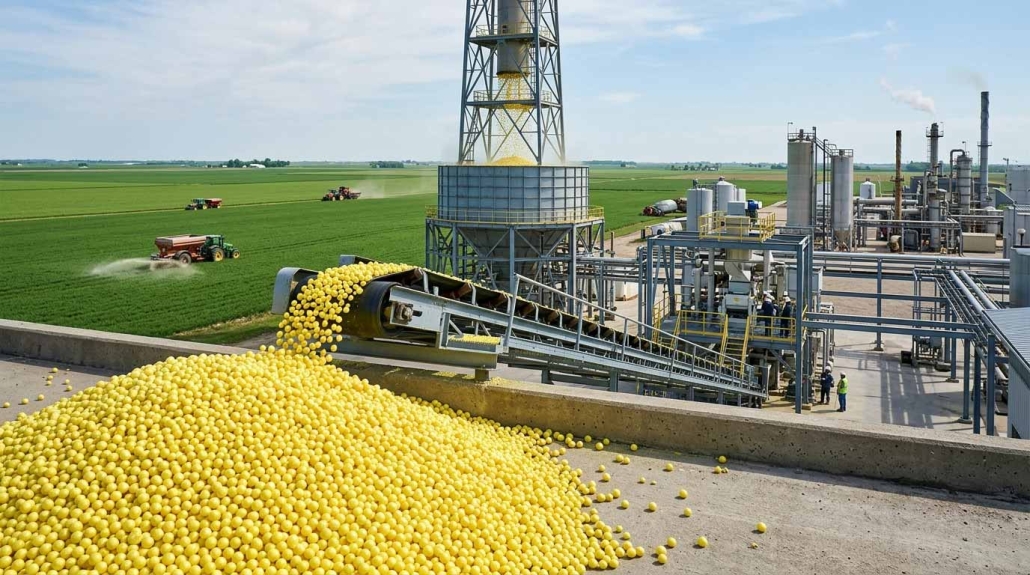
Prilled sulfur is a processed form of elemental sulfur produced by transforming molten sulfur into small, round particles known as prills. These particles typically have a diameter of 1–3 mm, making them easy to store, transport, and apply in various industrial and agricultural settings.
The prilling process is designed to produce sulfur with consistent particle size and minimal dust generation. This makes prilled sulfur suitable for bulk handling, blending with fertilizers, and use in industrial processes.
How Prilled Sulfur Is Produced
Prilled sulfur is manufactured through a process called sulfur prilling, which involves the following steps:
- Molten sulfur preparation – Sulfur recovered from oil and gas refining is heated and purified.
- Prilling tower process – The molten sulfur is sprayed from the top of a tall tower through specialized nozzles.
- Droplet formation – As the droplets fall through cooled air inside the tower, they solidify.
- Particle collection – The solidified spherical particles are collected at the bottom of the tower.
This controlled cooling process produces uniform, round particles with relatively low dust levels and good flowability, which is essential for large‑scale handling and export logistics. Laboratory testing is often performed to confirm purity and quality before shipment; see our guide to Sulfur technical data sheet for more details on common testing standards.
Comparison with Other Sulfur Grades
Sulfur is traded globally in several physical forms. Each grade is designed for specific handling requirements and industrial applications.
Prilled sulfur
Small spherical particles produced by a prilling tower. Easy to handle and suitable for fertilizer blending and chemical manufacturing.
Larger particles produced through granulation processes. Granular sulfur is stronger and generates less dust, making it highly preferred for agricultural distribution and bulk fertilizer blending. Our article on Agricultural Sulfur Standards explains why particle size matters for farming applications.
Pastillated sulfur
Small, lens‑shaped solid pieces formed on a cooling steel belt. This grade is known for high uniformity and low breakage during transportation.
Irregular solid chunks of sulfur produced during traditional solidification methods. It often requires crushing before industrial use.
Finely ground sulfur used mainly in pesticides, fungicides, and specialty chemical applications.
Molten sulfur
Liquid sulfur transported and used directly in large industrial facilities such as sulfuric acid plants.
Each form has different handling characteristics, logistics requirements, and end‑use applications.

Does Prilled Sulfur Dissolve in Water?
A common question from buyers and farmers is whether prilled sulfur dissolves in water.
The answer is no—elemental sulfur is not water‑soluble. Prilled sulfur, like most elemental sulfur products, does not dissolve directly in water. Instead, it must undergo a biological oxidation process in soil.
Soil microorganisms convert elemental sulfur into sulfate (SO₄²⁻), which is the form plants can absorb. Because of this microbial conversion step, sulfur acts as a slow‑release nutrient in agricultural systems.
The rate of this conversion depends on several factors:
• Soil temperature
• Soil moisture
• Microbial activity
• Particle size
Smaller sulfur particles generally oxidize faster than larger ones.
Key Industrial Applications of Prilled Sulfur
Prilled sulfur is widely used in multiple industries due to its purity, transport efficiency, and chemical properties.
Sulfuric Acid Production
The largest global use of sulfur is the production of sulfuric acid, a key chemical used in fertilizers, mining, petroleum refining, and chemical manufacturing.
Fertilizer Manufacturing
Sulfur is an essential nutrient for crops and is frequently blended with nitrogen fertilizers. In fact, sulfur demand is closely connected to fertilizer production trends, including markets dominated by nitrogen products such as those discussed in Top 10 sulfur‑Producing Countries.
Rubber and Tire Manufacturing
Sulfur is used in the vulcanization process, which improves the strength and elasticity of rubber products.
Chemical and Industrial Processes
Many chemical intermediates, detergents, and synthetic materials depend on sulfur derivatives.
Agricultural Uses of Prilled Sulfur
In agriculture, sulfur plays a critical role in plant growth because it contributes to protein synthesis, enzyme activity, and chlorophyll formation.
Prilled sulfur can be used in agriculture in several ways:
• Soil amendment to correct sulfur deficiency
• Soil pH management in alkaline soils
• Blending with NPK fertilizers
• Use in compound fertilizers
However, for direct soil application, granular or bentonite‑based sulfur products are often preferred, as they break down faster and distribute more evenly in soil.
Best Practices for Using Prilled Sulfur
For effective use of prilled sulfur, consider the following practical guidelines:
For agriculture
- Apply sulfur before planting or during soil preparation.
- Ensure adequate soil moisture to support microbial oxidation.
- Consider blending sulfur with fertilizers for more even distribution.
For industrial use
- Store sulfur in dry, ventilated areas to prevent moisture accumulation.
- Use dust‑control systems during large‑scale handling.
- Follow quality standards verified through laboratory testing.
For buyers evaluating international suppliers, our Export‑Grade Sulfur Buying Guide explains important specifications and documentation to consider before purchasing.
Market Demand and Global Trade
The global sulfur market is heavily influenced by fertilizer demand, refinery output, and natural gas processing. Market prices can fluctuate depending on regional supply chains and energy production trends. For a deeper look at industry trends and price expectations, see our Global Sulfur Price Forecast.
Frequently Asked Questions
Is prilled sulfur suitable for direct soil application?
Yes, but it is often blended with fertilizers or used where slow sulfur release is acceptable.
Is prilled sulfur the same as granular sulfur?
No. Granular sulfur usually has larger particles and greater mechanical strength, making it more suitable for agricultural distribution.
What purity level does prilled sulfur usually have?
Most commercial prilled sulfur contains 99.5% elemental sulfur or higher, depending on refinery standards.
Learn More About Sulfur Products
Prilled sulfur is just one form of this versatile industrial element. Buyers, traders, and agricultural professionals can benefit from understanding the full range of sulfur products, quality standards, and applications. Explore more resources in our Sulfur Articles section for in‑depth guides, market insights, and technical information about sulfur trading and usage.









Leave a Reply
Want to join the discussion?Feel free to contribute!