
What Is Green Petroleum Coke (Fuel‑Grade Petcoke)? Properties, Uses
What Is Green Petroleum Coke?
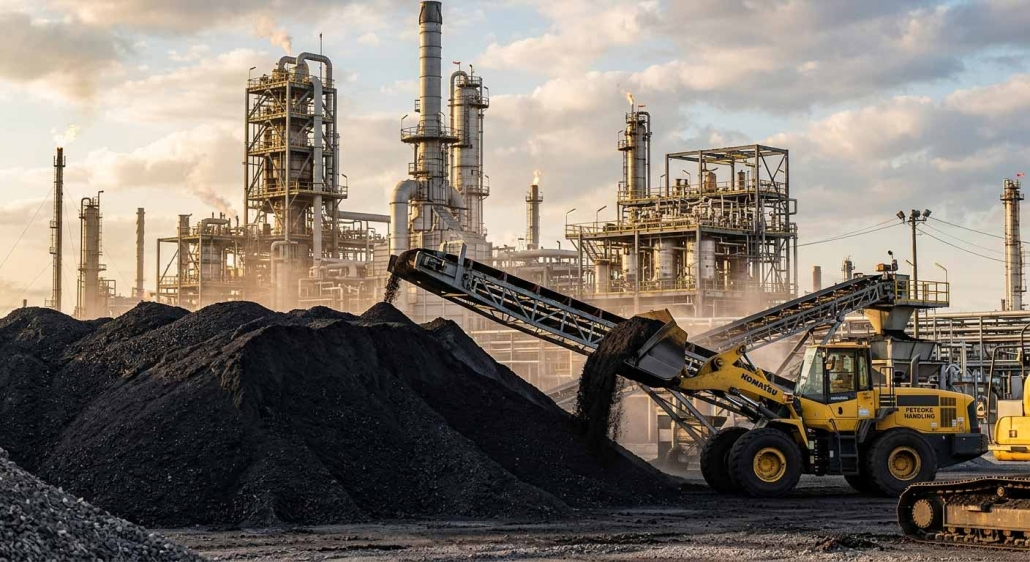
Green Petroleum Coke—often referred to as GPC, green petcoke, or fuel‑grade petroleum coke—is the solid carbon‑rich material produced during the thermal cracking of heavy refinery fractions. It is one of the most widely used industrial fuels in the cement, power, steel, and smelting sectors due to its high calorific value and competitive pricing.
For readers interested in broader background topics, you may also explore:
What Makes Green Petroleum Coke “Green”?
The term “green” does not refer to environmental attributes. Instead, it means the coke is raw—unprocessed and not yet subjected to calcination. Green petcoke retains higher levels of:
- Volatile matter (VM)
- Sulfur
- Moisture
- Trace metals
These characteristics make GPC primarily suitable for fuel applications, unlike CPC (Calcined Petroleum Coke) used in aluminum, graphite, and metallurgy.
To understand these differences more fully, refer to Fuel‑Grade GPC vs Calcined CPC Differences.
How Green Petroleum Coke Is Produced
GPC is produced in the Delayed Coker Unit (DCU), typically the final step in refining heavy crude residues. The process includes:
- Thermal cracking of vacuum residue (VR) or reduced crude
- Formation of solid coke + coker gas oil + lighter hydrocarbons
- Cooling, cutting, and handling of solid coke
- Storage and shipping
Different coking conditions (temperature, feed quality, residence time) result in varying petcoke structures: shot, sponge, or needle.

Physical and Chemical Properties of Green Petroleum Coke
1. Fixed Carbon (FC)
- Typically 80–90% in fuel-grade GPC
- Determines energy content and combustion performance
2. Sulfur Content (S)
- Ranges 1% to 7% depending on crude source and process
- Cement and power industries often accept higher sulfur levels
3. Volatile Matter (VM)
- Usually 8–15%
- Higher VM than calcined coke; aids combustion
4. Heating Value
- 7,500–8,500 kcal/kg (31–36 MJ/kg)
- One of the highest among solid industrial fuels
5. Ash Content
- Low ash (0.3–5%) improves furnace efficiency
6. Metal Impurities
- Vanadium, nickel, iron—relevant for emissions control and furnace design

Major Industrial Applications of Green Petroleum Coke
1. Cement Industry
The largest consumer of fuel-grade petcoke.
Advantages:
- High calorific value → lower fuel cost
- Stable combustion
- Competitive price vs coal
For a deeper comparative analysis, see Petcoke vs Coal Comparison.
2. Power Generation
Used in circulating fluidized bed (CFB) boilers that handle high‑sulfur fuels.
Benefits:
- Low ash → less slag formation
- More stable price compared to coal markets
3. Lime and Brick Kilns
GPC provides long, steady heating cycles required for mineral processing.
4. Steel and Foundries (as a carbon source)
Although CPC is preferred, some operations use GPC for:
- Carbon injection
- Reducing agents
- Coke blend optimization
5. Gasification and Industrial Blending
Used to produce:
- Syngas
- Hydrogen
- Blended fuels for industrial boilers
Advantages of Green Petroleum Coke for Industrial Buyers
- Cost‑effective: Often cheaper than coal per unit of energy
- Stable supply: Large-scale global production from refineries
- High heating value: Greater fuel efficiency
- Low ash: Reduced waste handling
- Versatile: Suitable for cement, power, lime, steel, and kilns
Disadvantages and Considerations
- High sulfur emissions require FGD (Flue Gas Desulfurization) systems
- Metal residues (V, Ni) can affect clinker quality in cement
- Special handling needed to control dust and moisture
- Not suitable for applications requiring high‑purity carbon (that’s CPC)
Global Market Insights and Trends (2026 Outlook)
1. Supply & Demand
- Strong demand from Asia (India, China, Southeast Asia)
- Long-term supply tied to refinery upgrades and heavier crude processing
2. Price Drivers
- Crude oil quality
- Sulfur limits in importing countries
- Freight costs
- Power/coal price fluctuations
3. Regulatory Factors
- Environmental restrictions affect sulfur thresholds
- Countries adopting modern emission control technologies increase GPC demand
How to Choose the Right Grade of GPC for Your Industry
When sourcing GPC, buyers should evaluate:
- Sulfur level (1–7%)
- HGI (Hardgrove Grindability Index)
- VM and moisture content
- Grain size (0–50mm, 0–6mm, etc.)
- Ash and metals (V, Ni)
- Calorific value
For more details on grading differences, revisit:
Types of Petroleum Coke Introduction
Conclusion
Green Petroleum Coke (Fuel‑Grade Petcoke) plays a critical role in modern industrial energy systems due to its high calorific value, cost efficiency, and widespread availability. Understanding its properties, applications, and market dynamics helps industrial buyers make better procurement decisions.
Global Petroleum Trade Solutions | Universal Trades
As a reputable international petroleum trading enterprise, Universal Trades specializes in the reliable procurement, export, and supply chain management of high-grade petroleum commodities, refined fuels, and industrial feedstocks designed to meet rigorous global standards.






Leave a Reply
Want to join the discussion?Feel free to contribute!