
Virgin vs Blended Petroleum Products: Key Differences
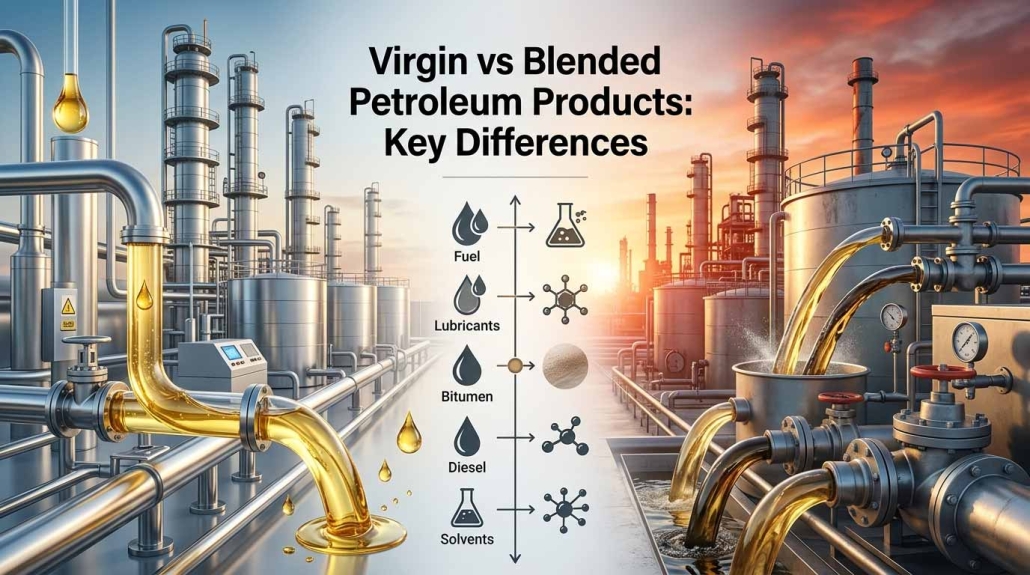
In international petroleum trading, understanding the distinction between virgin and blended petroleum products is essential for buyers, distributors, and industrial users. Product origin and processing methods can significantly influence performance, regulatory compliance, and overall procurement costs.
For fuel distributors, lubricant manufacturers, and industrial procurement teams, selecting the appropriate product type affects equipment reliability, operational efficiency, and long‑term maintenance costs. Differences in purity, consistency, and chemical stability also impact export standards and market pricing.
As global energy markets become more competitive, buyers increasingly evaluate whether virgin refinery products or blended alternatives offer the best balance between quality and cost.
What Are Virgin Petroleum Products?
Virgin petroleum products are refined directly from crude oil without blending with recycled or secondary materials. These products originate from controlled refinery processes such as atmospheric and vacuum distillation, catalytic cracking, and hydroprocessing.
Because they come directly from primary refining streams, virgin products generally provide high purity and consistent chemical composition.
Typical characteristics include:
- Stable viscosity and chemical structure
- Predictable performance under industrial conditions
- Compliance with international product specifications
- Low contamination risk
Examples of common virgin petroleum products include:
- Virgin base oil used for high‑performance lubricant manufacturing
- Virgin bitumen used in road construction and infrastructure projects
- Virgin solvents used in chemical and industrial processes
Industries requiring strict technical standards—such as automotive lubrication, aviation, and advanced manufacturing—often rely on virgin refinery products due to their predictable quality.
What Are Blended Petroleum Products?
Blended petroleum products are created by mixing different petroleum streams or additives to achieve specific performance characteristics or cost targets.
Blending is a common practice in modern refineries and fuel terminals. By combining various components, producers can optimize viscosity, sulfur levels, combustion performance, or other specifications required by regional markets.
Blending may involve:
- combining different refinery fractions
- adjusting fuel properties with additives
- mixing virgin materials with secondary streams
Commercial reasons for blending include:
- cost optimization
- meeting regional fuel standards
- adjusting product performance for specific applications
- improving supply flexibility
Examples of commonly blended petroleum products include:
- Base oils used for lubricant production
- Diesel fuels adjusted for seasonal or regional specifications
- Fuel oils used in marine and industrial energy systems
- Lubricant formulations containing additive packages
- Solvent mixtures used in industrial processing
- Bitumen blends designed for particular climate conditions
Understanding the blending strategy and product specifications is critical for buyers evaluating product suitability.

Virgin vs Blended Petroleum Products
While both product types are widely used across global markets, their differences influence performance, cost, and regulatory acceptance.
Key comparison factors include:
- Purity: Virgin products typically contain fewer impurities due to direct refinery processing.
- Viscosity stability: Virgin oils often maintain more consistent viscosity across temperature ranges.
- Sulfur content: Blended fuels may adjust sulfur levels to meet regional regulations.
- Oxidation resistance: Higher‑quality virgin products often demonstrate improved chemical stability.
- Consistency: Blended products may vary depending on component sources.
- Environmental impact: Blending can help meet environmental fuel standards.
- Operational performance: Sensitive machinery may require higher purity products.
- Export suitability: Some markets specify minimum virgin content.
- Storage stability: Virgin products often have longer shelf stability.
- Pricing: Blended products are generally more cost‑competitive.
For procurement managers, the decision typically depends on performance requirements, regulatory compliance, and price sensitivity.
Common Industries Using Blended Products
Blended petroleum products are widely used across multiple sectors where performance flexibility and cost efficiency are important.
Major industries include:
Transportation
Blended diesel and gasoline fuels are optimized to meet regional emission standards and seasonal requirements.
Construction
Bitumen blends are widely used in road paving and infrastructure projects.
Manufacturing
Industrial fuels and lubricants are often blended to meet specific machinery requirements.
Marine fuel supply
Marine fuels frequently involve blending to meet international maritime standards.
Lubricant production
Base oil blending enables lubricant manufacturers to achieve targeted viscosity grades.
Energy sector
Fuel oil blends are commonly used in power generation and industrial heating.
When Should Buyers Choose Virgin Products?
Virgin petroleum products are often preferred in situations where performance reliability and compliance are critical.
Buyers may prioritize virgin products when:
- machinery requires strict lubrication standards
- export regulations demand high product purity
- OEM equipment specifications must be maintained
- sensitive industrial processes require consistent chemical composition
High‑performance lubricant manufacturing and specialized industrial operations often fall into this category.
When Are Blended Products More Cost‑Effective?
Blended petroleum products can offer significant economic advantages in many commercial environments.
They are often selected when:
- cost efficiency is a primary purchasing factor
- the application does not require ultra‑high purity
- regional fuel standards allow blended compositions
- large‑volume fuel consumption favors lower procurement costs
In many markets, blended fuels represent the most practical balance between performance and affordability.
Comparison Table
| Product Type | Virgin Advantages | Virgin Dis-advantages | Blended Advantages | Blended Dis-advantages | Common Applications |
|---|---|---|---|---|---|
| Base Oil | High purity, stable viscosity | Higher cost | Flexible viscosity design | Quality variability | Lubricant manufacturing |
| Diesel Fuel | Consistent combustion | Higher refining cost | Cost efficient | Possible composition variation | Transportation |
| Bitumen | Strong structural stability | Limited flexibility | Climate‑optimized blends | Performance varies by mix | Road construction |
| Lubricants | Predictable chemical stability | Expensive base stock | Customized performance | Additive dependence | Industrial machinery |
| Fuel Oil | Stable composition | Higher production cost | Lower cost energy source | Variable sulfur levels | Power generation |
| Solvents | High purity | Expensive | Adjustable chemical properties | Possible impurities | Chemical processing |
Buyer Considerations in Petroleum Procurement
Experienced petroleum buyers typically evaluate several factors before selecting a product supplier.
Important considerations include:
- product specification sheets
- refinery origin documentation
- quality certification reports
- supply reliability
- international shipping capability
Working with suppliers that understand global petroleum markets and refinery product specifications helps reduce procurement risks and ensures consistent product quality.
Buyers exploring related topics may also benefit from resources such as Introduction to Petroleum Products, Introduction to Different Types of Base Oil, and Top Refineries in the World, which provide deeper insight into global petroleum supply chains.
FAQ
What are blended petroleum products?
Blended petroleum products are fuels or oils created by mixing different refinery streams or additives to achieve desired performance characteristics or regulatory specifications.
Are blended petroleum products lower quality?
Not necessarily. Many blended fuels meet international standards and are designed specifically to match regional regulations or industrial performance requirements.
Why are blended fuels cheaper than virgin fuels?
Blending allows refiners to combine different petroleum components, which can reduce production costs while still meeting required product specifications.
Which industries use blended petroleum products most?
Transportation, marine fuel supply, construction, manufacturing, and energy generation commonly use blended petroleum products.
Is virgin base oil better for lubricant production?
Virgin base oils are typically preferred for high‑performance lubricants because they offer higher purity and consistent chemical stability.
Global Petroleum Trade Solutions | Universal Trades
As a reputable international petroleum trading enterprise, Universal Trades specializes in the reliable procurement, export, and supply chain management of high-grade petroleum commodities, refined fuels, and industrial feedstocks designed to meet rigorous global standards.











Leave a Reply
Want to join the discussion?Feel free to contribute!