
Naphtha vs. Naphthalene: Understanding the Key Differences in Hydrocarbons
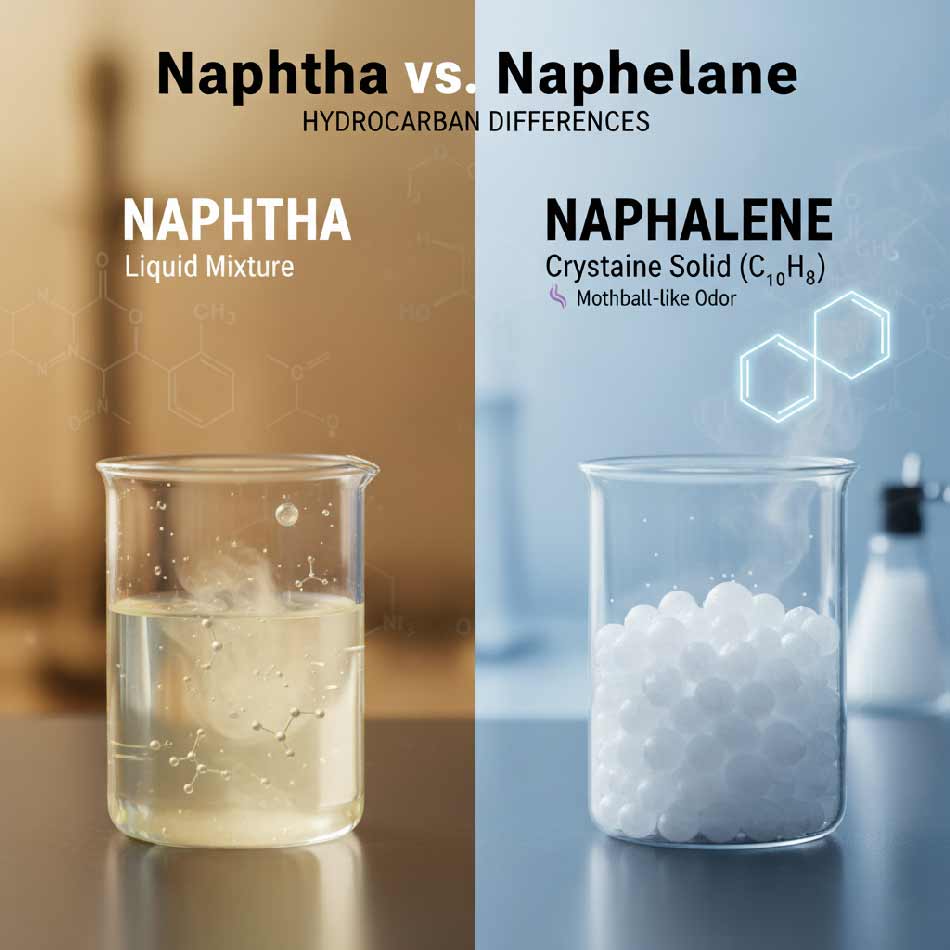
While their names sound strikingly similar, Naphtha and Naphthalene are distinct chemical substances with significant differences in their composition, properties, and applications. Understanding these differences is crucial for anyone working in the petroleum, chemical, or manufacturing industries.
This guide will break down what sets these two substances apart, ensuring clarity and precision for those navigating the world of hydrocarbons.
What is Naphtha?
Naphtha is not a single, pure compound; rather, it’s a broad, flammable liquid mixture of various hydrocarbons. It is primarily a fraction of crude oil obtained through the refining process of fractional distillation.
Think of Naphtha as a general term for a range of petroleum distillates that boil at a temperature higher than gasoline but lower than kerosene. Its exact composition—and therefore its specific properties and grades—varies depending on the source of the crude oil and the distillation process.
Key Characteristics of Naphtha:
- Composition: A complex mixture of aliphatic (straight-chain) and aromatic (ring-structured) hydrocarbons, typically with 5 to 12 carbon atoms per molecule ( to ).
- Form: A volatile, colorless liquid.
- Source: Derived from crude oil, coal tar, or natural-gas condensates.
- Primary Uses: A vital feedstock in the petrochemical industry (used to produce ethylene and propylene), a component in high-octane gasoline production via catalytic reforming, and used widely as a solvent (e.g., in paints and cleaning fluids).
What is Naphthalene?
In sharp contrast, Naphthalene is a specific, pure chemical compound. It is the simplest polycyclic aromatic hydrocarbon (PAH) and has the fixed chemical formula . It is famously recognizable by its strong, distinctive “mothball-like” odor.
Naphthalene can be obtained from coal tar or petroleum and is a key building block in many chemical syntheses.
Key Characteristics of Naphthalene:
- Composition: A pure, single chemical compound () consisting of two fused benzene rings.
- Form: A white, crystalline solid that easily sublimes (turns directly from a solid to a gas) at room temperature, which is why its odor is so noticeable.
- Source: Historically from coal tar, but now often produced from petroleum.
- Primary Uses: Primarily used as a chemical precursor for the industrial production of phthalic anhydride (used in plasticizers and dyes) and, historically, as the main active ingredient in mothballs and fumigants.
Naphtha vs. Naphthalene: The Direct Comparison
The fundamental difference lies in their chemical identity: Naphtha is a mixture of various hydrocarbons, while Naphthalene is a single, defined compound. This leads to all their other distinguishing characteristics:
Frequently Asked Questions FAQ
Is Naphtha related to Naphthalene?
Yes, historically, the name “Naphthalene” was derived from a kind of Naphtha (coal tar) because it was first isolated from it. However, they are chemically distinct substances today.
Which one is used in mothballs?
Naphthalene is the compound famously used in traditional mothballs due to its ability to sublime, releasing a vapor that repels or kills fabric-eating moths.
Are Naphtha and Naphthalene hazardous?
Both substances are hazardous and require careful handling. Naphtha is highly volatile and flammable. Naphthalene is classified as a potential human carcinogen and its vapors are toxic, especially if inhaled over long periods.
What is the most common commercial use for Naphtha?
The most common and economically significant use for Naphtha is as a feedstock in steam crackers to produce essential chemical building blocks like ethylene and propylene, which are then used to make plastics.




Chemically, what is the fundamental difference between Naphtha and Naphthalene?
The fundamental difference lies in their chemical identity: Naphtha is a broad, complex mixture of various hydrocarbons (typically $\text{C}_5$ to $\text{C}_{12}$) that is a fraction of crude oil. Conversely, Naphthalene is a pure, single chemical compound with a fixed chemical formula ($\text{C}_{10}\text{H}_{8}$), classifying it as the simplest polycyclic aromatic hydrocarbon (PAH).
I have two products in the warehouse with unclear labels. What is the easiest way to quickly distinguish Naphtha from Naphthalene without laboratory equipment?
The easiest way is to check their physical state and smell. Naphtha is a colorless liquid with a gasoline-like odor, while Naphthalene is a white crystalline solid with a very strong and distinctive odor (like mothballs).
A very practical guide for distinguishing these two. It’s crucial to highlight that while Naphtha is a primary feedstock for ethylene crackers, Naphthalene’s biggest industrial role today is the production of Phthalic Anhydride. For companies handling bulk storage, the safety protocols differ immensely—Naphthalene requires sublimation control, whereas Naphtha requires strict Vapour Recovery Systems (VRS) due to its high volatility. Does Universal Trades provide Material Safety Data Sheets (MSDS) tailored for maritime transport for both?
Hello Dr. Vance, thank you for emphasizing the safety aspect. You are absolutely right—the storage of a sublimating solid like Naphthalene is a different ballgame compared to high-volatility liquid Naphtha. To answer your question: Absolutely. At Universal Trades, we provide comprehensive MSDS and Technical Data Sheets for every shipment, ensuring that all maritime and land transport safety regulations are met, especially regarding vapor pressure and temperature control during transit.