Group 1 Base Oil: Properties, Grades and Applications

,
روغن پایه گروه 1 | Group 1 Base Oil | زيوت الأساس من المجموعة الأولى

Base oil is the foundation of any lubricant, making up 60% to 90% of its volume. Critical lubricant properties like viscosity, oxidation stability, solubility, and volatility are directly influenced by the quality of the base oil. The American Petroleum Institute (API) categorizes base oils into five groups (I to V) based on their saturate levels, sulfur content, and Viscosity Index (VI). Higher saturate levels, lower sulfur, and a higher VI generally indicate better quality.

Group I base oils are the oldest and most traditional type, produced through a solvent refining process. This process involves fractional distillation, solvent extraction to remove unwanted compounds like sulfur and aromatics, followed by dewaxing to eliminate waxy paraffin molecules.

Definition and Characteristics of Group I Base Oils

Group I base oils are defined by the following specifications:

  • Saturate Level: Less than 90%
  • Sulfur Content: Greater than 0.03%
  • Viscosity Index (VI): Between 80 and 120

These oils are primarily derived from paraffinic crude oil.
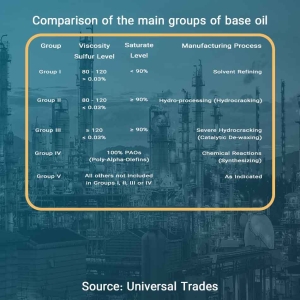
Comparison of the main groups of base oils. Group 1 base oil, Group 2 base oil, Group 3 base oil, Group 4 base oil, Group 5 base oil,

Key Properties:

  • Color: Amber to golden brown (due to residual sulfur, nitrogen, and cyclic compounds).
  • Volatility: Relatively low.
  • Solvency: High, which is crucial for dissolving additives in lubricants.
  • Lubricity: Possess good inherent lubricating properties to reduce friction and wear.
  • Oxidation Stability: Good, though less superior compared to Group II and III oils.
  • Flash Point: High.
  • Low-Temperature Properties: Suitable, but may have limitations in extremely low temperatures.
  • Typical Operating Temperature Range: Approximately 0 to 65.5°C (32 to 150°F).

Advantages and Limitations

Advantages:

  • Accessibility and Cost-Effectiveness: Their simpler production process makes them readily available and economically attractive.
  • Versatility: Widely used in hydraulic systems, gearboxes, and general industrial lubricants.
  • Good Solvency: Excellent solvency for additives is a significant advantage in lubricant formulation.

Limitations:

  • Lower Performance: Not recommended for high-performance applications or severe operating conditions (e.g., modern automotive engines).
  • Weaker Antioxidant Properties: Inferior to Group II oils, which undergo more severe hydrocracking.
  • Limitations in Extreme Pressure/Low-Temperature Applications: May not provide adequate performance in very low temperatures or under extreme pressures.
  • Darker Color: Their lower purity results in a darker color compared to higher groups.

Group I Base Oil Grades (SN and Bright Stock)

Group I base oils are available in various grades, primarily categorized by their viscosity. SN (Solvent Neutral) grades and Bright Stock are the most common. SN grades are typically named based on their approximate kinematic viscosity at 40°C. A higher number after “SN” indicates higher oil viscosity. This viscosity directly determines the oil’s suitability for different applications requiring specific film thickness and load-carrying capacity.

Base Oil Grade General Description Primary and Common Applications
SN 60/70/80 Light base oil General applications with no need for very high viscosity or specific performance.
SN 100 Light base oil Automotive and industrial lubricants, general oils, mold oils, transmission fluids, gear oils, metalworking fluids, additives, hydraulic oils, transformer oils, cutting oils, textile lubricants, agricultural spray oils.
SN 150 Medium viscosity base oil High-quality lubricants, hydraulic oils, transformer oils, industrial lubricants, gasoline and diesel engine oils, greases, specialty products, general oils, mold oils, transmission fluids, gear oils, metalworking fluids, additives.
SN 300 Higher viscosity base oil Engine oils, gear oils, heavy-duty lubricants, general oils, mold oils, transmission fluids, metalworking fluids, additives, hydraulic oils, transformer oils, cutting oils, textile lubricants, shoe polish, pigments, agricultural spray oils.
SN 500 Heavier base oil with high viscosity Advanced lubricants, engine oils, greases (requiring greater thickness), transmission fluids, gear oils, metalworking fluids, hydraulic oils, transformer oils.
SN 600/650 Highest viscosity specifications for Group I base oils Lubricants and lubricant additives, gasoline and diesel engine oils, dual-fuel and gas engine oils, industrial lubricants, grease, specialty products, transmission fluids, gear oils, metalworking fluids, hydraulic oils, transformer oils.
Bright Stock (BS 150) Very high viscosity (HVI) base oil Heavy industrial lubricants, marine oils, greases, engine oils, additives, gear oils, transmission fluids, metalworking fluids, hydraulic oils, transformer oils.

Explanation and Applications of Each Base Oil Grade

Here’s a detailed explanation of the common Group I base oil grades and their applications:

SN 60/70/80 Base Oil:

  • Description: These are the lighter Group I base oils, with parameters at the lower end for general lubricants.
  • Applications: Primarily used in general applications where very high viscosity or specific performance is not required.


SN 100 Base Oil:

  • Description: SN100 is a light base oil derived from further processing of specific crude oil vacuum distillates. This grade is at the lower end of the viscosity specifications for Group I light base oils.
  • Applications: Widely used in the production of lubricants and lubricant additives. It is suitable for a wide range of automotive and industrial lubricants. Specific applications include general oils, mold oils, power transmission fluids, gear oils, metalworking fluids, additives, hydraulic oils, and transformer oils. It also finds use in soluble and neat cutting oils, textile lubricants such as spinning oils, and agricultural spray oils.


SN 150 Base Oil:

  • Description: SN150 is a medium viscosity base oil obtained from further processing of specific crude oil vacuum distillates. This grade also falls at the lower end of the specifications for Group I light base oils. It is produced through solvent extraction and dewaxing processes, and also hydrogen-treated to further remove impurities.
  • Applications: Often used in the production of high-quality lubricants, including hydraulic oils, transformer oils, and other industrial lubricants. It’s also used for formulating gasoline and diesel engine oils, greases, and specialty products. Similar applications to SN100, such as general oils, mold oils, power transmission fluids, gear oils, metalworking fluids, and additives, also apply to this grade.


SN 300 Base Oil:

  • Description: SN300 is known for its higher viscosity. This grade is also derived from further processing of specific crude oil vacuum distillates. To ensure purity, this oil is solvent-refined, dewaxed, and hydrogen-treated. Its properties include high thermal stability and a long service life.
  • Applications: Widely used in the manufacturing of engine oils, gear oils, and heavy-duty lubricants. General industrial applications, mold oils, power transmission fluids, metalworking fluids, additives, hydraulic oils, and transformer oils are also among its uses. Additionally, it is employed in soluble and neat cutting oils, textile lubricants such as coning oils, antistatic oils, spin finish oils, shoe polish, pigments, and agricultural spray oils.


SN 500 Base Oil:

  • Description: SN500 is a heavier base oil with high viscosity, sitting at the higher end of the viscosity specifications for Group I base oils. This grade also results from further processing of specific crude oil vacuum distillates.
  • Applications: Ideal for producing advanced lubricants, engine oils, and greases that require greater consistency and thickness. It has extensive applications in the production of engine oils, power transmission fluids, gear oils, metalworking fluids, greases, hydraulic oils, and transformer oils.


SN 600/650 Base Oil:

  • Description: SN 600/650 is a base oil at the highest end of the specifications for Group I base oils. This grade is produced through solvent refining and dewaxing processes.
  • Applications: Generally used in the production of lubricants and lubricant additives. Its applications include gasoline and diesel engine oils, dual-fuel and gas engine oils, industrial lubricants, grease, and specialty products. It is also used in power transmission fluids, gear oils, metalworking fluids, greases, hydraulic oils, and transformer oils.


Bright Stock (BS 150):

  • Description: Bright Stock is a very high viscosity Group I base oil, derived from further processing of specific crude oil vacuum distillates. These oils fall into the category of high viscosity index (HVI) base oils. Bright Stock undergoes solvent refining, dewaxing, and hydrogen treatment to remove impurities and enhance its properties.
  • Properties: Features high oxidation stability, good additive response, low sulfur content, and excellent viscosity-temperature characteristics. These properties make it suitable for demanding applications.
  • Applications: Traditionally used in blending heavy industrial lubricants, marine oils, and greases. It also finds application in the production of engine oils, additives, gear oils, power transmission fluids, metalworking fluids, hydraulic oils, and transformer oils. Due to its high viscosity and excellent thermal stability, Bright Stock is used in specific applications where these properties are of particular importance. This demonstrates that Bright Stock, despite the overall decline of Group I base oils in certain sectors, has maintained a crucial and stable position. Its value is based on its inherently high viscosity and excellent thermal stability, which are vital for heavy-duty applications where strong film thickness and high-temperature performance are essential.


 

Selected Technical Specifications for Group 1 Base Oil Grades

Parameter Unit Test Method SN 100 SN 150 SN 300 SN 500 SN 600/650 Bright Stock (BS 150)
Color ASTM D 1500 0.5-2.0 2.0-2.2, 1.5-2.5 2.0-2.5, 2.0-3.0L 2.0-2.5L, 3.0L 3.0, Max 3L 3.0
Density at 15°C kg/m³ ASTM D 1298, D 4052 875, 0.865 0.870, 0.864–0.874 (15.6°C) 0.870–0.880, 0.870–0.880 0.885–0.890, 0.877 0.0893 0.9066
Kinematic Viscosity at 40°C cSt ASTM D 445 21-28, 13 30.0–31.54, 40-45 45.0–65.0, 60–70 97.5–102.0, 90.76 127.94 440-460
Kinematic Viscosity at 100°C cSt ASTM D 445 4.0-4.5, 3.3 5.0–5.5, 6-7.5 6.5–8.0, 8.0–9.0 10.5–11.5, 10.42 12.5, Min 12.6 28-31
Viscosity Index (VI) ASTM D 2270 95-99, > 95 90–92, 90-100 89–92, ≥ 95 89.0–92.0, Min 95 87, Min 80 95 Min
Flash Point (COC) °C ASTM D 92 190, > 180 200–210, +190 210–220, ≥ 210 225–235, Min 245 262, Min 235 295-310
Pour Point °C ASTM D 97 -15, -9 max -3, -3 -3, –3 -3, Max -9 -6, Max -3 -6
Sulfur Content %m/m ASTM D 4294, D 2622 0.6, 0.7 ≤ 0.03 0.4 0.761 0.65-0.85 0.65-0.85
Water Content ppm ASTM D 6304 ≤ 100 Max 100 52
Acid Number (TAN) mgKOH/g ASTM D 664, D 974 0.05 0.03 Max 0.05 0.02 0.01
Carbon Residue Wt% ASTM D 189, D 524 0.05 0.50 Max
Ash Content Wt% ASTM D 482 0.01 Max

Specific Applications and Blending Strategies

The future of Group 1 base oils isn’t about disappearing, but rather about strategic adaptation.

Niche Markets: Despite an overall decline in demand, Group 1 base oils have carved out a niche market in less demanding applications, particularly in industrial and agricultural lubricants. They continue to be used in specific formulations where their unique properties remain advantageous.

Blending with Other Groups: Some companies are blending Group 1 base oils with other base oil groups (like Group 3 or PAO) or additives. This strategy improves performance and maintains Group 1’s presence in more modern formulations. This approach transforms Group 1 from a general-purpose base oil into a specialized, cost-effective component in custom or industrial lubricants. Its inherent qualities, such as good solvency and lower cost, preserve its competitive edge and ensure its continued presence in the global lubricant market.

Stronger Demand for Heavier Grades: The demand for heavier Group 1 base oil grades (SN and Bright Stock) remains more stable. This highlights the increasing value of high viscosity in heavy industrial applications. While automotive lubricants are shifting towards lighter, higher VI oils, heavy Group 1 oils are ideal for applications requiring robust film strength, durability, and high load-carrying capacity. This trend indicates a strategic shift by Group 1 manufacturers to focus on these more stable, higher-viscosity segments.

Regional Differences

The adoption patterns of Group 1 base oils show significant regional variations. In some geographies, these oils remain dominant due to specific market conditions, existing refinery infrastructure, and regulatory requirements. For example, Europe continues to hold a significant share of Group 1 production capacity.

Sustainability Initiatives (Recycling and Re-refining)

There’s growing interest in recycling and re-refining used Group 1 base oils as part of sustainability initiatives. This approach helps reduce waste and enhances environmental responsibility, potentially contributing to the future sustainability of this base oil group. Some companies are also producing recycled Group 2 and 3 base oils. These efforts to align with growing environmental awareness and stricter regulations help maintain Group 1’s market position.

Frequently Asked Questions (FAQ)

This section addresses some common questions regarding base oils and their classifications.

What is Group 1 Base Oil? Group I Base Oil refers to a category of mineral base oils produced from crude oil through a solvent refining process. This process primarily aims to remove undesirable compounds like sulfur, aromatics, and waxes. Their key characteristics, according to API classification, include: less than 90% saturates, more than 0.03% sulfur, and a Viscosity Index between 80 and 120. Due to their relatively simpler production process, these oils are cost-effective and readily available, offering good solvency for additives. However, due to lower purity and oxidation stability compared to higher groups, they are not recommended for high-performance applications.

What is Type 1 oil?Type 1 oil” typically refers to Group I base oil. This term may be used in some industries or regions as a synonym for Group I base oil, as it represents the first and most traditional category of base oils derived from direct crude oil refining, historically being the first common “type.”

What is Type 2 base oil? Type 2 base oil refers to Group II Base Oil. These oils are also derived from crude oil but undergo a more severe hydroprocessing or hydrocracking process, resulting in higher purity and improved properties. Their characteristics include: over 90% saturates, less than 0.03% sulfur, and a Viscosity Index between 80 and 120. Compared to Group 1, Group 2 oils have better antioxidant properties and a clearer color, and are commonly used in mineral engine oils in the market.

What are the three main types of base oil? The American Petroleum Institute (API) classifies base oils into five main groups. The three primary types derived from direct crude oil refining are:

  • Group I: Less than 90% saturates, more than 0.03% sulfur, VI between 80 and 120. Produced by solvent refining.
  • Group II: More than 90% saturates, less than 0.03% sulfur, VI between 80 and 120. Produced by hydroprocessing.
  • Group III: More than 90% saturates, less than 0.03% sulfur, VI above 120. Produced by severe hydrocracking. Groups 4 (PAO) and 5 (including esters, vegetable oils, etc.) also exist, which are synthetic or other than Groups 1-3.

What is the best base oil for massage? For massage, carrier oils are typically used, which are derived from plant sources and fall under API Group 5 base oil. The best oil choice depends on skin type and specific needs. Some popular and effective options include:

  • Sweet Almond Oil: Very popular for general body massage, rich in linoleic acid, vitamins, and minerals, softening and nourishing for the skin.
  • Grapeseed Oil: A popular choice for general massage, light, non-greasy, and easily absorbed, rich in Vitamin E and linoleic acid. Also hypoallergenic and anti-inflammatory.
  • Coconut Oil: Especially its fractionated type, which remains liquid at room temperature, is light, easily absorbed, non-greasy, and has antioxidant and moisturizing properties.
  • Jojoba Oil: Due to its similarity to natural skin oils, it’s easily absorbed and rich in antioxidants. It’s a very nourishing massage base.
  • Apricot/Peach Kernel Oil: Light, easily absorbed, and suitable for facial massage, especially for dry, mature, or sensitive skin.
  • Avocado Oil: Thick and nourishing, ideal for very dry, dehydrated, and mature skin or skin conditions like eczema. Usually diluted with lighter oils.

What is Class 1 oil?Class 1 oil” most likely refers to “Group I base oil.” This term, like “Type 1 oil,” might be used in some contexts as a colloquialism or synonym to refer to this category of traditional mineral base oils, which are the first and most common group in API classification.

What are the three grades of oil? If “three grades of oil” refers to the main categories of engine oils based on performance, we can refer to the API classifications for gasoline and diesel engines:

  • “S” (Service) Category: For gasoline engines in passenger cars, vans, and light trucks. The newest and most common grades include API SP (for 2020 and newer engines, protecting against LSPI, timing chain wear, and deposits) and API SN (for 2020 and older engines). Older grades like SM, SL, SJ are still “Current” but recommended for older engines.
  • “C” (Commercial) Category: For diesel engines in heavy-duty trucks and diesel vehicles. The newest grades include API CK-4 (for 2017 and newer diesel engines, advanced protection against oil oxidation, viscosity loss, and engine wear) and API CJ-4 (for 2010 and newer engines). CI-4 and CH-4 grades are also still “Current.”
  • “F” (Fuel-Efficient Diesel) Category: Includes API FA-4, designed for specific high-speed four-stroke diesel engines that meet 2017 greenhouse gas emission standards. These oils are not interchangeable with CK-4 or CJ-4. These grades represent different performance levels and compatibility with various engine technologies and emission standards.

Conclusion

Despite extensive developments in the petroleum products industry, Group 1 base oil continues to maintain its position as a vital component in the global market. These oils, derived from crude oil through a solvent refining process, have less than 90% saturates, more than 0.03% sulfur, and a viscosity index between 80 and 120. Their key advantages include wide availability, reasonable pricing, and excellent solvency for additives, making them suitable for industrial and general applications, unlike finished products such as gasoline or diesel.

However, this group faces challenges, including lower performance compared to Group 2 and 3 base oils used in more advanced lubricant production. New industrial standards and stringent environmental regulations, along with the inefficiency of some older refineries that might also affect the production of products like kerosene or LPG, have led to a decline in Group 1 base oil’s market share and production capacity. Nevertheless, this group still holds a significant revenue share in the market.

The future of Group 1 base oil lies in strategic adaptation. This includes focusing on more specialized applications such as industrial and agricultural lubricants, where its specific properties are still required, much like the position of bitumen in road construction industries. Furthermore, blending it with higher-quality base oils or additives helps maintain its role in more modern formulations. The stable demand for heavier SN and Bright Stock grades also demonstrates the importance of “viscosity value” in heavy-duty applications. Additionally, sustainability initiatives like recycling help preserve the presence of this group of petroleum products in the market. Ultimately, Group 1 base oil is evolving towards a more specialized and complementary role in the lubricant industry.

2 replies
  1. dara
    dara says:

    I’m looking at the specs. How exactly does the solvent refining process give Group I oils better solvency for additives compared to the purer Group II and III oils?

    Reply
    • mehdi
      mehdi says:

      That’s a great question about the trade-off! Solvent refining doesn’t remove all the aromatics and polar compounds. These leftover compounds are precisely what gives Group I base oils their excellent solvency. The purer Group II/III oils (produced by hydroprocessing) have much lower amounts of these compounds, making it sometimes harder to dissolve certain additives fully.

      Reply

Leave a Reply

Want to join the discussion?
Feel free to contribute!

Leave a Reply

Your email address will not be published. Required fields are marked *