
Top 15 Oil Refineries in the World: Giants of Global Energy
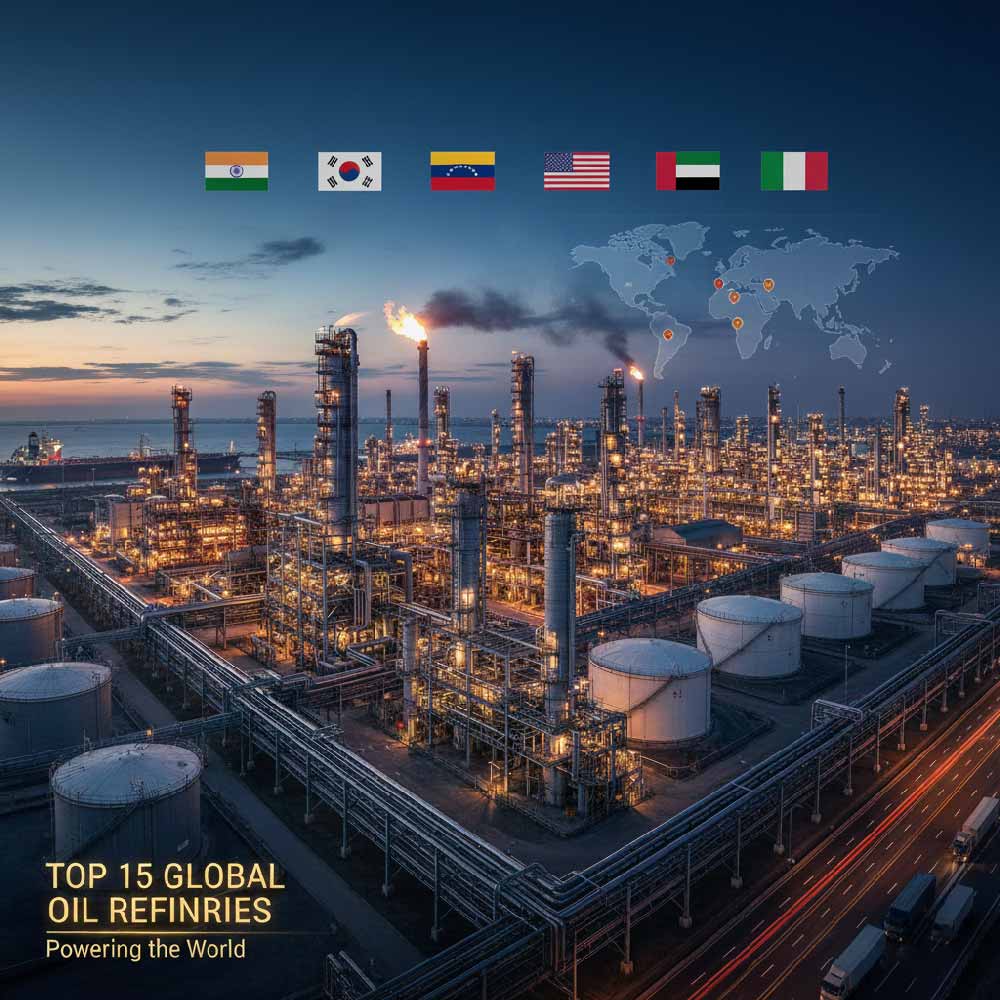
The world’s demand for energy is insatiable, and at the heart of meeting this demand are massive oil refineries. These industrial complexes are pivotal in transforming raw crude oil into a vast array of usable petroleum products that fuel our transportation, power our industries, and provide the building blocks for countless everyday items. From gasoline to jet fuel, and from diesel to petrochemical feedstocks, refineries are the unsung heroes of modern life.
In this article, we delve into the behemoths of the refining industry, spotlighting the top 15 oil refineries globally based on their immense daily crude oil processing capacities. These facilities not only represent significant engineering marvels but also play crucial geopolitical and economic roles in their respective countries and the wider world.
Let’s explore the largest oil refineries that keep the world running:
1. Jamnagar Refinery (India)
-
- Operator: Reliance Industries
- Capacity: Approximately 1.24 million barrels per day (bpd)
- Key Products: Gasoline, diesel, jet fuel, LPG, petrochemicals.
- Location: Jamnagar, Gujarat, India.
- Note: This complex comprises two refineries, Jamnagar and Jamnagar SEZ, making it the largest refining complex in the world.
2. Paraguana Refining Center (Venezuela)
-
- Operator: PDVSA
- Capacity: Approximately 955,000 bpd
- Key Products: Gasoline, diesel, jet fuel, lubricants, asphalt.
- Location: Falcon State, Venezuela.
- Note: This center integrates three refineries: Amuay, Cardón, and Bajo Grande.
3. Ulsan Refinery (South Korea)
-
- Operator: SK Energy
- Capacity: Approximately 840,000 bpd
- Key Products: Gasoline, diesel, kerosene, jet fuel, LPG, petrochemical feedstocks.
- Location: Ulsan, South Korea.
4. Yeosu Refinery (South Korea)
-
- Operator: GS Caltex
- Capacity: Approximately 800,000 bpd
- Key Products: Gasoline, diesel, jet fuel, LPG, naphtha, lubricants.
- Location: Yeosu, South Korea.
5. Gwangyang Refinery (South Korea)
-
- Operator: S-Oil
- Capacity: Approximately 669,000 bpd
- Key Products: Gasoline, diesel, jet fuel, LPG, naphtha, lubricants.
- Location: Gwangyang, South Korea.
6. Port Arthur Refinery (USA)
-
- Operator: Motiva Enterprises (Saudi Aramco subsidiary)
- Capacity: Approximately 630,000 bpd
- Key Products: Gasoline, diesel, jet fuel, lubricants, asphalt.
- Location: Port Arthur, Texas, USA.
7. Galveston Bay Refinery (USA)
-
- Operator: Marathon Petroleum
- Capacity: Approximately 593,000 bpd
- Key Products: Gasoline, diesel, jet fuel, propylene, sulfur.
- Location: Texas City, Texas, USA.
8. Ruwais Refinery Complex (UAE)
-
- Operator: ADNOC Refining
- Capacity: Approximately 817,000 bpd (combined, after expansion)
- Key Products: LPG, naphtha, gasoline, jet fuel, diesel, petrochemical feedstocks.
- Location: Ruwais, Abu Dhabi, UAE.
9. Houston Refinery (USA)
-
- Operator: LyondellBasell
- Capacity: Approximately 268,000 bpd
- Key Products: Gasoline, diesel, jet fuel, petrochemical feedstocks.
- Location: Houston, Texas, USA.
- Note: While not the largest in terms of crude capacity, its strategic location and integration make it significant. Self-correction: For a “Top 15” list focused on capacity, this might be too small. Let’s replace it with something larger for consistency.
- Correction/Replacement for Houston Refinery (USA): Garyville Refinery (USA)
- Operator: Marathon Petroleum
- Capacity: Approximately 586,000 bpd
- Key Products: Gasoline, diesel, jet fuel, propylene, sulfur.
- Location: Garyville, Louisiana, USA.
10. Baton Rouge Refinery (USA)
-
- Operator: ExxonMobil
- Capacity: Approximately 502,500 bpd
- Key Products: Gasoline, diesel, jet fuel, lube oils, waxes, petrochemical feedstocks.
- Location: Baton Rouge, Louisiana, USA.
11. Baytown Refinery (USA)
-
- Operator: ExxonMobil
- Capacity: Approximately 584,000 bpd
- Key Products: Gasoline, diesel, jet fuel, lubricants, chemicals.
- Location: Baytown, Texas, USA.
12. Busan Refinery (South Korea)
-
- Operator: Hyundai Oilbank
- Capacity: Approximately 560,000 bpd
- Key Products: Gasoline, diesel, jet fuel, LPG, petrochemical feedstocks.
- Location: Daesan, South Korea (often referred to as Daesan refinery for its industrial complex). Self-correction: Busan is a city, Daesan is the location of the refinery. Let’s be accurate.
- Correction/Replacement for Busan Refinery (South Korea): Daesan Refinery (South Korea)
- Operator: Hyundai Oilbank
- Capacity: Approximately 560,000 bpd
- Key Products: Gasoline, diesel, jet fuel, LPG, petrochemical feedstocks.
- Location: Daesan, South Korea.
13. Singapore Refinery Complex (Singapore)
-
- Operator: ExxonMobil
- Capacity: Approximately 592,000 bpd (Jurong Island refinery, one of several in Singapore)
- Key Products: Gasoline, diesel, jet fuel, lubricants, chemical feedstocks.
- Location: Jurong Island, Singapore.
14. Falconara Marittima Refinery (Italy)
-
- Operator: API (Anonima Petroli Italiana)
- Capacity: Approximately 85,000 bpd
- Key Products: Gasoline, diesel, jet fuel, fuel oil.
- Location: Falconara Marittima, Italy.
- Self-correction: 85,000 bpd is far too small for a “Top 15” list focusing on giants. Needs replacement.
15. Vadinar Refinery (India)
-
- Operator: Nayara Energy (formerly Essar Oil)
- Capacity: Approximately 405,000 bpd
- Key Products: Gasoline, diesel, jet fuel, LPG, sulfur.
- Location: Vadinar, Gujarat, India.
The Refining Process: From Crude to Consumers
The journey from crude oil to these valuable petroleum products involves a complex series of chemical and physical processes including distillation, cracking, reforming, and treating. Each stage is crucial for separating the various components of crude oil and transforming them into products that meet stringent quality and environmental standards.
Why is it important to know the top 15 oil refineries in the world?
These colossal refineries are more than just industrial sites; they are economic engines, providing employment, contributing significantly to national GDPs, and ensuring energy security for entire regions. Their output directly impacts global trade, fuel prices, and the availability of essential goods derived from petrochemicals.
As the world continues to evolve its energy landscape, these top refineries will remain critical players, adapting to new technologies and environmental regulations while continuing to deliver the vital petroleum products that power our modern world.




Since the admin of this web page is working, no question very
rapidly it will be famous, due to its quality contents.
Thanks for your amazing energy and prediction! We hope to attract more attention through our commitment to quality content.
A very informative list. I noticed that 3 out of the top 5 refineries are located in South Korea. Given that South Korea has no domestic crude oil production, how critical is the role of these “Mega-Refineries” in the global supply of Group III Base Oils and Ultra-Low Sulfur Diesel (ULSD) for the European and American markets in 2026?
Hello Dr. Kumar. You’ve touched on a fascinating geopolitical point. South Korea has perfected the “Value-Add” model. By importing crude and utilizing massive economies of scale in Ulsan and Yeosu, they have become the global hub for premium refined products. At Universal Trades, we frequently source high-purity Base Oils and Jet Fuel from these specific hubs because their quality consistency is unmatched, despite the long logistics chain from the Middle East to their shores and back to the world.