
Top 10 Base Oil Producing Countries 2026: The Foundation of the Global Lubricants Market
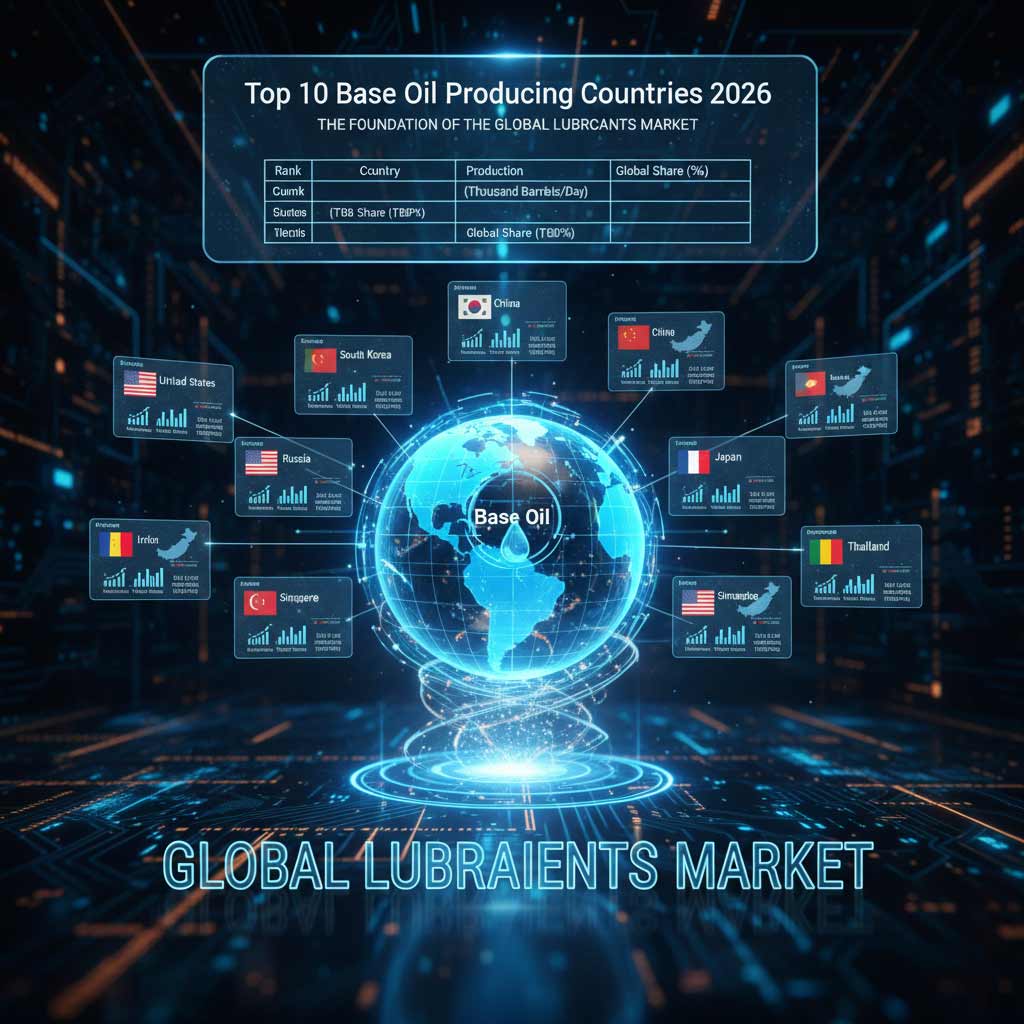
In 2026, the global lubricants industry is undergoing a structural transformation driven by tighter emission standards, longer oil drain intervals, and the rapid growth of electric and hybrid vehicles. At the core of this evolving value chain lies base oil, the primary feedstock for automotive, industrial, and marine lubricants. As demand shifts away from Group I toward higher-performance Group II and Group III base oils, countries with advanced refining and hydroprocessing capabilities are strengthening their dominance in global production.
This report examines the Top 10 Base Oil Producing Countries in 2026, highlighting the nations that underpin the global lubricants supply chain.
Table: Top 10 Base Oil Producing Countries in 2026
| Rank | Country | Production (Thousand Barrels/Day) | Global Share (%) |
| 1 | United States | 1,050 | 18.8% |
| 2 | China | 920 | 16.4% |
| 3 | South Korea | 640 | 11.4% |
| 4 | India | 560 | 10.0% |
| 5 | Russia | 470 | 8.4% |
| 6 | Saudi Arabia | 420 | 7.5% |
| 7 | Japan | 360 | 6.4% |
| 8 | Singapore | 300 | 5.4% |
| 9 | United Arab Emirates | 260 | 4.6% |
| 10 | Thailand | 230 | 4.1% |
| – | Asia-Pacific Total | ~2,800 | ~50% |
| Total | World Production | ~5,600 | 100% |
1. United States
The United States remains the world’s largest base oil producer in 2026, supported by its highly sophisticated refining network along the Gulf Coast. U.S. refiners focus heavily on Group II and Group III base oils, leveraging shale-derived feedstocks and advanced hydrocracking units. Major producers such as ExxonMobil and Chevron supply both domestic lubricant manufacturers and export markets across Latin America and Europe, where demand for low-sulfur, high-viscosity-index base oils continues to rise.
2. China
China has rapidly expanded its base oil capacity as part of its broader downstream integration strategy. In 2026, state-owned and private refiners are increasing production of higher-quality base oils to support the country’s massive automotive and industrial sectors. Beyond meeting domestic demand, China has emerged as a competitive exporter of base oils to Southeast Asia and Africa, reshaping regional supply dynamics.
3. South Korea
South Korea is a global leader in premium Group III base oil production. With world-class facilities operated by companies such as SK Lubricants and S-Oil, the country supplies high-performance base oils to international lubricant brands. In 2026, South Korean base oils are widely used in synthetic and semi-synthetic lubricants, particularly in Europe and North America.
4. India
India has strengthened its position as a major base oil producer through large-scale refining complexes such as Jamnagar. The country benefits from competitive production costs and strategic access to export markets in Africa, the Middle East, and Southeast Asia. In 2026, India’s base oil output supports both domestic consumption and a growing export-oriented lubricants industry.
5. Russia
Russia continues to play a significant role in global base oil production, particularly in Group I and Group II grades. While a substantial portion of output serves domestic and regional markets, Russian base oils remain essential for heavy industry, rail transport, and marine applications across Eurasia. In 2026, Russia’s base oil sector remains resilient despite shifting global trade patterns.
6. Saudi Arabia
Saudi Arabia has expanded its base oil production under Saudi Aramco’s downstream diversification strategy. Modern refineries are increasingly configured to convert heavy crude into higher-value base oils and specialty lubricants. In 2026, Saudi base oils are key to supplying lubricant markets across the Middle East, Europe, and parts of Asia.
7. Japan
Japan’s refining industry continues to specialize in high-quality and specialty base oils. Although overall fuel demand has declined, Japanese producers focus on precision-engineered base oils used in advanced automotive and industrial lubricants. In 2026, Japan maintains a stable export flow to premium lubricant markets.
8. Singapore
Singapore functions as a strategic refining and trading hub for base oils in the Asia-Pacific region. Its advanced infrastructure and logistics capabilities allow it to serve as both a producer and a redistribution center. In 2026, Singaporean base oils play a crucial role in balancing regional supply and demand.
9. United Arab Emirates
The United Arab Emirates has increased base oil production capacity through expansions at the Ruwais refining complex. ADNOC’s integrated downstream strategy positions the UAE as a growing supplier of base oils to Africa, South Asia, and the Middle East. In 2026, base oil production complements the country’s broader petrochemical ambitions.
10. Thailand
Thailand has emerged as a notable base oil producer within the ASEAN region. With competitive refining economics and stable output, Thai base oils are widely used in regional lubricant blending operations. In 2026, Thailand continues to strengthen its role in Southeast Asia’s lubricants supply chain.
Explore More in Our Energy & Base Oil Series
To gain a deeper understanding of global energy and lubricants markets, explore our related professional resources:
- Market Rankings:
Top crude oil reserves countries | Largest gasoline producing countries | Top diesel producing countries - Base Oil Fundamentals:
Introduction to base oil | Base oil production process | Base oil articles - Related Petroleum Products:
Bitumen articles | Sulfur articles





Interesting ranking for 2026. Singapore remains a key player at rank 8, but with the rapid expansion of India’s Jamnagar refinery and UAE’s Ruwais complex, do you foresee Singapore losing its status as the primary “price setter” for the Asia-Pacific base oil market by the end of the decade?
Hello Sarah. While India and the UAE are significantly increasing physical volume, Singapore’s strength lies in its integrated trading ecosystem and financial infrastructure. At Universal Trades, we observe that even if physical production shifts, Singapore’s “Price Discovery” role remains dominant. However, the UAE’s ADNOC is increasingly offering competitive direct-to-market supplies to Africa and South Asia, which might eventually decentralize the traditional Singapore-centric pricing model.