
Paraffinic vs. Naphthenic Base Oil: Understanding Key Differences in Structure and Application
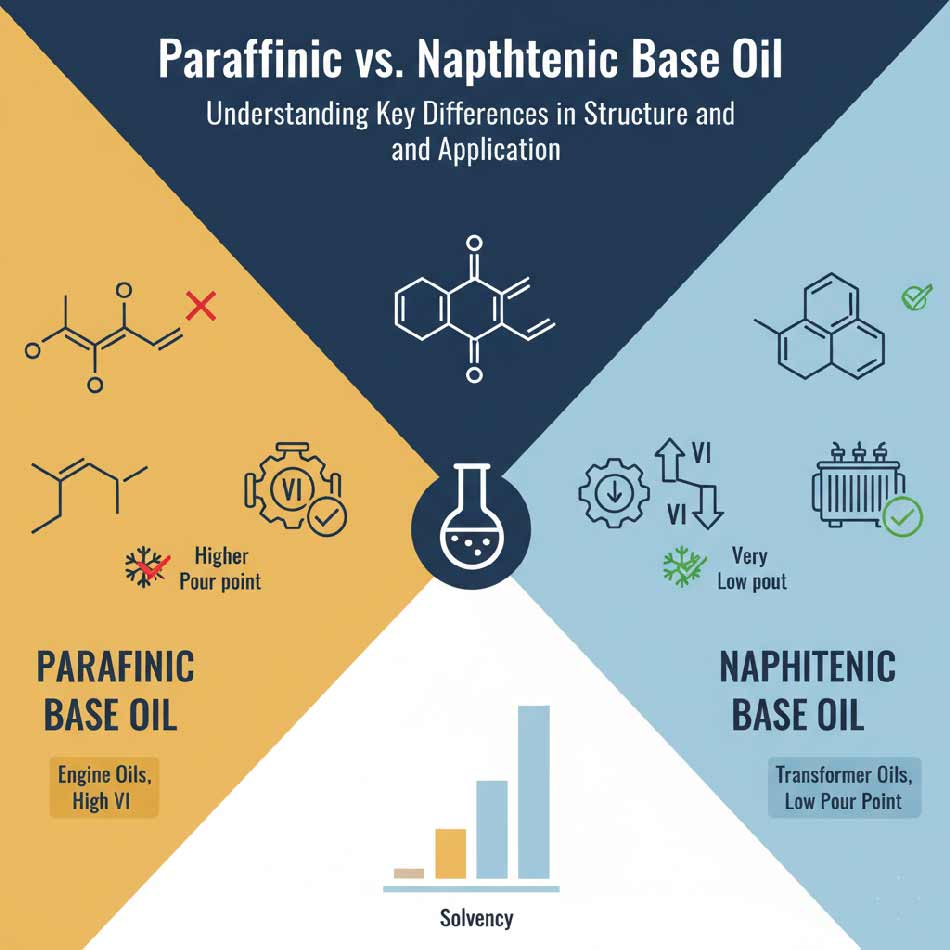
Base oil is the backbone of any lubricant, often comprising over 90% of the formulation of engine oils, greases, and industrial fluids. The two primary types of mineral base oils are Paraffinic and Naphthenic. Though both originate from crude oil, they possess fundamental differences in their chemical structure, physical properties, and, consequently, their final applications. Choosing the correct base oil is crucial for the optimal performance of a lubrication system.
Chemical Structure: The Root of Differentiation
The core difference lies in the molecular arrangement of their constituent hydrocarbons:
| Feature | Paraffinic Base Oil | Naphthenic Base Oil |
| Molecular Structure | Primarily Chain Hydrocarbons (Alkanes) | Primarily Cyclic Hydrocarbons (Cycloalkanes) |
| Wax Content | High Wax Content | Very Low or Zero Wax Content |
| Density | Lower (Lighter) | Higher (Heavier) |
| Saturation | Higher | Lower |
Paraffinic oils (which largely define API Group I, Group II, and Group III) have a high wax content due to their straight-chain structure. This historically caused them to solidify at low temperatures (high pour point). However, modern, more severe refining processes (like hydrocracking) mitigate this issue and yield a higher Viscosity Index (VI).
In contrast, Naphthenic oils, due to their compressed, ring-like structure, contain very little or no wax. This characteristic naturally gives them an exceptionally low Pour Point.
Properties and Performance: Impact on Lubrication
The structural differences directly influence how these oils perform under various operating conditions:
1. Viscosity Index (VI)
- Paraffinic: Characterized by a higher VI (typically above 90). This means their viscosity changes less with temperature fluctuations, offering better stability at high temperatures.
- Naphthenic: Exhibit a lower VI (typically below 90). Their viscosity is more prone to change with temperature swings.
2. Low-Temperature Performance (Pour Point)
- Paraffinic: Requires extensive dewaxing to achieve a low pour point due to its wax content.
- Naphthenic: Naturally possess a much lower pour point, providing excellent flowability in cold weather.
3. Solubility
- Paraffinic: Have relatively low solvency, requiring stronger additives to dissolve contaminants, sludge, or deposits.
- Naphthenic: Boast excellent solvency, readily dissolving additives and keeping internal engine parts cleaner.
Applications: Where and Why to Use Each Type?
The performance differences dictate their optimal use cases:
| Application | Paraffinic Base Oil | Naphthenic Base Oil |
| Engine and Gear Oils | ✅ Excellent (Due to high VI and thermal stability) | ❌ Less Common (Except niche uses) |
| Cold Hydraulic Fluids | ❌ Poorer performance without special additives | ✅ Ideal (Due to low pour point) |
| Rubber/Tire Production | ❌ Less Common | ✅ Ideal (As a process oil due to high solvency) |
| Transformer/Insulating Oils | ❌ Less Common | ✅ Ideal (Due to dielectric properties) |
Paraffinic oils are the primary choice for high-performance engine oils and general industrial lubricants due to their superior thermal stability and suitable Viscosity Index.
Naphthenic oils excel in specialized applications demanding exceptional cold-weather performance (like refrigeration oils and transformer oils) and are favored in process applications that rely heavily on their high solvency.
Conclusion: The Smart Choice
The key difference between Paraffinic and Naphthenic base oil is their molecular arrangement, which translates into higher VI and thermal stability for Paraffinic, and superior low pour point and excellent solvency for Naphthenic. While Paraffinic oils (Groups II and III) increasingly dominate the market due to refining advancements, Naphthenic oils remain indispensable for niche applications where cold flow and high solvency are critically important.
Frequently Asked Questions (FAQ)
Is Paraffinic base oil better than Naphthenic?
Not necessarily. Paraffinic oils (especially Group II and III) are better for engine oils and many high-performance industrial lubricants due to their high VI and oxidation stability. However, Naphthenic oils are superior for applications like transformer oil or process oils that require a very low pour point and high solvency.
Which type of base oil are Groups I, II, and III?
Groups I, II, and III are classified by API primarily as Paraffinic base oils, as they are derived from refining crude oil with high paraffin content and undergo a dewaxing process.
Which base oil is more natural?
Both types are considered mineral base oils and are refined from crude oil. However, structurally, Paraffinic hydrocarbons (chain-like) are simpler, and Naphthenic hydrocarbons (cyclic) are more complex.





What is the main difference in application between Paraffinic and Naphthenic base oil?
Paraffinic base oils are the primary choice for high-performance engine oils and general industrial lubricants due to their higher Viscosity Index (VI) and better thermal stability. Conversely, Naphthenic base oils are ideal for specialized applications such as transformer oils and cold hydraulic fluids because of their extremely low pour point and excellent solvency.
Why is “naphthenic” base oil almost always used in high-voltage electrical transformers?
There are two main reasons: first, naphthenic oil remains completely fluid in extreme cold and does not freeze. Second, it has excellent cooling and electrical insulation properties and can dissolve impurities caused by transformer operation, preventing them from forming deposits.
A very clear distinction. In the utilities sector, we exclusively use Naphthenic base oils for high-voltage transformer cooling. My question is: with the current shift towards Group II/III Paraffinics in global refineries, are we facing a future shortage of high-quality Naphthenic oils for electrical applications? Also, how does the gas-absorbing property of Naphthenics compare to Paraffinics in high-stress environments?
Hello Sarah, that’s a forward-thinking question. You are right; as refineries optimize for fuels, Naphthenic capacity is becoming a “niche” market. However, Naphthenics remain superior for transformers because of their Gas-Absorbing tendency under electrical stress, whereas Paraffinics tend to evolve gas, which can lead to equipment failure. At Universal Trades, we maintain a robust supply chain for specialized Naphthenic oils to ensure critical infrastructure sectors like yours face no shortages in 2026.