
E85 Gasoline: Fuel of the Future or Today’s Challenge?
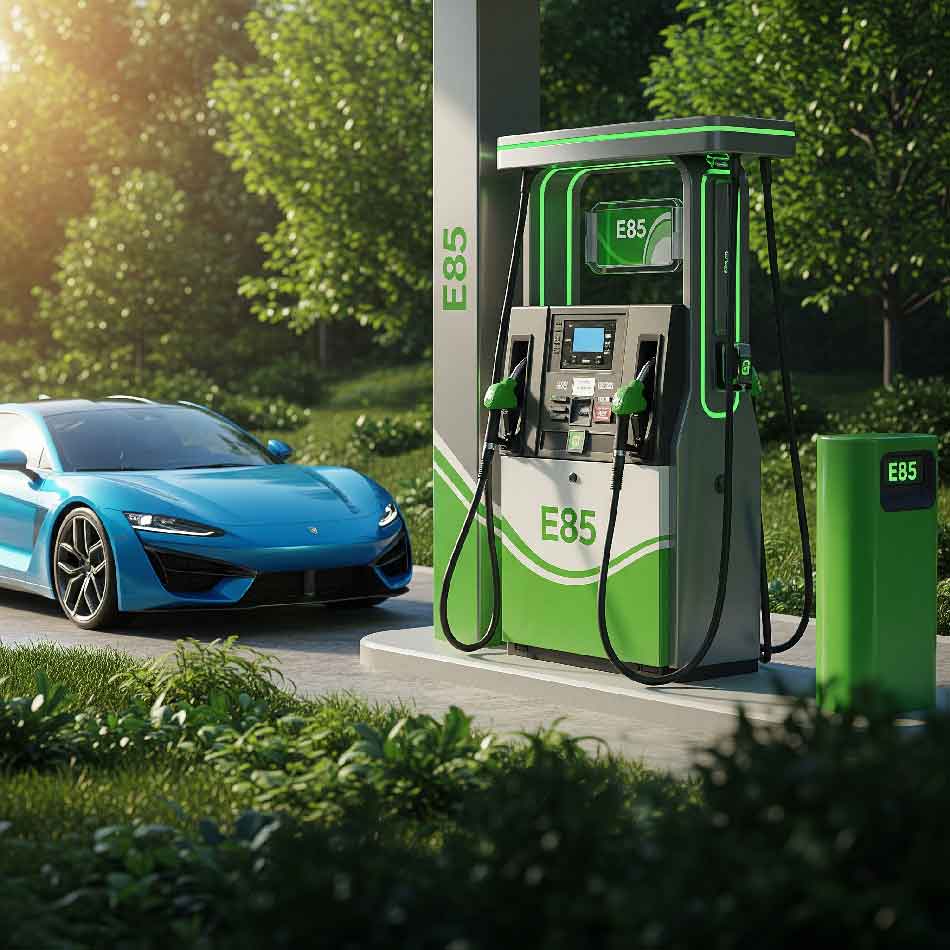
In the fast-paced world of energy, we are constantly seeking fuels that are both efficient and leave a smaller environmental footprint. E85 gasoline is one such option. While its name might be less familiar in Iran, it’s gaining traction in various parts of the world as an alternative to conventional gasoline. But what exactly is E85, what are its pros and cons, and can your car use it? This article will answer all these questions.
What is E85? A Blend of Ethanol and Gasoline
E85 is essentially a blend of 85% ethanol (ethyl alcohol) and 15% gasoline. The “E” stands for ethanol, and the “85” indicates the percentage of ethanol in the mix. The ethanol used in E85 is typically produced from renewable sources like corn or sugarcane, which is why it’s also called bioethanol. The primary goal behind developing E85 is to reduce reliance on fossil fuels and cut down on environmental emissions.
Technical and Performance Characteristics: More Power with High Octane?
Due to its high ethanol content, E85 has different technical characteristics compared to regular gasoline:
High Octane Rating: Potential for Increased Power
One of E85’s most significant features is its very high octane rating, usually between 100 and 105. This contrasts with regular gasoline, which often has an octane rating of 87 or 95 in many countries. High octane allows engines designed for E85 to operate at higher compression ratios. This can lead to increased power and performance, especially in high-performance and sports cars capable of using this fuel.
Fuel Consumption and Efficiency
Ethanol releases less energy per unit volume compared to gasoline. This means that to travel a specific distance, your vehicle might have higher fuel consumption (per liter) when running on E85. However, due to its high octane rating and improved overall engine efficiency in compatible vehicles, this difference in overall efficiency can be offset.
Engine Cooling
Ethanol has cooling properties. This feature can help maintain optimal engine temperature and prevent overheating.
Is Your Car Compatible with E85? A Crucial Point!
This is a very important point to understand: E85 is exclusively designed for specific vehicles known as “Flex-Fuel Vehicles” (FFVs) or “dual-fuel ethanol vehicles.”
- Flex-Fuel Vehicles: These cars have specialized fuel systems that can operate on varying blends of gasoline and ethanol. Their internal engine components, sensors, gaskets, fuel pump, and injectors are resistant to the corrosive properties of ethanol.
- Danger for Regular Cars: Using E85 in conventional gasoline vehicles can severely damage engine components. Ethanol has a high corrosive nature and can harm gaskets, hoses, fuel pumps, and other rubber and plastic parts that are designed to resist only pure gasoline. Additionally, ethanol tends to absorb water, which can lead to serious problems in the fuel system.
- Check Your Owner’s Manual: Always consult your car’s owner’s manual before using E85. If your vehicle is an FFV, this information will be clearly stated in the manual and usually indicated by a specific label on the fuel cap or on the car itself.
Advantages of E85: Why Consider It?
Using E85, particularly in countries with the necessary infrastructure, offers several benefits:
Reduced Emissions and Environmental Benefits
One of E85’s biggest advantages is its potential to reduce greenhouse gas emissions (like carbon dioxide) and certain toxic pollutants (such as benzene) compared to pure gasoline. This is especially significant when ethanol is produced from sustainable sources.
Renewability and Energy Security
E85 is produced from renewable sources like corn or sugarcane. This helps reduce countries’ reliance on oil and enhances energy security, as fuel production can be sourced domestically.
Disadvantages and Challenges: Obstacles Facing E85
Despite its advantages, E85 also faces challenges and drawbacks:
Limited Availability in Many Countries
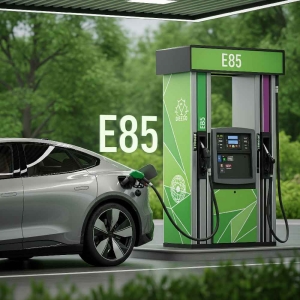
One of the most significant hurdles for the widespread adoption of E85 is its severe limitation in availability across many parts of the world. Unlike regular gasoline, E85 isn’t found at all fuel stations, which can be problematic for drivers.
Specifically, in countries where large-scale production of fuel ethanol does not occur or where there are no supportive policies for it, access to E85 is very rare. Iran is one such country, where E85 dispensing stations are practically non-existent, making this fuel unavailable to consumers. Besides Iran, in many European and Asian countries where the focus is on gasoline and diesel, E85 is not readily available, and the necessary infrastructure for its distribution is lacking. This scarcity of dispensing stations makes accessing this fuel extremely difficult for buyers of Flex-Fuel Vehicles (which are capable of using E85).
Higher Fuel Consumption and Potential Cost
While E85 might be cheaper than regular gasoline in some regions, it has higher fuel consumption (per liter) because it contains less energy. This means that, in the end, the cost per kilometer of driving with E85 might not differ significantly from gasoline, or it could even be higher.
Risks for Incompatible Vehicles
As mentioned, using E85 in conventional vehicles can cause serious and costly damage to the fuel system and engine.
Environmental Challenges of Ethanol Production
Large-scale ethanol production, especially from corn, can have its own environmental challenges, including: high water consumption, the need for vast tracts of land which can lead to deforestation, and the use of chemical fertilizers and pesticides.
The Future of E85 and Biofuels in Iran and Globally
While E85 is more common in countries like Brazil and the US due to abundant sugarcane and corn resources and supportive policies, the situation in Iran is entirely different.
Currently, E85 is practically unavailable in many countries, and the necessary infrastructure for its production, distribution, and use (like FFVs) is lacking. Although ethanol is produced in Iran for industrial and health purposes, its production at fuel scale and distribution at gas stations is not currently planned.
The future outlook for biofuels in Iran depends on various factors, including government energy policies, agricultural development for raw material production, and investment in necessary infrastructure. Given Iran’s vast oil and gas reserves, the primary focus remains on fossil fuels, but the potential for research and development in alternative and renewable fuels always exists.
Conclusion
Ultimately, E85 gasoline, with advantages like high octane, reduced emissions, and renewability, holds significant potential for the future of fuel. However, this fuel is not without its challenges; higher consumption and the risk of damage to incompatible vehicles are among its most notable drawbacks. Nevertheless, the biggest obstacle to the widespread adoption of E85 in countries is the lack of necessary infrastructure for its production and distribution. Currently, Iran’s main focus remains on fossil fuels, but given the growing importance of clean energy, we might see more investment in biofuels and the entry of E85 into the market in the not-so-distant future. Until then, it is crucial for consumers to ensure their vehicle’s compatibility with any new fuel to prevent potential issues.
Frequently Asked Questions about E85 Gasoline
- Can I mix E85 with regular gasoline?
- Only if your car is a Flex-Fuel Vehicle. Otherwise, it will damage your engine and fuel system.
- How do I know if my car is Flex-Fuel?
- Check your car’s owner’s manual. Usually, there’s an FFV label on the fuel cap or near the vehicle’s specification plate.
- Will using E85 harm my engine?
- Yes, if your car isn’t designed for E85, it can cause severe damage.
- What is the octane rating of E85?
- Its octane rating is between 100 and 105.
- Is E85 cheaper than regular gasoline?
- The price of E85 varies in global markets. Even if its unit price is lower, due to higher consumption, the overall fuel cost might not differ much. In Iran, this fuel is not publicly available.






What are the most significant advantages and disadvantages of E85 gasoline, and is it available in Iran?
Thank you for bringing up this important topic!
The main advantages of E85 include:
Very high octane rating (100-105), which has the potential to increase engine power.
Reduced emissions and greenhouse gases compared to pure gasoline (especially if produced from sustainable sources).
Production from renewable sources (corn, sugarcane), which contributes to energy security.
The disadvantages and challenges are:
Higher fuel consumption (per liter) due to ethanol’s lower energy content.
Risk of severe damage to incompatible vehicles.
Environmental challenges in large-scale ethanol production (water consumption, land requirements, chemical fertilizers).
Lack of availability in Iran: Currently, E85 is practically not available in Iran, and the necessary infrastructure for its production and distribution does not exist.
The article states E85 has lower energy content but higher octane. If my Flex-Fuel Vehicle (FFV) uses E85, why do I have to stop for gas more often? Doesn’t the high octane make it more efficient?
That’s the core trade-off. Octane only prevents knock and allows for higher compression ratio (better engine efficiency). However, ethanol has a lower caloric value (less heat/energy per liter) than gasoline. Your engine needs to inject more volume of E85 to get the same power, which directly leads to higher consumption and more frequent fill-ups.
A very insightful read on E85. One interesting point to add is the Shelf Life of this fuel. Unlike pure gasoline, E85 is much more prone to Phase Separation if moisture enters the storage tank. For large-scale distributors or industrial users, what specific precautions should be taken in storage facilities to prevent water contamination in high-ethanol blends?
Hello Dr. Wells, thank you for contributing this technical point. Phase separation is indeed a major challenge. At Universal Trades, we advise our logistics partners to use specialized desiccant breathers on storage tanks and conduct regular “water paste” tests. Since ethanol is polar and binds with water, maintaining a hermetic seal is crucial to prevent the fuel from splitting into an ethanol-water mix at the bottom, which could be catastrophic for FFV engines.