
Diesel Price Forecast 2026: Navigating Volatility and Opportunities
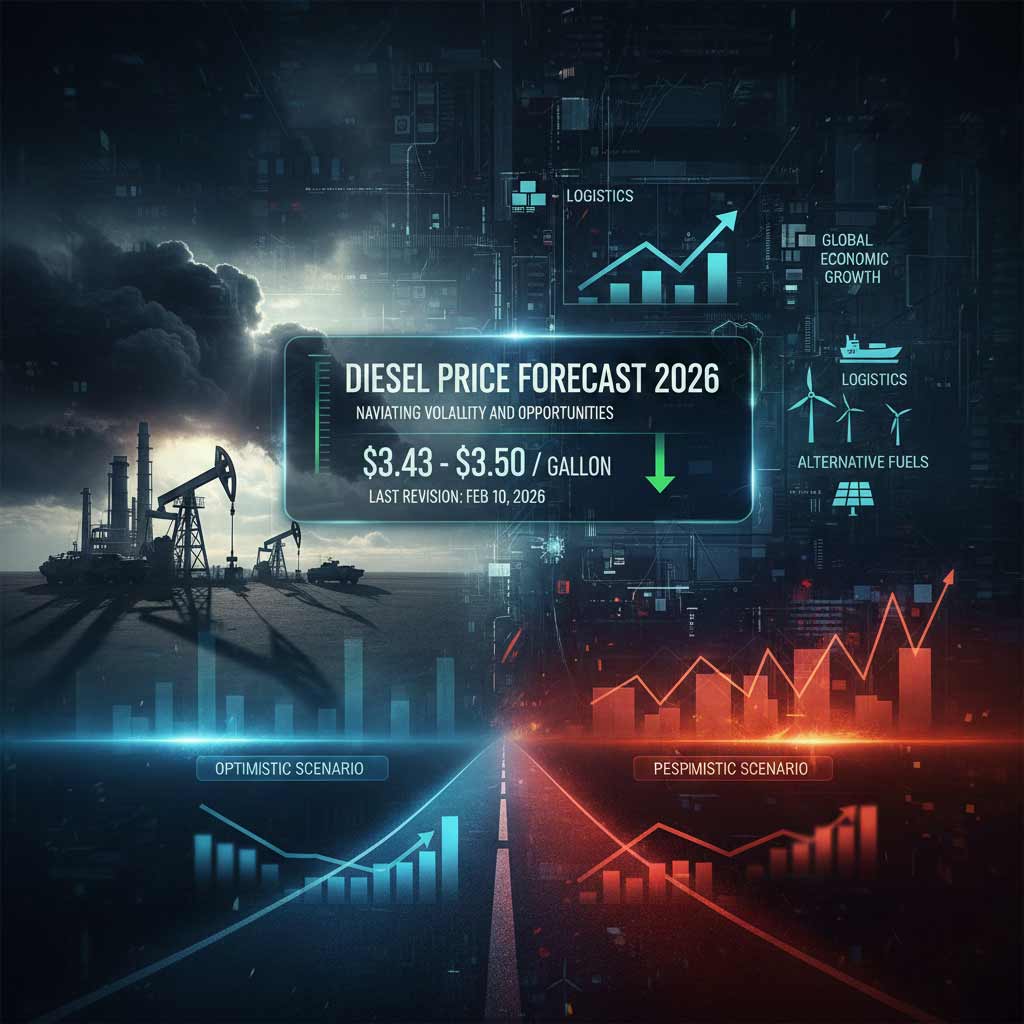
Date of last revision: February 10, 2026
The future of diesel prices is a complex tapestry woven with geopolitical threads, economic shifts, and the relentless dynamics of supply and demand. As we look towards 2026 and beyond, businesses and consumers alike are keen to understand the forces at play. While the U.S. Energy Information Administration (EIA) projects a potential decrease in U.S. on-highway diesel retail prices in 2026, averaging around $3.43 to $3.50 per gallon, this forecast comes with inherent uncertainties.
The Shadow of Geopolitics: Middle East Insecurity and its Impact
One of the most significant and unpredictable factors influencing global oil and, consequently, diesel prices is the potential for insecurity in the Middle East. This region is home to many of the largest diesel producing countries and a significant portion of the world’s top oil producers. Any escalation of tensions, disruptions to shipping lanes, or attacks on oil infrastructure could lead to immediate and substantial price spikes. For instance, a major supply disruption could easily add $0.50 to $1.00 per gallon or more to global diesel prices, regardless of underlying economic trends.
Factors Shaping Diesel Prices in the Coming Years
Beyond immediate geopolitical concerns, several fundamental factors will continue to exert influence on diesel prices:
-
Global Economic Growth: Robust economic activity typically correlates with higher demand for transportation and industrial fuels, including diesel. Conversely, economic slowdowns can suppress demand and prices.
-
Crude Oil Production and Inventory Levels: The overall supply of crude oil, influenced by OPEC+ decisions, shale oil production, and global inventory builds, directly impacts refining costs and thus diesel prices.
-
Refining Capacity and Utilization: The availability of refining capacity to process crude into diesel, as well as maintenance schedules and potential closures (particularly in regions like Europe), can create bottlenecks and influence prices.
-
Environmental Regulations and Alternative Fuels: Stricter emissions standards and the growing adoption of alternative fuels in certain sectors could gradually reduce long-term diesel demand, though this impact might be more pronounced in later years.
-
Transportation and Logistics Costs: The cost of shipping crude oil and refined diesel products also plays a role in the final retail price.
Diesel Price Forecasts: An Optimistic and Pessimistic Outlook
Given the multitude of variables, providing precise figures is challenging. However, we can outline potential scenarios for the coming years:
2026:
-
Optimistic Scenario: If global crude oil production remains high, demand growth is moderate, and geopolitical stability prevails, we could see average U.S. diesel prices in the range of $3.30 – $3.60 per gallon. This aligns with EIA projections of a continued downward trend.
-
Pessimistic Scenario: Should significant geopolitical instability emerge in the Middle East or other key producing regions, coupled with unexpected refinery outages or a stronger-than-anticipated global economic recovery boosting demand, prices could easily surge to $3.80 – $4.50 per gallon.
2027:
-
Optimistic Scenario: Continued efficiency gains in fuel consumption, a steady increase in crude oil supply, and a generally stable global environment could see prices hover around $3.20 – $3.50 per gallon.
-
Pessimistic Scenario: A confluence of sustained geopolitical tensions, persistent supply chain issues, or stronger economic growth than anticipated could push prices towards $3.70 – $4.40 per gallon.
2028:
-
Optimistic Scenario: By this point, increased investment in new production capacities and a maturing transition towards renewable energy in some sectors might help stabilize prices, potentially averaging $3.10 – $3.40 per gallon.
-
Pessimistic Scenario: Major geopolitical conflicts, unforeseen natural disasters impacting production, or a slower-than-expected transition away from fossil fuels could see prices remain elevated, possibly ranging from $3.60 – $4.30 per gallon.
2030:
-
Optimistic Scenario: Significant advancements and adoption of alternative fuels, coupled with a more diversified global energy supply, could lead to a long-term easing of demand pressure, potentially bringing prices down to $3.00 – $3.30 per gallon.
-
Pessimistic Scenario: A failure to adequately invest in new crude production, coupled with persistent geopolitical risks and a slower energy transition, could mean prices remain structurally higher, possibly in the $3.50 – $4.20 per gallon range.
Quarterly and Annual Diesel Price Forecast Table
Here’s a detailed look at some projected quarterly and annual prices, incorporating both optimistic and pessimistic outlooks:
Note: Q1 2025 is a reference point based on historical projections. All other figures are forecasts and subject to change.
Understanding Diesel and its Market
For a deeper dive into the fundamental aspects of this vital fuel, explore our Introduction to diesel article. You might also find our analysis of the gasoline price forecast in 2026 and 2027 insightful, as gasoline and diesel markets often share common drivers.
Conclusion
The diesel market in 2026 and beyond will likely be characterized by continued volatility. While underlying trends suggest a potential easing of prices from recent peaks, geopolitical events, particularly in the Middle East, remain a critical wild card. Businesses and consumers should monitor these factors closely and consider diversified energy strategies where feasible. Staying informed about global supply-demand dynamics and geopolitical developments will be key to navigating the evolving landscape of diesel prices.









Your analysis of the Middle East “Risk Premium” is spot on. For the Q4 2026 pessimistic scenario ($4.10/gallon), is this based on FOB Middle East benchmarks or delivered prices like CIF Mediterranean? Also, do you expect the rising cost of maritime insurance due to regional insecurity to impact diesel more than other refined products?
Hello Carlos. The forecast figures primarily reflect global benchmarks (like Brent-linked refining margins). However, in a “pessimistic” scenario involving the Strait of Hormuz, maritime insurance and freight rates for tankers would definitely spike. At Universal Trades, we’ve noticed that diesel often carries a higher logistical risk premium than gasoline because it is the lifeblood of global industrial supply chains, making its spot price much more sensitive to any disruption in the shipping lanes.