
What is Mineral Base Oil? Unveiling the Power of Mineral Base Oil
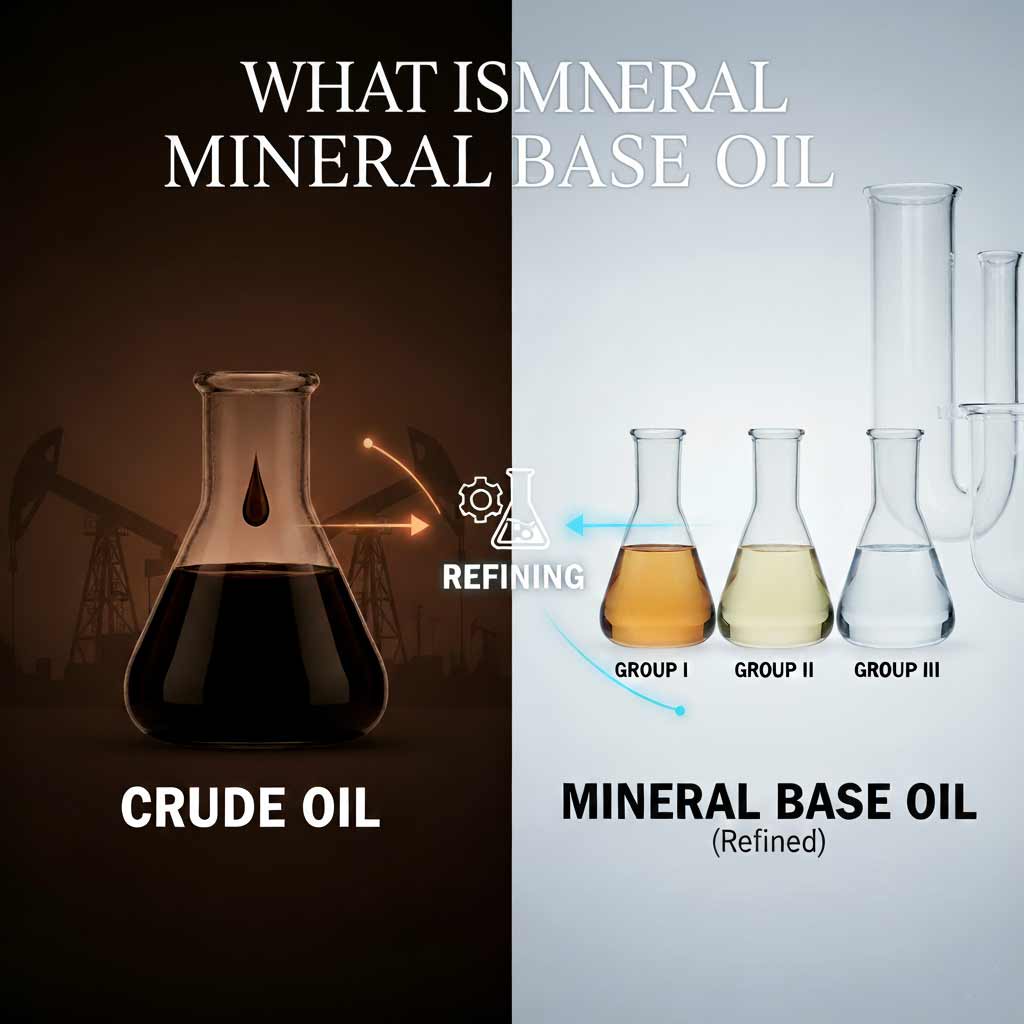
Mineral base oil, often referred to simply as petroleum base oil or conventional base oil, is the foundation of many lubricants, including motor oils, hydraulic fluids, and gear oils. It constitutes 60-90% of the finished lubricating product, with the remainder being performance-enhancing additives. This oil is derived directly from crude petroleum oil through a refining process.
Key Distinctions
Mineral Base Oil vs. Crude Petroleum
Petroleum (or crude oil) is the raw, unrefined material extracted from the earth. It is a complex mixture of thousands of different hydrocarbon molecules, along with impurities like sulfur, nitrogen, and heavy metals.
Mineral base oil is a refined product of crude petroleum. It has been chemically and physically processed (distilled, extracted, and often hydrocracked) to remove most of the undesirable components, resulting in a stable, lubricating fluid.
Mineral Base Oil vs. Synthetic Base Oil
The primary difference lies in their origin and molecular uniformity:
-
Mineral Base Oil (Groups I, II, III): Derived from crude oil. Even after refining, the molecules are still varied in size and shape (heterogeneous), which limits their stability and performance in extreme conditions.
-
Synthetic Base Oil (Group IV, V): Chemically engineered (synthesized) from purified base components. This process creates molecules that are nearly uniform in size and shape (homogeneous). This uniformity results in superior thermal stability, lower volatility, and a much higher Viscosity Index, making them ideal for high-performance and extreme-temperature applications. Group III oils, while technically mineral-derived, are often commercially marketed as “synthetic” due to their high level of refinement.
Vegetable Oils vs. Mineral Oils (Can they be eaten?)
Can they be eaten? Industrial mineral base oils are NOT safe for consumption. They contain impurities and additives that are toxic. However, highly purified, food-grade mineral oils (e.g., pharmaceutical-grade white mineral oil, commonly used as a laxative or in food preservation) are safe for ingestion. Vegetable oils in their raw or refined food-grade state (like olive oil or sunflower oil) are safe and intended for consumption.
Production Process of Mineral Base Oil
The production of mineral base oil involves several stages of refining crude oil to remove undesirable compounds like waxes, asphalt, and reactive hydrocarbons: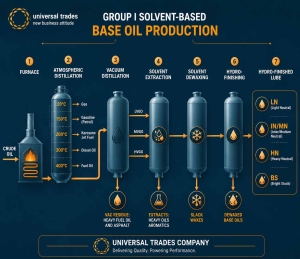
-
Distillation: Crude oil is heated and separated into different fractions (components) based on their boiling points in an atmospheric and then a vacuum distillation tower. The heavier fractions are used to produce base oil.
-
Solvent Extraction (For Group I): A solvent is used to dissolve and remove undesirable aromatic hydrocarbons, improving the oil’s viscosity index and oxidation stability.
-
Dewaxing: Waxy components are removed to lower the oil’s pour point, ensuring it remains fluid at low temperatures.
-
Hydroprocessing/Hydrocracking (For Group II & III): This is a more severe refining process that uses hydrogen gas under high temperature and pressure. It breaks down (cracks) large molecules and removes impurities like sulfur and nitrogen, significantly increasing the oil’s purity, stability, and performance.

Additives in Mineral Base Oil and Their Effect on Quality
While the base oil provides the primary lubrication function, additives are crucial for meeting modern performance demands. They are chemical compounds blended into the base oil to enhance desirable properties and suppress undesirable ones.
API Base Oil Groups (Group I to V)
The American Petroleum Institute (API) classifies base oils into five groups based on their refining process, sulfur content, saturate content, and Viscosity Index (VI). The first three groups are derived from crude oil (mineral oil).
FAQ Section
Q: What is another name for mineral base oil?
A: Conventional oil or petroleum base oil.
Q: Are Group III base oils synthetic?
A: Technically, they are highly refined mineral oils derived from crude oil. However, due to their excellent performance (VI > 120), they are legally allowed to be marketed as synthetic in many parts of the world.
Q: Why do lubricants need additives?
A: Additives are necessary to boost the mineral oil’s performance, providing essential functions like cleaning, preventing corrosion, reducing wear, and maintaining consistent viscosity across a wide temperature range, which the base oil alone cannot achieve.
Q: Is mineral oil bad for my engine?
A: No. High-quality mineral oils (especially Group II) with the correct additive package are suitable and cost-effective for standard, non-extreme-performance applications and older engine designs.









What is the main difference in performance between mineral base oil (Group II) and synthetic oils in modern engines?
The difference lies in molecular uniformity. In mineral oils, molecules vary in size, causing them to evaporate sooner at very high temperatures. However, synthetic oils have a uniform structure, providing better stability and protection for the engine under extreme conditions.
Great breakdown of the API groups. As we move through 2026, we are seeing a significant decline in the availability of Group I Base Oils as refineries shift towards Group II and III. For a blending plant in Southeast Asia, is it economically viable to completely switch from Group I to Group II for industrial hydraulic fluids, considering the difference in additive solubility?
Hello Robert, you’ve touched on a major 2026 market trend. While Group I is becoming scarcer, Group II offers much better oxidation stability. However, you’re right about Solvency. Group II has lower solvency than Group I, so you might need to adjust your additive package or include a small percentage of Group V (like Esters) or even Naphthenic oil to ensure the additives stay in solution. At Universal Trades, we help our clients optimize their “Base Oil Mix” to balance performance and cost-efficiency.