
Top 10 Sulfur Producing Countries: The Industrial Backbone of 2026
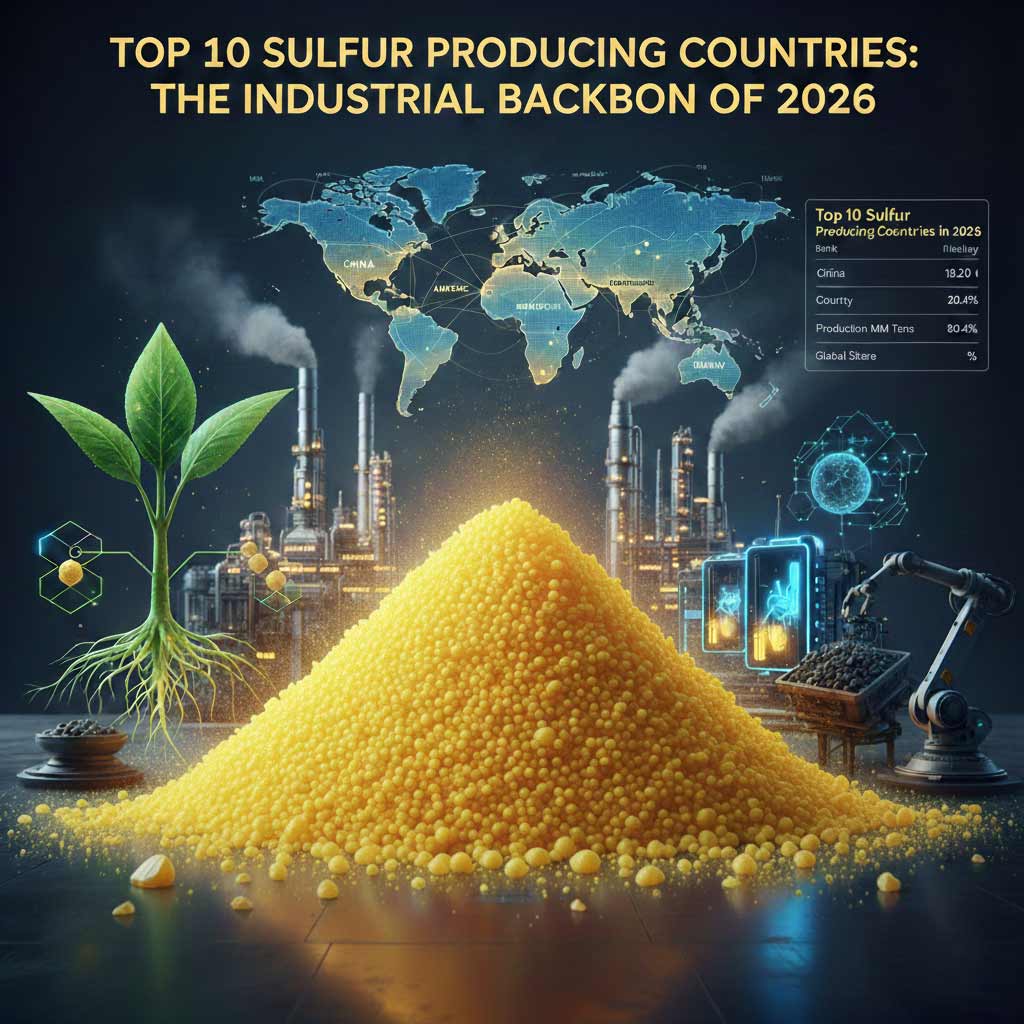
In 2026, sulfur has completed its transformation from a burdensome refinery byproduct into a high-value “critical energy mineral.” As the world accelerates its green transition, sulfur has become the invisible engine behind global food security and the electric vehicle revolution. Beyond its traditional role in phosphate fertilizers, sulfur is now indispensable for high-pressure acid leaching in nickel mining and the commercial scale-up of next-generation lithium-sulfur batteries. While production remains tied to the desulfurization of fossil fuels, the strategic stockpiling of elemental sulfur has become a priority for industrial superpowers. This report analyzes the Top 10 Sulfur Producing Countries 2026, the nations supplying the chemistry for a sustainable future.
Table: Top 10 Sulfur Producing Countries in 2026
| Rank | Country | Production (Million Metric Tons) | Global Share (%) |
| 1 | China | 18.20 | 20.4% |
| 2 | United States | 9.10 | 10.2% |
| 3 | Russia | 7.80 | 8.8% |
| 4 | UAE | 6.50 | 7.3% |
| 5 | Saudi Arabia | 6.20 | 7.0% |
| 6 | Canada | 5.40 | 6.1% |
| 7 | Kazakhstan | 4.60 | 5.2% |
| 8 | India | 3.90 | 4.4% |
| 9 | Japan | 3.20 | 3.6% |
| 10 | Germany | 2.50 | 2.8% |
| – | Middle East Total | ~21.50 | 24.1% |
| Total | World Production | ~89.20 | 100% |
1. China
China remains the global titan of sulfur production, driven by a unique dual-stream model. While Sinopec and PetroChina recover massive volumes of elemental sulfur via hydrodesulfurization at their refineries, China is also the world leader in pyrite mining. In 2026, this production is almost entirely absorbed domestically to fuel the world’s largest phosphate fertilizer industry and the burgeoning LFP (Lithium Iron Phosphate) battery supply chain.
2. United States
The U.S. maintains its silver medal by leveraging its ultra-complex refining sector. American production is primarily a secondary result of processing “sour” crude and natural gas. In 2026, the Gulf Coast remains a hub for sulfur recovery, with companies like The Mosaic Company integrating this supply directly into the production of high-tech crop nutrients and industrial acids for domestic manufacturing.
3. Russia
Russia’s sulfur output is intrinsically linked to its vast natural gas processing plants in Western Siberia and metal smelting operations in the Arctic. Gazprom continues to be a dominant player, extracting sulfur to meet environmental mandates. Despite geopolitical shifts, Russia remains a critical supplier for the “gray markets” of Central Asia, where sulfur is vital for regional agricultural productivity.
4. UAE
The United Arab Emirates has surged in the rankings thanks to the massive expansion of the Shah Gas Plant and the Ghasha ultra-sour gas project. Managed by ADNOC, the UAE’s sulfur strategy is centered on export. In 2026, much of their “Yellow Gold” is shipped to Indonesia to support the intensive acid-leaching processes required for EV-grade nickel production.
5. Saudi Arabia
Under Vision 2030, Saudi Aramco has transitioned from a crude exporter to a downstream powerhouse. The Kingdom’s sulfur production has climbed alongside its refining capacity at Jazan and Jubail. Saudi Arabia is increasingly using its sulfur locally to build a domestic specialized fertilizer industry, aiming to become a guarantor of global food security through sulfur-enhanced nutrients.
6. Canada
Canada’s production is concentrated in the oil sands of Alberta and natural gas fields in the West. While logistics remain a challenge, Canadian producers excel at “forming” sulfur into premium granules for the international market. In 2026, Canada is a key exporter to the United States and Asia, providing high-purity elemental sulfur recovered from the cleaning of bitumen-derived fuels.
7. Kazakhstan
Kazakhstan’s sulfur story is written at the Tengiz and Kashagan fields, where natural gas is exceptionally “sour.” The country has invested heavily in modern sulfur-block management and pelletizing facilities. Kazakhstan serves as the primary sulfur source for the massive uranium leaching operations within its own borders, which are essential for the global nuclear energy resurgence.
8. India
India has climbed the ranks as its refining capacity has expanded to meet the needs of a growing population. Reliance Industries and other state refiners have optimized their recovery units to reduce import dependency. In 2026, India’s sulfur is the backbone of its “Aatmanirbhar Bharat” (Self-Reliant India) initiative in the fertilizer sector, supporting millions of hectares of sulfur-deficient soil.
9. Japan
Despite a lack of domestic resources, Japan’s advanced technological refineries make it a major sulfur producer through crude oil processing. Japanese refiners are world leaders in high-purity sulfur production, which is increasingly diverted into the high-tech sector for specialized chemical processing and the manufacturing of advanced rubber products for the automotive industry.
10. Germany
As Europe’s industrial heart, Germany remains the continent’s top producer, primarily through recovery at its high-efficiency refineries and coking plants. Even as it moves toward a hydrogen economy, sulfur remains a critical byproduct of its remaining petrochemical clusters. In 2026, German sulfur is vital for the domestic production of sulfuric acid, which supports the country’s world-class chemical and pharmaceutical sectors.
Explore More in Our Industrial Series
To stay ahead of the volatile 2026 commodities market, explore our specialized reports:
-
Market Rankings: Top oil producing countries, Top gasoline producing countries, and Top diesel producing countries.
-
Sulfur Deep Dives: Get started with an Introduction to sulfur or read our latest Further reading about sulfur.



Hello There. I found your blog using msn. This is a very well written article. I will be sure to bookmark it and return to read more of your useful information. Thanks for the post. I will definitely comeback.
Thanks for your feedback! We aim to create intuitive, value-driven content, and knowing it resonated with you helps us improve. Is there any specific topic you’d like us to simplify or cover next?