
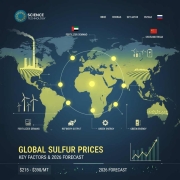
Global Sulfur Price Outlook: 2026, 2027, and the Path to 2030

Published: February 13, 2026
As of February 13, 2026, the global sulfur market is undergoing a period of intense structural shifts. Following a year of unprecedented price surges in 2025, the industry is now balancing high demand from the agricultural sector against a backdrop of geopolitical uncertainty. With sulfur being a critical byproduct of oil and gas refining, its price remains intrinsically linked to energy market stability and industrial output.
The Geopolitical Catalyst: Middle East Insecurity
A primary driver for the current market volatility is the rising possibility of insecurity in the Middle East. As a central hub for global oil refining and natural gas processing, any disruption in this region directly impacts the global sulfur supply.
Leading producers such as ADNOC (UAE), Qatar Energy, and KPC (Kuwait) have already adjusted their February 2026 Official Selling Prices (OSP) upward, reflecting a risk premium. If regional tensions escalate, the resulting logistical bottlenecks and potential refining shutdowns could lead to acute shortages, driving prices far beyond historical norms.
Market Forecast: 2026–2030
The trajectory of sulfur prices is shaped by the competing forces of fertilizer demand, the transition to green energy, and the commissioning of new refining projects.
2026: The Year of Volatility
In 2026, the market is expected to face a “tug-of-war” between high feedstock costs and consumer resistance.
-
Optimistic Scenario: If new refining capacities in India and China come online ahead of schedule and Middle East tensions ease, the price could stabilize. In this scenario, we project an optimistic price of $480/MT.
-
Alternative Market Impact: If a stable energy environment persists, the possible price of Base Oil (a fellow refining byproduct) could hold steady at approximately $1,100/MT.
2027: Supply Relief on the Horizon
The year 2027 is widely viewed by analysts as a potential turning point due to major gas project commissions, such as the North Field expansion in Qatar.
-
Optimistic Scenario: With increased global supply, the price could settle at $420/MT.
2028: Achieving Structural Balance
By 2028, the market is expected to move toward a more sustainable equilibrium.
-
Optimistic Scenario: If the major sour gas projects in the Middle East reach full capacity, sulfur prices could soften to $350/MT, easing the burden on the global fertilizer industry.
2030: The Green Demand Surge
Looking toward 2030, sulfur demand will increasingly be driven by the battery sector (Lithium-Sulfur batteries) and high-purity industrial applications.
-
Optimistic Scenario: Even with high supply, the energy transition could maintain prices at a firm $380/MT.
Factors Influencing Future Prices
-
Fertilizer Consumption: Traditional demand for phosphoric acid remains the market’s backbone.
-
Environmental Regulations: Stringent SOx emission caps are forcing refineries to invest in cleaner recovery, affecting operational costs.
-
Battery Technology: The commercialization of lithium-sulfur batteries could introduce a new, high-margin demand segment.
-
Refinery Decarbonization: As the world moves away from heavy crude, the “inelastic” supply of sulfur from traditional refining may decrease.







Leave a Reply
Want to join the discussion?Feel free to contribute!