
Cetane Number: A Key Metric for Diesel Fuel Quality
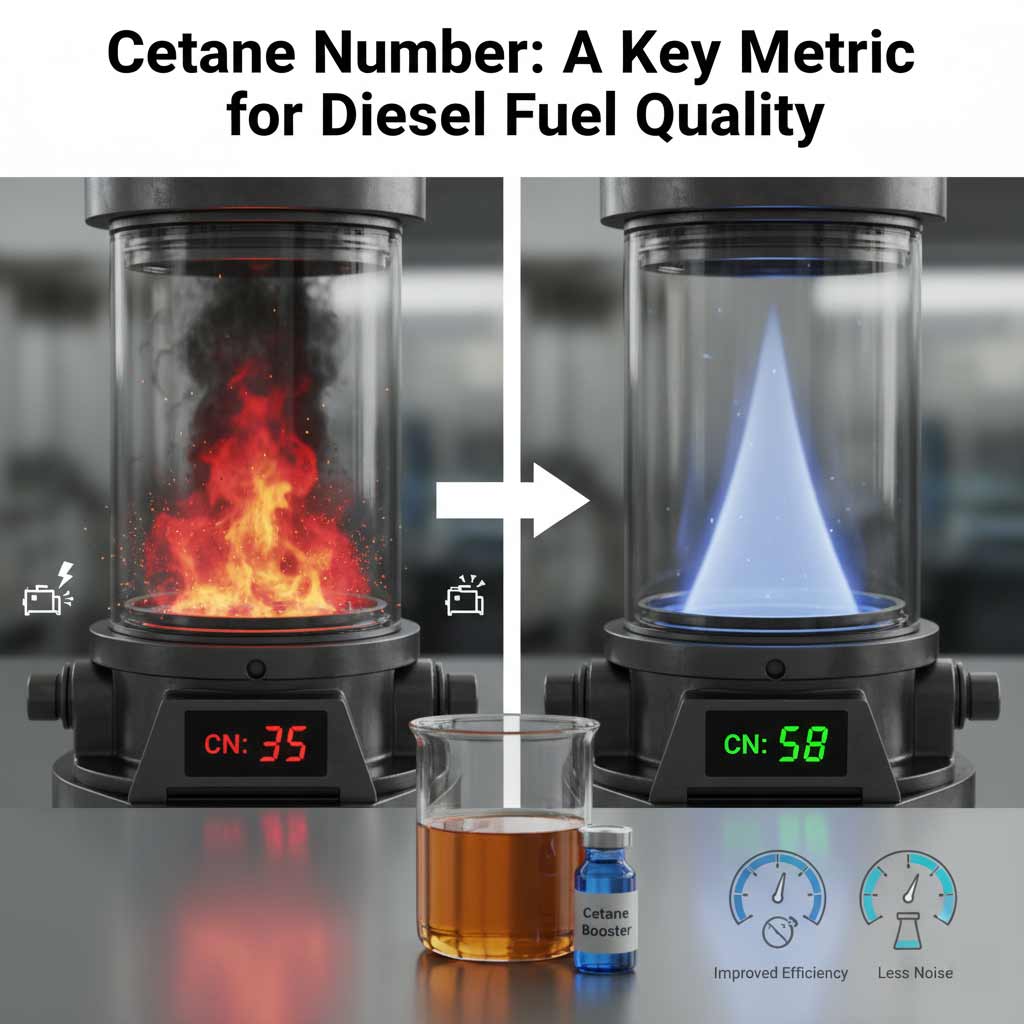
Cetane Number (CN) is one of the most important quality indicators for diesel fuel. This number measures the fuel’s ability to ignite rapidly and spontaneously under compression in a diesel engine. Simply put, the Cetane Number indicates the time delay between the start of fuel injection into the combustion chamber and the actual start of combustion (the ignition delay).
The higher the Cetane Number, the shorter the ignition delay; meaning the fuel ignites faster and more uniformly. This is crucial for optimal diesel engine performance.
The Importance of Cetane Number in Diesel Engine Performance
The Cetane Number plays a role similar to the Octane Number in gasoline engines, with the key difference that Octane measures resistance to premature ignition (unwanted auto-ignition), while Cetane measures the fuel’s tendency toward rapid ignition. In diesel engines, where combustion occurs solely based on pressure and heat (without a spark plug), rapid fuel ignition is a significant advantage.
Why is a High Cetane Number Important?
- Reduced Engine Knocking: A long ignition delay causes a build-up of unburnt fuel, which, upon ignition, results in a sudden, noisy explosion (knocking). A higher Cetane Number shortens this delay, providing a smoother and quieter combustion.
- Improved Cold Start: In cold weather, faster fuel ignition significantly aids in starting the engine quickly and easily.
- Reduced Emissions: More complete and uniform combustion resulting from high cetane reduces the production of pollutants such as particulate matter, unburnt hydrocarbons, and carbon monoxide.
- Increased Efficiency and Power: Timely and complete combustion increases the engine’s thermal efficiency, leading to improved fuel economy and power output.
- Engine Protection: The harsh, knocking combustion that occurs with low-cetane fuels can, over time, lead to increased wear and damage to engine components.
Appropriate Range for Cetane Number
Cetane Number standards for diesel fuel vary across the globe, but generally:
- Minimum Standard: Many standards, like the North American ASTM D975, set a minimum Cetane Number of 40 for Ultra-Low Sulfur Diesel (ULSD).
- Optimal Range: Most modern highway and heavy-duty diesel engines perform best with Cetane Numbers between 45 and 55.
- **Premium Fuels and Biodiesel: High-quality diesel fuels or Biodiesel typically have a Cetane Number around 51 to 60, resulting in better performance and efficiency.
- Note that using a fuel with a Cetane Number significantly higher than the engine manufacturer’s recommendation does not necessarily improve performance and may cause pre-combustion in some cases.
Improving the Cetane Number: Better Fuel Performance
Can the Cetane Number be improved? Yes! Besides the diesel production process at the refinery (such as hydrogenation), the Cetane Number can be increased by adding specific chemical additives.
How Cetane Boosters (Cetane Improving Additives) Work?
Cetane Boosters (Cetane Improvers) are chemical additives mixed with diesel fuel to raise its Cetane Number. The most common type of these additives is alkyl nitrates (especially 2-ethylhexyl nitrate).
Mechanism of Action:
- Lowering the Auto-Ignition Temperature: These additives are chemicals that ignite more easily at a lower temperature compared to the main components of the diesel fuel itself.
- Earlier Start of Oxidation Reactions: Upon fuel injection, the cetane boosters activate quickly in the combustion chamber. This causes the necessary oxidation reactions for combustion to start sooner than usual.
- Shortening the Ignition Delay: Consequently, the time delay between injection and the start of combustion is significantly reduced, leading to smoother and more efficient fuel burning.
The addition of these substances can typically increase the base fuel’s Cetane Number by 3 to 5 units, having a notable impact on engine performance, particularly in lower-quality types of diesel fuel categories.
Conclusion
Cetane Number is a vital property of diesel fuel that directly impacts combustion quality, engine noise, emissions, and overall efficiency. While minimum standards ensure basic functionality, using a fuel with an appropriate Cetane Number (generally in the 45-55 range) is recommended for achieving best performance, reduced emissions, and longer engine life. With advancements in diesel engine technology and stricter environmental standards, the importance of monitoring and improving this key indicator through refining methods and the use of cetane boosters has become increasingly significant. To better understand the differences between commonly used fuels, you might want to look at the article on difference between diesel and gasoline or differences between kerosene and diesel to grasp the differences in combustion mechanisms.
Frequently Asked Questions (FAQ)
What is Cetane Number?
A measure of diesel fuel’s combustion quality, indicating how quickly the fuel ignites under compression. A higher number means a shorter ignition delay and better ignition.
What is the main difference between Cetane and Octane Number?
Octane Number measures gasoline’s resistance to premature ignition (anti-knock); Cetane Number measures diesel’s tendency toward rapid ignition.
Does increasing the Cetane Number affect fuel consumption?
Yes. Higher cetane leads to more complete combustion and can result in improved fuel efficiency and reduced consumption.
What lowers the Cetane Number?
The presence of aromatic hydrocarbons and cracked compounds in the fuel (such as those found in some low sulfur diesel) lowers the Cetane Number.








How does Ignition Delay in diesel fuel relate to the Cetane Number?
Ignition Delay is the time between fuel injection and the actual start of combustion. A higher Cetane Number means a shorter delay, resulting in faster ignition and smoother engine operation.
In harsh Norwegian winters where temperatures drop below -30°C, how does the Cetane Number help us?
In extreme cold, the air inside the cylinder struggles to reach the required temperature for diesel ignition. Fuel with a high Cetane Number (like 55+) ignites faster. This means the engine starts with fewer cranks, and the famous “white smoke” at startup, caused by incomplete combustion, is significantly reduced.
Is using fuel with a cetane number higher than 60 beneficial for standard diesel engines, or could it damage the fuel injectors?
An excessively high cetane number won’t necessarily damage injectors physically, but it can cause pre-ignition (combusting before the piston reaches the optimal point), leading to reduced efficiency and wasted fuel. A range of 50 to 55 is ideal for most engines.
Excellent technical summary. In 2026, we are seeing a major shift towards HVO (Hydrogenated Vegetable Oil) which naturally boasts a very high Cetane Number (often above 70). While this is great for emissions, I wonder if such a high CN could lead to “Early Ignition” issues in older diesel engines designed for a CN of 45-50. Does Universal Trades provide customized diesel blends that balance the high CN of renewables with traditional refinery gasoil?
Hello Dr. Fletcher! You’ve hit on a very sophisticated point. Indeed, HVO is a “super-fuel” in terms of Cetane, but in legacy engines, an excessively high $CN$ can cause the flame front to develop too quickly, potentially increasing $NOx$ emissions. At Universal Trades, we specialize in Precision Blending. We can adjust the final Cetane Index of our deliveries by mixing paraffinic renewable streams with high-quality mineral diesel to ensure the fuel matches the specific compression ratio and injection timing of your equipment, providing both power and compliance.