
Bitumen Production Process: From Crude Oil to Diverse Bitumen Types

Bitumen, a vital material in road construction, waterproofing, and numerous other applications, is a sophisticated product derived from crude oil. Understanding its production process is crucial not only for industry professionals but also for the general public who benefit daily from its widespread use. This article delves into the common stages involved in producing all types of bitumen, followed by a detailed look at the key distinctions in the manufacturing of emulsion, cutback, oxidized (blown), and specialty bitumens.
Common Stages in Bitumen Production: The Foundation for All Bitumen Types
The bedrock of all bitumen production lies in the distillation of crude oil. Crude oil is a complex mixture of various hydrocarbons, each possessing a distinct boiling point. Within refineries, crude oil undergoes heating in distillation towers, where it is separated into different components based on their boiling points.
- Crude Oil Preheating: Initially, crude oil is heated in specialized furnaces to a specific temperature, typically ranging from 350-400 degrees Celsius.
- Atmospheric Distillation Tower Entry: The preheated crude oil then enters an atmospheric distillation tower. In this tower, lighter components of the oil, such as petroleum gases, gasoline, kerosene, and diesel, vaporize and exit from the top of the tower.
- Production of Heavy Fractions and Fuel Oil: The heavier components of the oil that do not vaporize at atmospheric pressure remain at the bottom of the tower, known as fuel oil or heavy fuel oil. This substance contains asphaltic compounds, which form the fundamental basis for bitumen production.
- Vacuum Distillation Tower Entry: The fuel oil obtained from atmospheric distillation is then transferred to a vacuum distillation tower to separate heavier components and enhance bitumen purity. In this tower, the internal pressure is significantly reduced, creating a vacuum. This pressure reduction allows heavier hydrocarbons to vaporize at lower temperatures, preventing their thermal decomposition and resulting in higher-quality bitumen.
- Production of Bitumen Residue: Ultimately, the extremely heavy, non-vaporizable residue remaining at the bottom of the vacuum distillation tower is pure bitumen residue. This material serves as the essential raw material for producing all types of bitumen.
This pure bitumen, also referred to as refinery bitumen, possesses specific properties like viscosity and penetration grade, which vary depending on the crude oil source and distillation process conditions. From this base bitumen, various specialized bitumen types are produced for diverse applications.
Differentiated Production Processes for Various Bitumen Types
Following the production of base bitumen through crude oil distillation, additional processing steps are undertaken to create specific bitumen types, altering their properties and applications:
1. Oxidized (Blown) Bitumen and Performance-Graded Bitumen
Production Process: To produce oxidized (blown) bitumen, the bitumen residue from the vacuum distillation tower is subjected to hot air blowing in a specialized reactor. In this process, oxygen from the air reacts with the bitumen hydrocarbons, leading to polymerization and cross-linking of the bitumen molecules.
Property Alteration: This oxidation reaction significantly increases the softening point, reduces the penetration grade, and enhances the elastic properties of the bitumen. Consequently, oxidized bitumen exhibits greater resistance to temperature changes and is less prone to flowing.
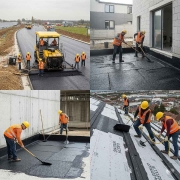
Applications: Oxidized bitumen (e.g., 60/70, 85/25, 90/15, 115/15) is primarily used in roof waterproofing, pipeline coating, polymer asphalt production, and sealants.
Important Note: The production of Performance-Graded (PG) bitumen involves modifications to the physical properties of bitumen, typically achieved through the addition of polymers and chemical additives, rather than solely air blowing. These bitumens are classified based on their performance across different temperatures, and their production process is more complex, involving precise mixing with additives (polymers) under controlled temperature and pressure. The objective is to enhance the bitumen’s resistance to rutting, fatigue, and cracking under various climatic conditions.
2. Emulsified Bitumen
Production Process: Emulsified bitumen is a mixture of bitumen, water, and an emulsifying agent (usually a surfactant). In this process, molten (hot) bitumen and water (containing the emulsifying agent) are simultaneously fed into a high-speed colloid mill or homogenizer. Within this equipment, the bitumen is broken down into extremely fine microscopic particles (0.1 to 5 microns in diameter) and dispersed stably in water. The emulsifying agent prevents the separation of the bitumen and water phases.
Property Alteration: The most significant characteristic of emulsified bitumen is its usability at ambient temperatures, eliminating the need for intense heating. The water in the emulsion gradually evaporates, leaving the bitumen to adhere to the underlying surface.
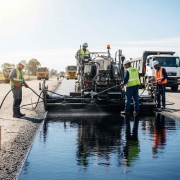
Applications: Emulsified bitumen (e.g., RS-1, SS-1) is used in road construction for chip seals, prime coats, tack coats, cold asphalt mixes, and surface repairs. Their primary advantages include reduced energy consumption, lower pollution, and ease of application.
3. Cutback Bitumen
Production Process: Cutback bitumen is produced by dissolving pure bitumen in a volatile petroleum solvent (such as naphtha, diesel, paraffin, or aromatic solvents). This process typically occurs in mixing tanks at elevated temperatures with agitation. The type and quantity of the solvent determine the drying rate and viscosity of the cutback bitumen.
Property Alteration: The petroleum solvent drastically reduces the bitumen’s viscosity, making it sprayable at ambient or slightly elevated temperatures. After spraying, the solvent gradually evaporates, leaving the pure bitumen on the surface.
Applications: Cutback bitumen (e.g., MC-30, RC-250) is used for prime coats (penetrating underlying layers to enhance adhesion), tack coats (creating an adhesive layer between layers), cold asphalt mixes, and road maintenance. Currently, due to environmental concerns regarding volatile organic compound (VOC) emissions and flammability risks, the use of cutback bitumens is declining, with emulsified bitumens being a more suitable alternative.
4. Specialty and Modified Bitumen
Production Process: This category encompasses a wide range of products with unique properties designed for specific applications. Their production process typically involves adding polymers, chemicals, fibers, or fillers to the base bitumen. These additives are mixed into the bitumen under controlled temperatures and pressures using powerful agitators to achieve a homogeneous blend.
Property Alteration: Additives can enhance properties such as elasticity, resistance to extremely high or low temperatures, adhesion, aging and fatigue resistance, and water resistance.
Applications:
- Polymer Modified Bitumen (PMB): Used to increase asphalt’s resistance to rutting, cracking, and fatigue in high-traffic roads and areas with significant temperature fluctuations.
- Rubberized Bitumen: Produced by adding recycled rubber powder to improve elastic properties and reduce tire noise on roads.
- Modified Oxidized Bitumen: With specific additives to enhance insulation properties and thermal stability.
- Adhesive and Sealing Bitumen: With special additives for waterproofing and bonding applications.
Conclusion
The bitumen production process originates from crude oil distillation and continues with supplementary processes to yield specific bitumen types. Understanding these processes and the key distinctions among oxidized, emulsified, cutback, and specialty bitumens significantly aids in selecting the appropriate product for each application. With technological advancements, the production of higher-performance and environmentally friendlier bitumens continues to evolve to meet the growing demands of various industries.
Frequently Asked Questions (FAQ) About Bitumen Production
1. What is the main raw material for bitumen production? The primary raw material for bitumen production is heavy crude oil, which is separated through the distillation process in refineries.
2. Why is a vacuum distillation tower used in bitumen production? A vacuum distillation tower is used because reducing the pressure lowers the boiling point of heavier hydrocarbons. This prevents the thermal decomposition of bitumen at high temperatures and contributes to the production of higher-quality bitumen.
3. What is the main difference between emulsified bitumen and cutback bitumen? Emulsified bitumen is produced by mixing bitumen with water and an emulsifying agent and can be used at ambient temperatures. In contrast, cutback bitumen is made by dissolving bitumen in a volatile petroleum solvent, which then evaporates after application. Emulsified bitumens are preferred due to environmental considerations.
4. Why does oxidized (blown) bitumen have different properties than pure bitumen? Oxidized bitumen is produced by blowing hot air through pure bitumen. This process causes oxidation and polymerization of the bitumen molecules, resulting in an increased softening point, reduced penetration, and enhanced elastic properties.
5. What is the primary application of polymer-modified bitumen? Polymer-modified bitumen (PMB) is produced by adding polymers to base bitumen. Its main application is to increase asphalt’s resistance to phenomena such as rutting, cracking, and fatigue on roads, especially in areas with heavy traffic or significant temperature fluctuations.
6. Can bitumen production harm the environment? Yes, the bitumen production process and the use of certain types (like cutback bitumens due to volatile solvent emissions) can have environmental impacts. Therefore, research and development continue towards producing high-performance and environmentally friendly bitumens (such as emulsified and modified bitumens).






Leave a Reply
Want to join the discussion?Feel free to contribute!