
Global Bitumen Price Outlook: Strategic Market Predictions for 2026–2030
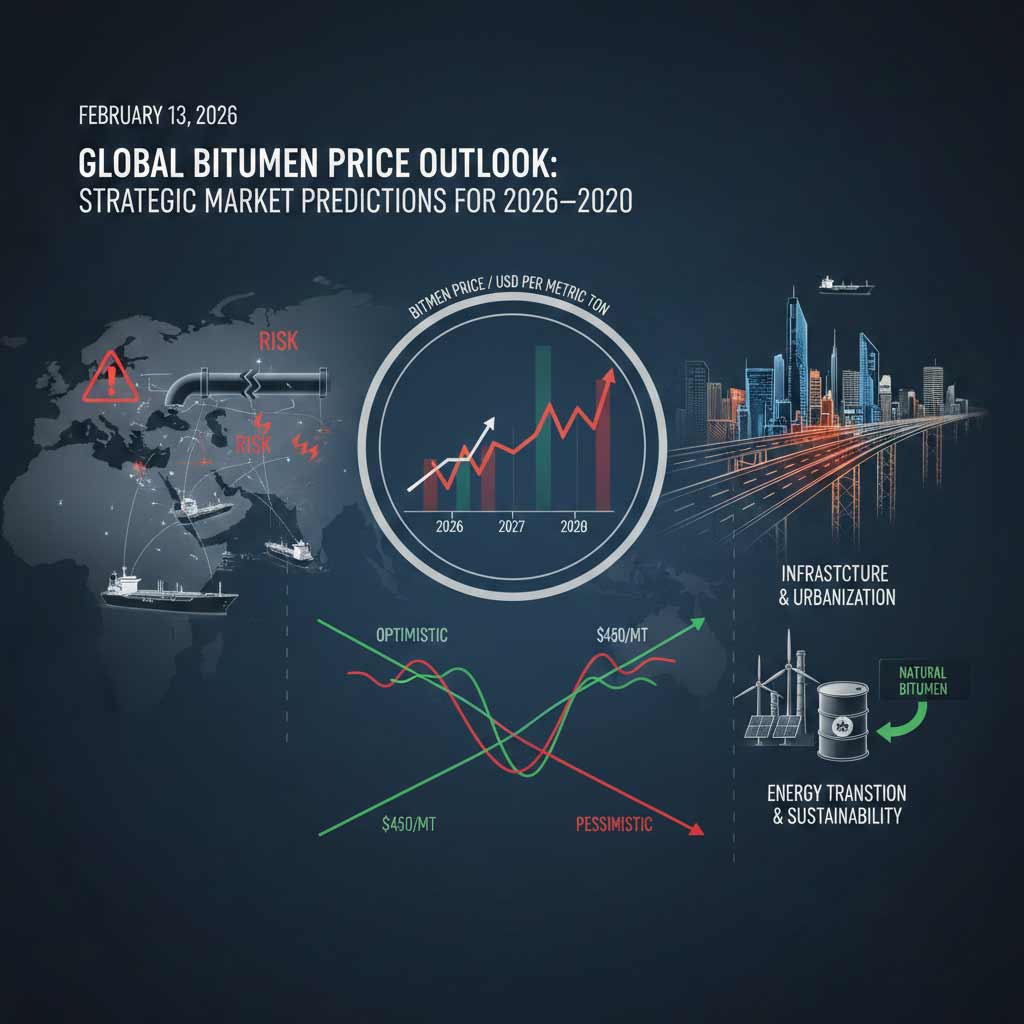
Date: February 13, 2026
As of today, February 13, 2026, the global bitumen market is navigating a complex landscape of shifting geopolitical alliances and volatile energy benchmarks. While bitumen remains the backbone of global infrastructure, the current year is marked by a “risk-on” sentiment driven primarily by the persistent possibility of insecurity in the Middle East. This instability has a dual impact: it threatens the stability of crude oil supply and elevates the cost of logistics, insurance, and refinery operations for downstream products.
In this strategic outlook, we examine the fundamental drivers and price trajectories for bitumen through 2030, offering both optimistic and pessimistic scenarios based on emerging global trends.
Key Factors Influencing Bitumen Prices (2026–2030)
Several structural and transient factors will define the price of bitumen over the next five years:
-
Middle East Geopolitical Risk: As a primary hub for global oil production and refining, any escalation in the Middle East (specifically around the Strait of Hormuz) triggers an immediate risk premium. Insecurity here not only spikes Brent crude prices but also disrupts the supply of vacuum bottom, the essential feedstock for bitumen.
-
Refinery Optimization: Modern refineries are increasingly shifting toward deeper conversion to produce lighter, higher-value fuels. This “bottom-of-the-barrel” optimization can lead to a structural deficit in bitumen supply, supporting higher floor prices.
-
Infrastructure & Urbanization: Massive projects such as China’s Belt and Road Initiative and India’s Bharatmala program continue to drive demand.
-
Energy Transition & Sustainability: The rise of natural-bitumen and Bitumen Production Process innovations aimed at reducing carbon footprints are introducing new cost variables into the market.
Price Forecasts: Optimistic vs. Realistic Scenarios
To navigate this volatility, stakeholders must consider multiple price pathways. Below are our projected benchmarks based on current market intelligence.
2026: The Year of Geopolitical Balancing
If Middle East tensions remain contained and crude stabilizes near $65-$70/bbl, we project an optimistic bitumen price of $385/MT. However, should insecurity escalate, disrupting shipping lanes, prices could easily breach $450/MT. In such a high-risk scenario, the gasoline price forecast in 2026 and 2027 also suggests significant upward pressure on all refined products.
2027–2028: Supply Chain Realignment
By 2027, as new refinery capacities in Asia and the Middle East come online, we anticipate a more balanced market.
-
2027 Forecast: Under stable conditions, the optimistic price is $410/MT.
-
2028 Forecast: Growing demand for bitumen in high-tech road projects may push prices toward $435/MT in an expansionary economic cycle.
2030: Long-term Equilibrium
By 2030, the market will likely be influenced by the peak of global oil demand.
-
Optimistic 2030 Price: $480/MT, driven by the scarcity of traditional heavy crude and the premium for sustainable bitumen articles.
-
Base Oil Correlation: If base oil demand for industrial lubricants remains robust, the possible price of base oil could reach $1,100 – $1,250/MT, maintaining a healthy spread over bitumen.
Comprehensive Price Prediction Table
The following table summarizes the market outlook, comparing the historical baseline of 2025 with the projected volatility of the coming years.
| Period | Optimistic Forecast (USD/MT) | Pessimistic/Risk Forecast (USD/MT) |
| Q1 2025 (Actual/Baseline) | $355 | $350 |
| Q2 2026 (Projected) | $390 | $425 |
| Q3 2026 (Projected) | $405 | $440 |
| Q4 2026 (Projected) | $415 | $460 |
| Full Year 2027 | $420 | $475 |
| Full Year 2028 | $440 | $490 |
Note: These prices refer to standard Penetration Grade 60/70. Specialized grades and Kerosene articles may follow different trajectories based on regional demand.
Industry Resources and Analysis
For a deeper dive into the fundamental mechanics of the oil and bitumen sectors, we recommend exploring our comprehensive guides:
-
Market Basics: Introduction to bitumen.
-
Global Supply: Insights into the largest bitumen producing countries and the top oil producers.
-
Refined Products: Explore our latest Gasoline articles.
The road ahead for bitumen remains paved with both opportunity and uncertainty. Successful market participants will be those who hedge against Middle East insecurity while investing in the industrial technologies of tomorrow.









our 2030 outlook mentions a scarcity of traditional heavy crude. In this scenario, will the production of Penetration Grade 60/70 still follow the ASTM D946 standards, or should we expect a shift towards more Viscosity Graded (VG) bitumen due to refinery upgrades?
Hello Robert. That’s a sharp observation. While 60/70 remains the market’s backbone, the industry is indeed leaning towards VG-30 and VG-40 for better performance in high-stress environments. At Universal Trades, we are already aligning our supply chain to ensure that even with lighter crude slates, the chemical properties of our bitumen meet the strictest international engineering requirements.